
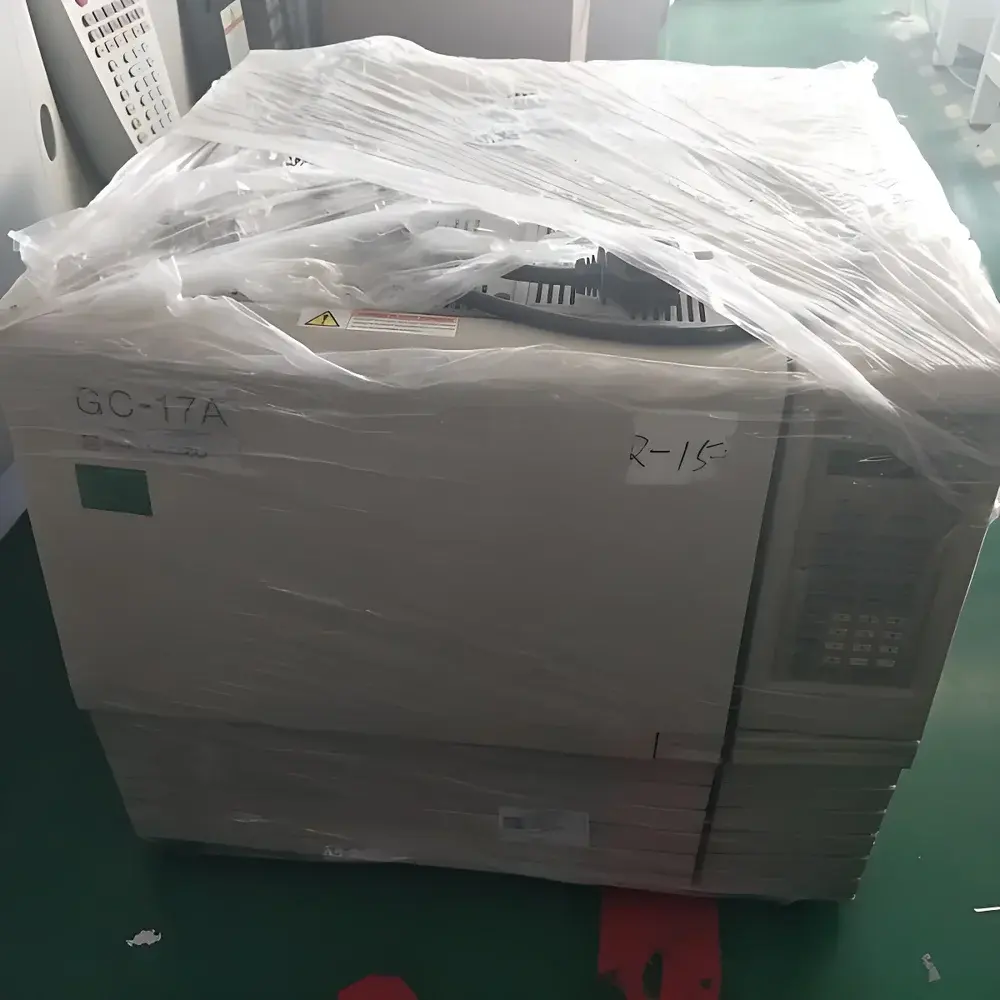
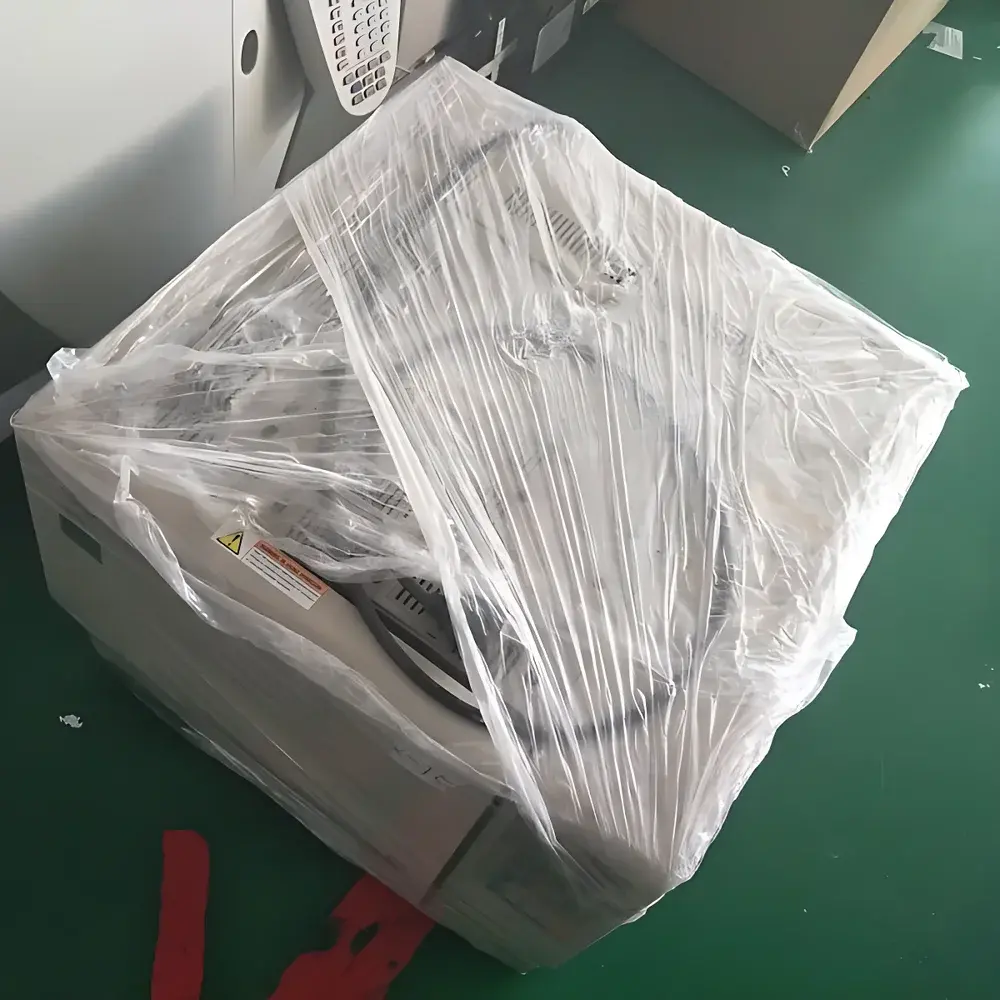
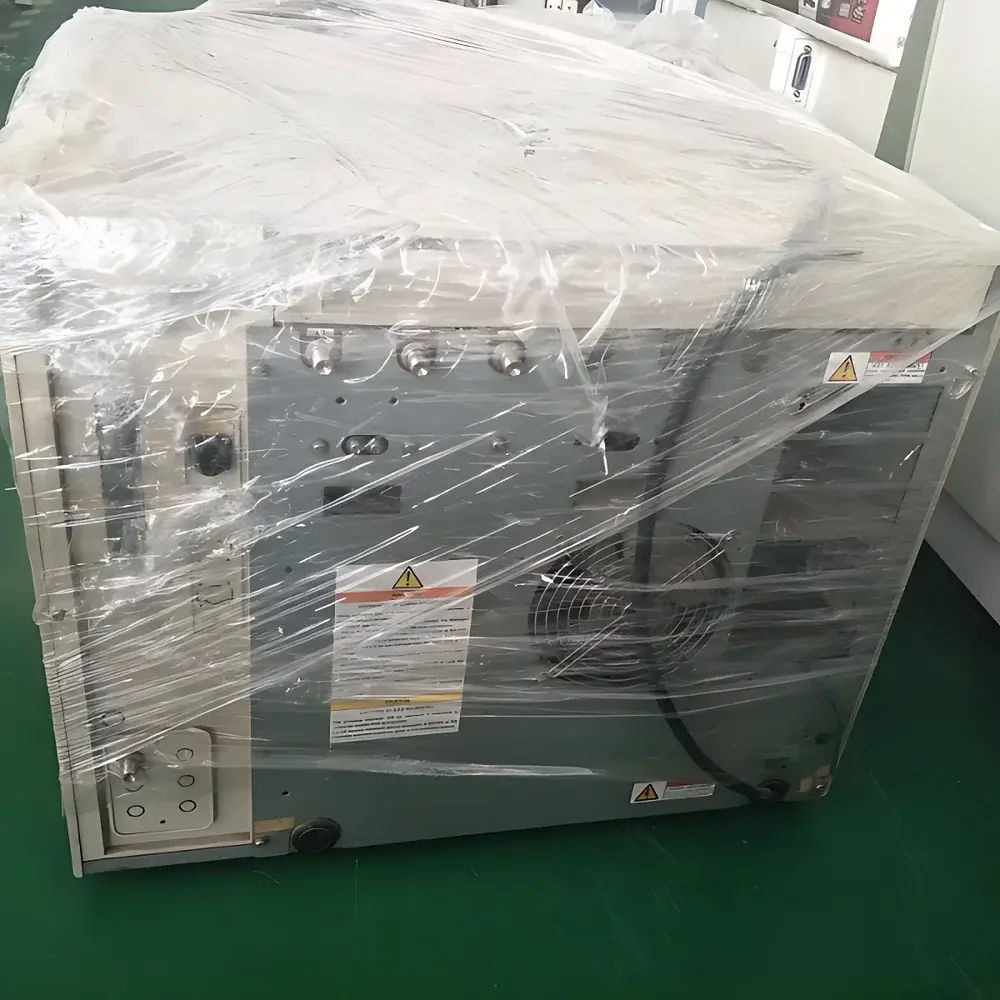
Shimadzu GC-17A Used Gas Chromatograph
| Brand | Shimadzu |
|---|---|
| Origin | Japan |
| Model | GC-17A |
| Instrument Type | Laboratory Gas Chromatograph |
| Temperature Control Range | +4 °C to 450 °C |
| Oven Ramp Rate | 0.1–40 °C/min |
| Oven Cool-down Rate | −50 °C to 450 °C (with optional LN₂ cooling) |
| Carrier Gas Flow Range & Control | 0–1200 mL/min |
| Carrier Gas Pressure Range & Control | 0–970 kPa |
| Injector Maximum Operating Temperature | 450 °C |
| Injector Pressure Setting Range | 0–970 kPa |
| Injector Total Flow Setting Range | −400 to +400 kPa/min |
| Temperature Accuracy | ±1% of set Kelvin temperature (with 0.01 °C calibration capability) |
| Temperature Stability | 0.01 °C/°C |
| Programmable Temperature Steps | 5 (including cooling ramps) |
| Split Ratio Digital Control Range | 0–400 |
| FID Detection Limit | 5 pg C/s (n-dodecane) |
| FID Dynamic Range | 10⁷ |
| NPD (FTD) Detection Limits | 0.4 pg N/s (azobenzene), 0.05 pg P/s (tributyl phosphate) |
| NPD Dynamic Range | 10⁴ |
Overview
The Shimadzu GC-17A is a legacy-generation laboratory gas chromatograph engineered for high reproducibility, robust architecture, and compliance-ready operation in regulated analytical environments. Based on capillary and packed column separation principles, the GC-17A employs carrier gas–driven solute partitioning across a thermally stable stationary phase to resolve volatile and semi-volatile organic compounds. Its core design reflects Shimadzu’s early commitment to digital pneumatic control — notably, it was the first commercial GC system globally to implement fully digitized split ratio programming (U.S. Patent US5339673; Japanese Patent JP2131776), eliminating mechanical flow splitters and enhancing method transfer fidelity. The instrument supports both isothermal and multi-step programmed temperature vaporization (PTV) or on-column injection (OCI) via a single configurable inlet module, enabling seamless adaptation between trace-level analysis and high-boiling compound introduction.
Key Features
- Digital flow and pressure control architecture with 1 kPa resolution for inlet pressure programming across five user-defined steps, including ramp-down sequences.
- Triple-inlet and quadruple-detector expandability: accommodates simultaneous installation of up to three injectors (e.g., split/splitless, PTV/OCI, and direct packed-column) and four detectors (FID, NPD/FTD, ECD, TCD).
- Integrated dual autosampler support: compatible with two Shimadzu AOC-14/17 series autosamplers for unattended overnight sequencing.
- Automated GLP/GMP-enabling functions: real-time septum injection counter, cryogenic coolant consumption tracker, and SYSTEM key for global heater shutdown — all programmable via time-based event scheduling.
- Column oven with extended thermal range: standard operation from (ambient + 4 °C) to 450 °C; optional liquid nitrogen cooling enables sub-ambient operation down to −90 °C for early-eluting polar analytes.
- High-stability FID with 10⁷ linear dynamic range and sub-pg carbon detection sensitivity; NPD variant optimized for selective nitrogen/phosphorus detection at 0.4 pg N/s and 0.05 pg P/s.
Sample Compatibility & Compliance
The GC-17A supports universal sample introduction across diverse matrices — including environmental water extracts, petrochemical distillates, pharmaceutical residual solvents, and food-grade flavor volatiles. Its inlet configurations accommodate split, splitless, direct, and cold-on-column modes, compatible with capillary columns (0.1–0.53 mm ID), wide-bore capillaries, and packed columns. Regulatory alignment includes built-in audit trail readiness for GLP and GMP workflows: injection counters provide maintenance-triggered septum replacement logs; system shutdown events are timestamped and non-erasable. While the GC-17A predates FDA 21 CFR Part 11 electronic record requirements, its hardware-level event logging and deterministic pneumatic control serve as foundational elements for validated method deployment under ISO/IEC 17025 and ASTM D3699-compliant laboratories.
Software & Data Management
Data acquisition and method development were originally performed using Shimadzu Class-GC Ver. 3.x software (Windows 3.1/95 era), which supported full instrument control, sequence definition for up to seven-day automated runs, and peak integration with customizable baseline algorithms. Raw data files (.GCW) are structured for long-term archival and third-party reprocessing. Though native software is no longer actively supported, modern chromatography data systems (CDS) such as OpenLab CDS or Chromeleon can interface via analog/digital I/O modules or RS-232 protocol emulation — subject to hardware retrofitting and validation per laboratory SOPs. All firmware parameters remain accessible via front-panel keypad navigation, ensuring operational continuity without PC dependency.
Applications
The GC-17A remains functionally suited for routine quantitative and qualitative analyses in environmental monitoring (EPA Method 8021B, 8240), fuel composition profiling (ASTM D3606, D5186), residual solvent testing per ICH Q3C guidelines, and pesticide residue screening (AOAC 996.08). Its precise inlet pressure programming and low-bleed oven performance make it particularly effective for headspace analysis of volatile organics in polymers and pharmaceutical excipients. Laboratories maintaining legacy methods or operating under budget-constrained infrastructure continue to deploy the GC-17A for method equivalence studies, reference standard verification, and training platforms emphasizing fundamental GC principles.
FAQ
Is the GC-17A compliant with current FDA 21 CFR Part 11 requirements?
No — the GC-17A lacks embedded electronic signature, audit trail encryption, and role-based access control required by Part 11. However, its deterministic hardware logging (e.g., injection count, system shutdown timestamps) may be incorporated into a validated hybrid system when paired with compliant CDS and procedural controls.
Can modern detectors be retrofitted to the GC-17A?
Mechanical and electrical interfaces for newer detectors (e.g., micro-ECD, PFPD) are not natively supported. Retrofitting requires custom manifold fabrication, voltage regulation adaptation, and full revalidation per ISO/IEC 17025 clause 5.5.2.
What is the typical service life expectancy of a refurbished GC-17A?
With documented maintenance history, replacement of critical wear components (oven heaters, injector seals, detector filaments), and recalibration against NIST-traceable standards, operational reliability beyond 15 years post-manufacture has been demonstrated in multiple academic and contract labs.
Does the GC-17A support mass spectrometric detection?
No — the GC-17A lacks a dedicated MS interface port, vacuum pumping capacity, or electron multiplier power supply. It was designed exclusively for standalone detector configurations.
Are consumables and spare parts still available?
Yes — key spares (injector liners, septa, ferrules, FID jets, NPD rubidium beads) remain commercially available through authorized Shimadzu legacy parts distributors and independent analytical supply channels.




