
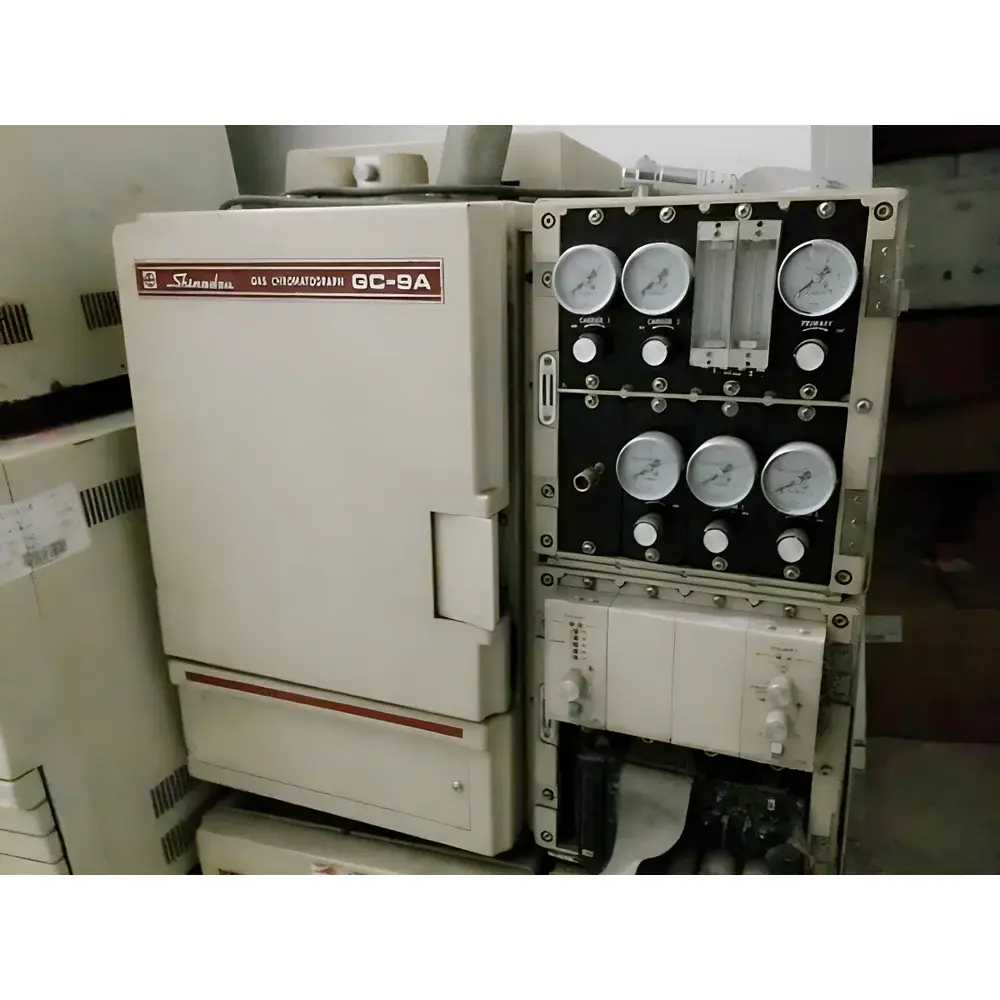
Shimadzu GC-9A Used Gas Chromatograph
| Brand | Shimadzu |
|---|---|
| Origin | Japan |
| Model | GC-9A |
| Instrument Type | Laboratory Gas Chromatograph |
| Application Scope | General-Purpose |
| Detector Configuration | Dual FID + TCD |
| Injector System | Capillary Split/Splitless Injector |
| Data System | Chinese-Language Chromatography Workstation |
| Column Included | One 30 m Capillary Column |
| Condition | ~85% New (Functional, Verified) |
| Warranty | 3 Months Limited |
Overview
The Shimadzu GC-9A is a robust, benchtop gas chromatograph originally introduced in the late 1980s and widely deployed across academic laboratories, quality control facilities, and industrial R&D centers in Japan and Asia. Designed around conventional packed-column architecture with retrofitted capillary capability, the GC-9A employs temperature-programmed separation based on differential partitioning of volatile analytes between a mobile phase (carrier gas) and a stationary phase (column coating). Its dual-detector configuration—comprising two flame ionization detectors (FIDs) and one thermal conductivity detector (TCD)—enables simultaneous or sequential detection of hydrocarbons, permanent gases, and organic compounds with complementary sensitivity profiles. While not compliant with modern electronic pressure control (EPC) or networked data acquisition standards, the GC-9A remains functionally viable for routine qualitative and semi-quantitative analysis where method transfer from legacy protocols is required or budget-constrained validation environments apply.
Key Features
- Thermally stable oven with programmable ramp rates and isothermal hold capability—engineered for reproducible retention time alignment across repeated injections
- Dual independent FID units with adjustable hydrogen/air flow ratios and optimized jet geometry for enhanced carbon response linearity
- TCD cell with tungsten-rhenium filament, offering universal detection for inorganic gases (e.g., O₂, N₂, CO, CH₄) and low-molecular-weight organics without ionization
- Capillary injector equipped with split/splitless mode selection, variable inlet pressure control, and glass liner compatibility for standard 0.25–0.53 mm ID columns
- Analog signal output interface (0–1 V or 0–5 V DC) compatible with third-party integrators or legacy chart recorders
- Mechanically actuated manual injection port with septum purge and adjustable needle depth—designed for high repeatability under operator-controlled conditions
Sample Compatibility & Compliance
The GC-9A supports liquid, gaseous, and headspace-derived samples applicable to environmental monitoring (e.g., VOC screening per EPA Method 8240B), petrochemical profiling (ASTM D3606), solvent residue testing (ICH Q3C), and food flavor compound identification. It accommodates packed columns (e.g., Porapak Q, Chromosorb 101) and fused-silica capillaries up to 30 m length and 0.53 mm internal diameter. Though lacking built-in 21 CFR Part 11 compliance features (e.g., electronic signatures, audit trails), its analog architecture permits integration into GLP-compliant workflows when paired with validated external data systems and documented procedural controls. All operational parameters—including oven temperature, detector voltages, and gas flows—are manually set and recorded via hardcopy logs, supporting traceability under ISO/IEC 17025:2017 Clause 7.7 requirements for measurement uncertainty documentation.
Software & Data Management
This unit includes a localized Chinese-language chromatography workstation running on Windows XP–based embedded hardware. The software provides real-time signal visualization, peak integration using tangent skim and valley-to-valley algorithms, retention time locking (RTL) for method consistency, and basic calibration curve generation (linear, quadratic). Raw data are stored in proprietary binary format (.DAT), convertible to ASCII via vendor-supplied utilities for export to Excel or LIMS. No cloud connectivity, remote access, or multi-user role management is supported. Data integrity is maintained through manual backup routines and version-controlled method files stored on removable CF cards.
Applications
- Residual solvent analysis in pharmaceutical intermediates per USP <467>
- Gas composition analysis in refinery streams and syngas production lines
- Volatile organic compound (VOC) profiling in indoor air and wastewater headspace
- Fatty acid methyl ester (FAME) quantification in biodiesel feedstocks
- Quality assurance of industrial solvents (acetone, ethanol, toluene purity verification)
- Academic teaching labs requiring hands-on understanding of GC fundamentals—retention mechanisms, resolution optimization, and detector response characteristics
FAQ
Is the GC-9A compatible with modern capillary columns?
Yes—the instrument includes a dedicated capillary inlet with split/splitless functionality and supports standard 0.25–0.53 mm ID fused-silica columns up to 30 m in length.
Does it support electronic pressure control (EPC)?
No—gas flow and pressure are regulated via mechanical rotameters and precision needle valves; EPC is not implemented.
What is the condition and verification status of this unit?
The system has been functionally tested: oven temperature accuracy verified ±2 °C across 40–250 °C range; FID baselines stable <0.5 mV over 30 min; TCD sensitivity confirmed via 100 ppm CO in N₂; all valves and switches operate without binding.
Can original Shimadzu service documentation be provided?
Yes—scanned English-language operation manuals, maintenance guides, and spare parts catalogs are included digitally upon request.
Is extended warranty or service contract available?
Third-party technical support and preventive maintenance packages can be arranged separately through authorized regional partners.





