
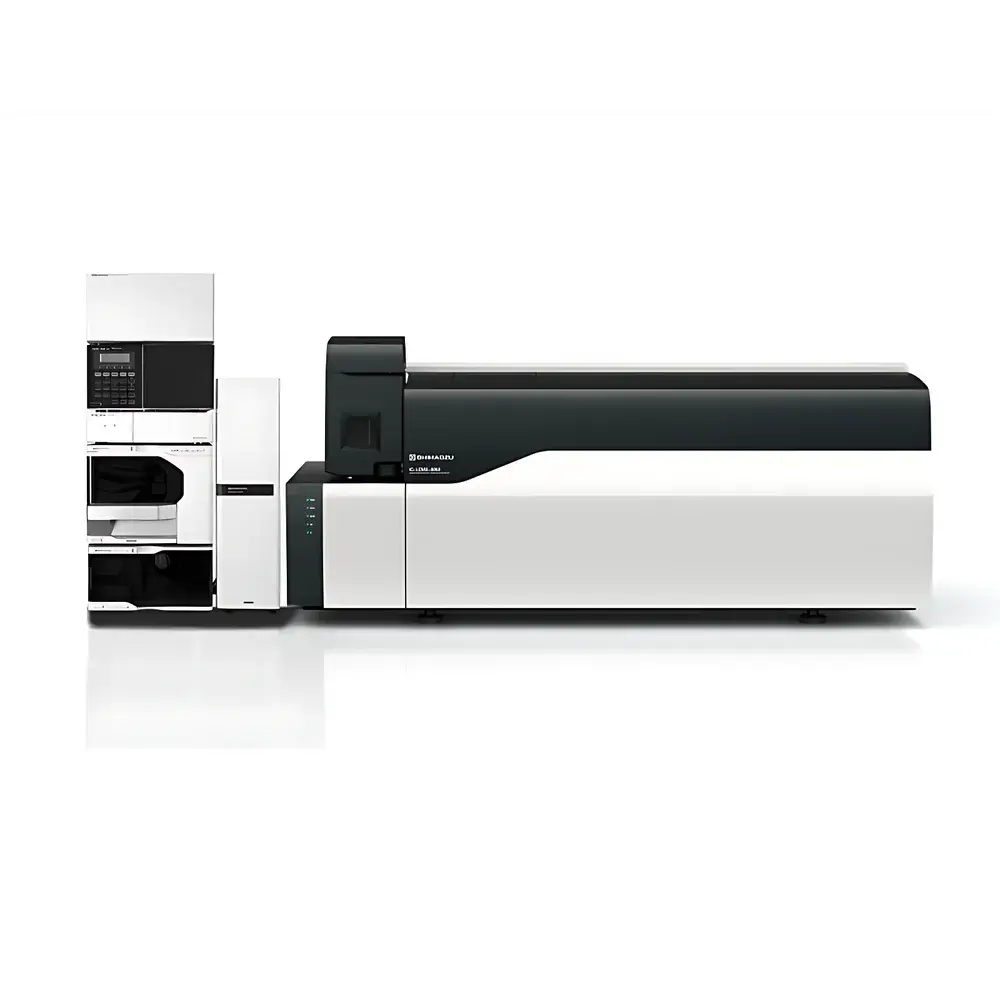
Shimadzu IC-MS/MS Ion Chromatography–Tandem Mass Spectrometry System
| Brand | Shimadzu |
|---|---|
| Origin | Jiangsu, China |
| Manufacturer Type | Original Equipment Manufacturer (OEM) |
| Product Origin | Domestic (PRC) |
| Model | IC-MS/MS |
| Instrument Type | Laboratory Benchtop System |
| Application Scope | General-Purpose Multi-Analyte Quantification |
| Pump Pressure Rating | 0–36 MPa |
| Flow Rate Range | 0.001–10.00 mL/min |
| Column Oven Temperature Range | Ambient +10 °C to 85 °C |
| Temperature Stability | ±0.1 °C |
| Eluent Concentration Range | 0.1–100 mM |
Overview
The Shimadzu IC-MS/MS is a fully integrated ion chromatography–tandem mass spectrometry system engineered for selective, sensitive, and quantitative analysis of inorganic and small organic anions and cations in complex matrices. Unlike conventional single-stage MS detection, this platform couples a high-resolution, low-dead-volume ion chromatograph—featuring an all-passive, chemically inert fluidic path—with a triple-quadrupole mass spectrometer (LCMS-8050) optimized for trace-level detection under regulated laboratory conditions. The system operates on the principle of sequential separation by suppressed or non-suppressed ion exchange chromatography, followed by electrospray ionization (ESI) in negative or positive mode and selective reaction monitoring (SRM) or multiple reaction monitoring (MRM) in the tandem MS stage. This architecture enables unambiguous identification and quantification of co-eluting species—particularly critical for regulatory applications involving perchlorate, bromate, chlorate, iodide, nitrite, and other oxyhalides in drinking water, wastewater, food extracts, and pharmaceutical excipients.
Key Features
- All-inert fluidic pathway (Essentia IC-16 module), including PEEKsil™ tubing, ceramic pump heads, and titanium-free eluent generation components, minimizing analyte adsorption and memory effects.
- Integrated electrolytic eluent generator supporting gradient and isocratic elution across 0.1–100 mM concentration range—eliminating manual preparation and improving reproducibility between runs.
- Triple-quadrupole mass spectrometer (LCMS-8050) with polarity-switching capability in ≤5 ms, enabling simultaneous acquisition of anionic and cationic species within a single chromatographic run.
- High-speed MRM scanning at up to 555 transitions per second and ultra-fast scan speed of 3000 u/s, preserving chromatographic peak integrity even at sub-minute retention times.
- Column oven with ±0.1 °C temperature stability over 10–85 °C range, ensuring retention time reproducibility essential for long-sequence batch analysis.
- Maximum system backpressure tolerance of 36 MPa, compatible with sub-2-µm particle-packed columns for enhanced resolution and peak capacity.
Sample Compatibility & Compliance
The IC-MS/MS supports aqueous extracts from environmental, food safety, and clinical samples—including drinking water, bottled water, infant formula, vegetable homogenates, and biological fluids—without derivatization. It complies with method requirements outlined in EPA Methods 300.1, 317.0, and 321.8; ISO 10304-4:2021 (water quality — determination of dissolved anions); and USP and for elemental impurity testing. Its hardware and software architecture support 21 CFR Part 11-compliant audit trails, electronic signatures, and role-based access control when deployed in GLP or GMP environments.
Software & Data Management
Instrument control, method development, and data processing are managed through Shimadzu’s LabSolutions IC-MS software suite. The platform provides automated calibration curve generation, peak integration with baseline correction algorithms, MRM transition optimization wizards, and customizable report templates aligned with ISO/IEC 17025 reporting requirements. Raw data files are stored in vendor-neutral .lcd format, enabling third-party reprocessing. All instrument events—including valve actuations, pressure fluctuations, and detector voltage adjustments—are timestamped and archived with full metadata for audit readiness.
Applications
- Regulatory monitoring of disinfection by-products (e.g., ClO₄⁻, BrO₃⁻, ClO₃⁻) in municipal water supplies per WHO and EU Drinking Water Directive limits.
- Simultaneous quantification of inorganic anions and organic acids (e.g., formate, acetate, oxalate) in fermentation broths and biopharmaceutical process streams.
- Screening for ionic contaminants in lithium-ion battery electrolytes and semiconductor-grade ultrapure water.
- Validation of ion-exchange resin performance and leachables profiling in medical device extractables studies.
- Multi-analyte residue analysis in infant foods and dairy products under Codex Alimentarius standards.
FAQ
Does the IC-MS/MS support both suppressed and non-suppressed ion chromatography modes?
Yes—the system is configurable for either mode via interchangeable suppressor modules and compatible with methanesulfonic acid (MSA) or KOH-based eluents.
Can the LCMS-8050 detect polyatomic interferences common in chloride-rich matrices?
Yes—collision-induced dissociation (CID) in Q2 and mass-resolved SRM filtering in Q3 effectively resolve isobaric overlaps such as 35Cl16O3− vs. ClO3−.
Is the eluent generator compatible with carbonate/bicarbonate eluents?
No—it is designed exclusively for methanesulfonic acid (MSA) and potassium hydroxide (KOH) electrolytic generation; carbonate systems require external eluent delivery.
What is the minimum detectable concentration for perchlorate in drinking water using this configuration?
Under optimized MRM conditions and 100 µL injection volume, the method detection limit (MDL) is ≤0.02 ng/L (ppt) in reagent water, consistent with EPA Method 317.0 validation criteria.
Does Shimadzu provide IQ/OQ documentation packages for GMP installations?
Yes—validated installation qualification (IQ) and operational qualification (OQ) protocols, including test scripts and acceptance criteria aligned with ASTM E2500-13, are available upon request.





