
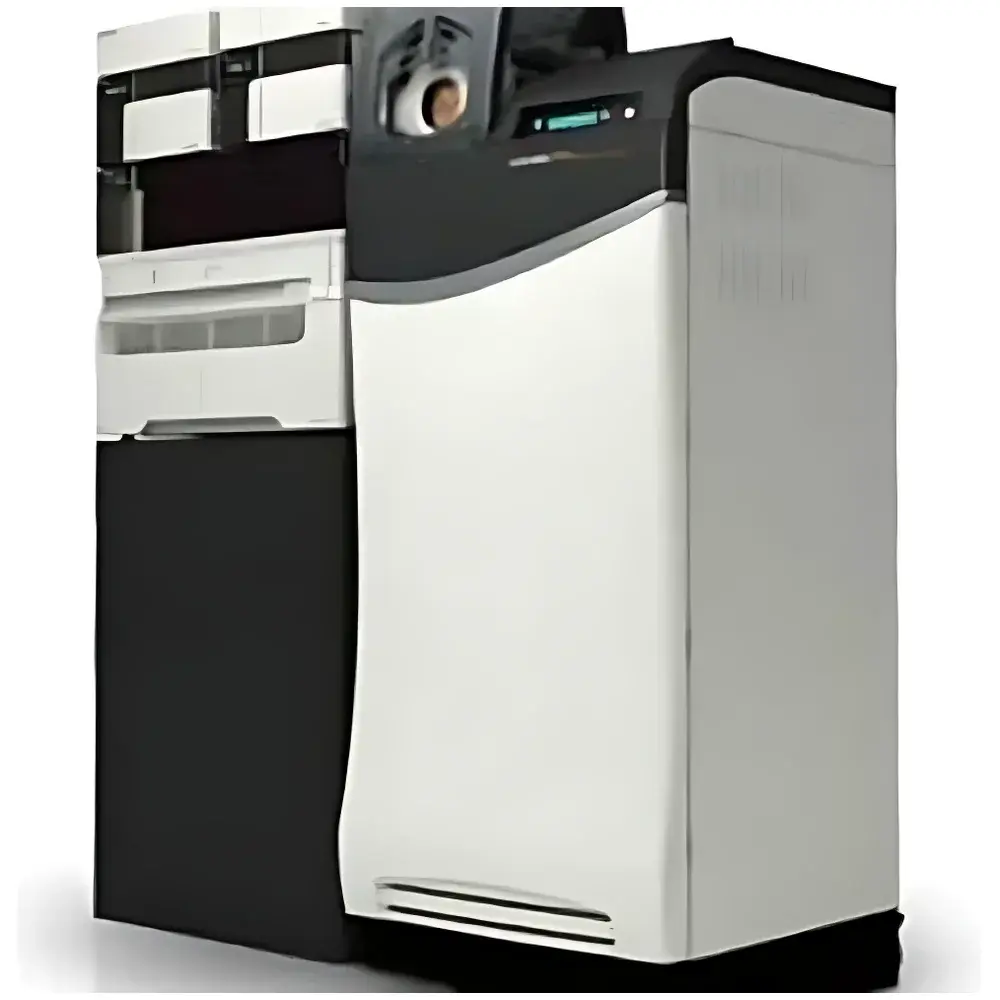
Shimadzu LCMS-8080 Triple Quadrupole Liquid Chromatography Tandem Mass Spectrometer
| Brand | Shimadzu |
|---|---|
| Origin | Japan |
| Model | LCMS-8080 |
| Instrument Type | Triple Quadrupole (TQ) |
| Mass Range | 10–3000 m/z |
| Sensitivity | S/N ≥ 100:1 (1 pg reserpine, ESI+) |
| Resolution | 0.5–0.7 m/z (FWHM) |
| Mass Accuracy | ±0.1 Da |
| Configuration | LC-MS/MS system with heated electrospray ionization (HESI) source |
Overview
The Shimadzu LCMS-8080 is a high-performance triple quadrupole liquid chromatography tandem mass spectrometer engineered for robust, reproducible quantitative analysis in regulated and research laboratories. Operating on the principle of electrospray ionization (ESI) coupled with collision-induced dissociation (CID) in a three-stage quadrupole mass filter architecture (Q1 → q2 → Q3), the system delivers exceptional selectivity, sensitivity, and dynamic range for targeted quantitation of small molecules across complex matrices. Its core design emphasizes ion transmission efficiency: the heated electrospray interface integrates coaxial heating gas to enhance desolvation and thermal ionization, while the High-Speed Ion Drive (HSID) ion optics and laminar-flow ion transport path minimize ion losses—enabling detection at sub-pg levels without compromising duty cycle or duty-time stability. The compact vertical chassis accommodates high-throughput workflows without sacrificing mechanical rigidity or thermal stability, making it suitable for 24/7 operation in QC, clinical, and pharmaceutical environments.
Key Features
- Triple quadrupole mass analyzer with independently controlled RF/DC voltages on Q1 and Q3 for optimal precursor ion selection and product ion detection
- Heated Electrospray Ionization (HESI) source with adjustable vaporizer temperature (up to 550 °C), sheath gas flow, and auxiliary gas parameters for broad compound coverage and matrix tolerance
- High-Speed Ion Drive (HSID) optics enabling rapid polarity switching (<20 ms) and stable ion transmission across wide mass ranges
- Laminar-flow ion guide technology minimizing neutral contamination and improving signal-to-noise ratio in high-background applications
- Integrated Nexera UHPLC platform compatibility—supporting gradient elution, column switching, and low-nL/min flow rates with <0.001% cross-contamination
- Modular, service-friendly architecture with hot-swap ion source and quick-access vacuum chamber components
Sample Compatibility & Compliance
The LCMS-8080 supports diverse sample types—including biological fluids (plasma, urine), tissue extracts, environmental water/soil digests, food homogenates, and pharmaceutical formulations—across acidic, basic, and neutral pH regimes. It complies with key regulatory frameworks for analytical method validation: fully compatible with USP , ICH Q2(R2), and ISO/IEC 17025 requirements. When operated with LabSolutions software configured for audit trail, electronic signatures, and data integrity controls, the system meets FDA 21 CFR Part 11 and EU Annex 11 expectations for GxP environments. Routine performance verification includes tuning with polytyrosine or reserpine standards, and calibration verification per ASTM D7861-19 (standard practice for LC-MS/MS instrument qualification).
Software & Data Management
LabSolutions LCMS software provides a validated, workflow-driven interface for method development, acquisition control, peak integration, and report generation. Its MRM optimization module automates dwell time allocation, collision energy ramping, and declustering potential adjustment based on compound-specific fragmentation patterns. All raw data are stored in proprietary .qgd format with embedded metadata (instrument parameters, sequence logs, user IDs), supporting traceable reprocessing and retrospective analysis. Audit trail functionality records all user actions—including parameter edits, peak integration overrides, and report exports—with timestamps and operator authentication. Data export options include CSV, PDF, and XML formats compliant with LIMS integration protocols (e.g., ASTM E1467, HL7).
Applications
The LCMS-8080 is routinely deployed in:
- Pharmaceutical R&D and manufacturing: pharmacokinetic (PK) studies, metabolite identification, impurity profiling, and stability-indicating assays
- Clinical research: therapeutic drug monitoring (TDM), biomarker quantification (e.g., vitamin D, steroids, immunosuppressants), and newborn screening
- Food safety: pesticide residue analysis (EU MRL compliance), mycotoxin detection, and allergen marker quantification
- Environmental testing: PFAS, pharmaceuticals in wastewater, and endocrine-disrupting compounds in surface water per EPA Method 1694
- Forensic toxicology: confirmation and quantitation of drugs of abuse in blood and hair matrices per SWGTOX guidelines
FAQ
Is the LCMS-8080 compliant with 21 CFR Part 11 for regulated laboratories?
Yes—when deployed with LabSolutions LCMS v5.95 or later and configured with password-protected user roles, electronic signatures, and immutable audit trails, the system satisfies technical and procedural requirements for electronic records and signatures.
What maintenance intervals are recommended for routine operation?
Ion source cleaning every 2–4 weeks (depending on sample load), quadrupole calibration every 3 months, and vacuum pump oil replacement every 6 months are standard practices aligned with Shimadzu’s Preventive Maintenance Guide (P/N 228-57258-91).
Can the LCMS-8080 be upgraded to support high-resolution mass accuracy?
No—the LCMS-8080 is a fixed-resolution triple quadrupole platform; high mass accuracy requires time-of-flight (TOF) or Orbitrap-based architectures such as the Shimadzu LCMS-9030 or LCMS-8060HR.
Is vendor-supplied method transfer support available for used instruments?
Yes—certified pre-owned LCMS-8080 systems include documentation of full functional verification, IQ/OQ reports, and optional remote application support packages for method migration from legacy platforms.





