
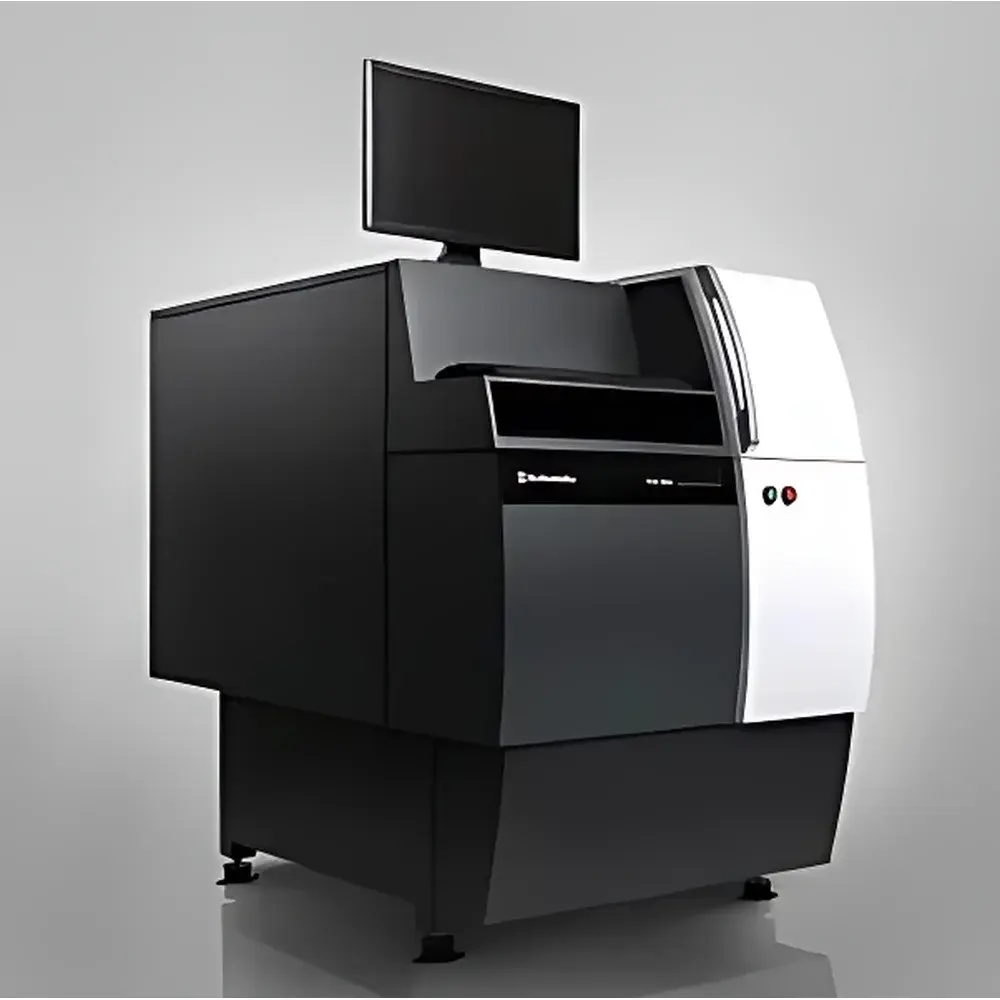
Shimadzu PDA-5000 Used Direct-Reading Optical Emission Spectrometer (OES)
| Brand | Shimadzu |
|---|---|
| Origin | Japan |
| Instrument Type | Floor-standing |
| Excitation Method | Arc/Spark |
| Detector Type | Photomultiplier Tube (PMT) |
| Optical System | Czerny-Turner with Fixed Grating |
| Focal Length | 500 mm (typical for PDA-series) |
| Groove Density | 1200–2400 lines/mm (model-dependent) |
| Wavelength Range | 130–800 nm (vacuum UV to near-IR) |
| Number of Channels | Up to 60 pre-aligned PMT channels |
| Operating Environment | 10–30 °C, <80% RH non-condensing |
| Vacuum System | Continuous rotary vane pump with pressure stabilization |
| Spark Stand | Horizontal sliding enclosed design with stainless steel sample stage |
| Temperature Control | Thermostatically stabilized optical chamber at 38 ± 0.1 °C |
Overview
The Shimadzu PDA-5000 is a floor-standing, multi-channel direct-reading optical emission spectrometer (OES) engineered for high-precision elemental analysis of metallic alloys in industrial quality control and production environments. Based on the principle of spark or arc excitation followed by wavelength-dispersive detection via photomultiplier tubes (PMTs), the PDA-5000 delivers rapid, repeatable quantitative analysis of major, minor, and trace elements (e.g., C, S, P, Mn, Si, Cr, Ni, Mo, Cu, Al, Ti, V) in ferrous and non-ferrous metals. Its robust Czerny-Turner optical architecture—featuring a fixed grating, 500 mm focal length, and vacuum-optimized optical path—ensures long-term spectral stability without argon purging. Designed for 24/7 operation in foundry, steelmaking, and automotive component manufacturing settings, the system maintains analytical integrity under variable ambient conditions through active thermal regulation (38 ± 0.1 °C) and continuous vacuum stabilization.
Key Features
- Digital solid-state excitation source with fully adjustable energy output and pulse frequency—enabling optimized excitation for cast iron, low-alloy steels, aluminum alloys, and copper-based materials without auxiliary electrodes or routine maintenance.
- Vacuum-sealed optical chamber constructed from low-expansion special cast iron, minimizing thermal drift and mechanical deformation over extended operational cycles.
- Horizontal, vibration-damped spark stand with sliding enclosure and large-diameter stainless steel sample stage—reducing particulate ingress in dusty furnace-side environments and accommodating irregular geometries including bars, billets, and machined parts.
- Pre-aligned PMT detector array supporting up to 60 independent analytical channels, each with dedicated slit and amplifier; no realignment required during routine use.
- Integrated temperature-controlled enclosure maintaining optical chamber at 38 ± 0.1 °C—eliminating need for external cooling water or argon purge while ensuring wavelength calibration stability.
- Automated standardization protocol combining time-scheduled recalibration with result-triggered re-standardization—reducing operator dependency and improving inter-shift reproducibility.
Sample Compatibility & Compliance
The PDA-5000 accepts flat, cylindrical, and irregularly shaped solid metal samples with minimal surface preparation (grinding or milling to expose fresh matrix). Optional accessories include wire holders, small-part fixtures, and specialized electrodes for low-mass samples. The instrument complies with core metallurgical testing standards including ASTM E415 (steel analysis), ASTM E1086 (stainless steel), ISO 11573 (aluminum alloys), and JIS G 1253 (Japanese industrial standards for OES). Its hardware architecture and firmware support audit-ready operation per GLP and GMP requirements, with full traceability of calibration events, analysis logs, and user actions.
Software & Data Management
The proprietary PDA Analysis Suite provides intuitive workflow-driven operation—from ignition setup and calibration management to report generation and statistical process control (SPC) charting. All spectral data, background corrections, intensity integrations, and calibration coefficients are stored in a structured relational database with timestamped metadata. Software supports export to CSV, XML, and LIMS-compatible formats (ASTM E1382-compliant). Audit trail functionality records user logins, method modifications, calibration interventions, and result approvals—fully compliant with FDA 21 CFR Part 11 requirements when deployed with electronic signature modules and role-based access controls.
Applications
Primary deployment domains include incoming raw material verification, ladle-to-ladle composition monitoring, heat-treatment batch validation, and final product certification across steel service centers, foundries, forging plants, and Tier-1 automotive suppliers. Typical use cases encompass carbon equivalency calculation (CEV), residual element screening (e.g., Sn, As, Pb), alloy grade identification (e.g., 304 vs. 316 stainless), and specification conformance testing against customer PPAP documentation. The system is routinely employed for QC/QA laboratories requiring turnkey OES performance without ongoing consumable costs associated with argon-purged instruments.
FAQ
Does the PDA-5000 require argon gas for operation?
No—the optical chamber operates under continuous vacuum and does not require argon purging, significantly reducing operating cost and infrastructure complexity.
Can additional elemental channels be added post-installation?
Yes—Shimadzu-certified field engineers can install supplementary PMT channels and corresponding calibration curves on-site, subject to physical grating port availability and software license configuration.
What maintenance intervals are recommended for the vacuum system?
The rotary vane pump oil should be replaced every 3,000 operating hours; vacuum gauge calibration and seal inspection are advised annually as part of preventive maintenance.
Is remote diagnostics supported?
Yes—the embedded Ethernet interface enables secure remote connection for firmware updates, log retrieval, and real-time status monitoring via Shimadzu’s authorized service portal.
How is measurement uncertainty managed across different operators?
Standardized spark timing parameters, automated normalization routines, and operator-level permission controls ensure consistent analytical execution regardless of personnel shift rotation or experience level.






