
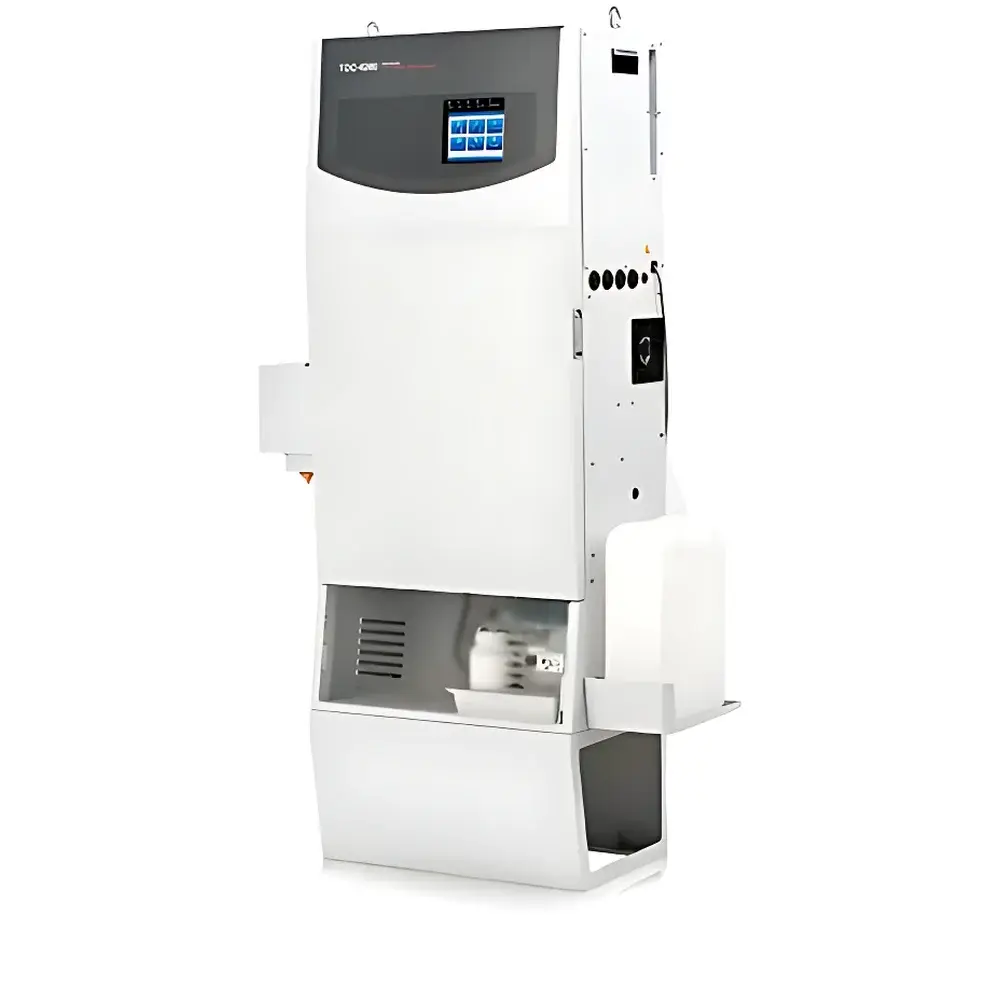
Shimadzu TOC-4200 Online Total Organic Carbon Analyzer
| Brand | Shimadzu |
|---|---|
| Origin | Jiangsu, China |
| Manufacturer Type | Original Equipment Manufacturer (OEM) |
| Product Category | Domestic |
| Model | TOC-4200 |
| Instrument Type | Online TOC Analyzer |
| Oxidation Method | High-Temperature Catalytic Combustion at 680 °C |
| Detection Principle | NDIR (Non-Dispersive Infrared) CO₂ Detection |
| Measurement Range | 0–1 ppm to 0–20,000 ppm (auto-ranging) |
| Cycle Time | Minimum 4 minutes per analysis |
| Carrier Gas | High-Purity Nitrogen (≥99.99%, 250–300 kPa) |
| Power Supply | 90–260 V AC, 50/60 Hz, 6 A |
| Power Consumption | 200 W (at operating temperature) |
| Operating Environment | 0–40 °C, ≤90% RH, Indoor Installation Only |
| Calibration | Auto-zero & span calibration |
| Sample Handling | Integrated high-speed rotary homogenizer |
| Internal Cleaning | Scheduled distilled-water flush of fluidic pathways |
| Interface | Full-color capacitive touchscreen |
| Communication | MODBUS RTU over RS-232/RS-485, 4–20 mA analog output, digital I/O |
Overview
The Shimadzu TOC-4200 Online Total Organic Carbon Analyzer is an industrial-grade, continuous-monitoring instrument engineered for precision, long-term stability, and minimal operator intervention in demanding water quality management environments. It employs high-temperature catalytic combustion oxidation at a precisely controlled 680 °C—ensuring complete mineralization of refractory and non-volatile organic compounds—followed by highly selective detection of evolved CO₂ via non-dispersive infrared (NDIR) spectroscopy. This dual-stage methodology delivers robust performance across diverse matrices, including municipal wastewater effluent, ultrapure water in semiconductor manufacturing, boiler feedwater in power generation, and surface water subject to regulatory surveillance. Designed for unattended 24/7 operation, the TOC-4200 meets the analytical rigor required under U.S. EPA Methods 415.3 and 9060A, as well as ISO 8245 and ASTM D7573, and supports compliance reporting frameworks such as U.S. EPA 40 CFR Parts 9, 141, and 142 (1998). Its architecture prioritizes corrosion resistance and fluidic integrity, featuring an eight-port valve system constructed from chemically inert materials (e.g., PTFE, quartz, and high-grade stainless steel), eliminating common failure points associated with solenoid-driven manifolds.
Key Features
- High-temperature catalytic combustion at 680 °C with platinum-based catalyst for quantitative oxidation of total organic carbon—including humic substances, surfactants, and recalcitrant polymers.
- NDIR CO₂ detector with temperature- and pressure-compensated signal processing, delivering sub-ppb-level baseline stability and low drift over extended deployment cycles.
- Auto-ranging measurement capability spanning 0–1 ppm to 0–20,000 ppm TOC, with programmable dilution up to 50× for high-concentration samples without manual intervention.
- Integrated sample homogenization and self-cleaning filtration: a high-speed rotary mixer ensures representative suspension of particulates, while automated backflushing with potable water maintains filter integrity over weeks of continuous operation.
- Onboard distilled-water flushing protocol scheduled via real-time clock, minimizing biofilm accumulation and carryover between analyses.
- Full-color capacitive touchscreen interface with multilingual support (English, Chinese, Japanese), intuitive workflow navigation, and embedded diagnostic logging.
- Comprehensive data traceability: all calibrations, maintenance events, and measurement records are time-stamped and stored locally with configurable retention policies.
Sample Compatibility & Compliance
The TOC-4200 accommodates a broad spectrum of aqueous samples without pre-filtration or chemical conditioning: raw surface water, chlorinated distribution system water, aggressive process streams (pH 2–12), saline cooling tower blowdown, and ultrapure water (UPW) with conductivity <0.1 µS/cm. Its acid/base-tolerant fluidic path enables direct analysis of samples containing residual chlorine, hydrogen peroxide, or low-concentration acids/bases commonly encountered in pharmaceutical clean-in-place (CIP) validation. Regulatory alignment includes full support for GLP/GMP audit trails, 21 CFR Part 11-compliant electronic signatures (when paired with optional secure authentication module), and automated TOC removal efficiency calculation per U.S. EPA guidance for advanced oxidation process (AOP) verification. The system complies with CE marking requirements for EMC and safety (EN 61326-1, EN 61010-1) and meets IP54 ingress protection for indoor industrial enclosures.
Software & Data Management
Embedded firmware provides local configuration, real-time trend visualization, alarm thresholding (with hysteresis), and event-driven data export. Standard communication protocols include MODBUS RTU over RS-232/RS-485 for integration into SCADA and DCS platforms, plus isolated 4–20 mA analog output for legacy PLC interfacing. Optional web server functionality enables remote browser-based access to live readings, historical charts (up to 30 days buffered), and calibration logs—without requiring proprietary client software. All data exports conform to CSV and XML formats compatible with LIMS systems (e.g., Thermo Fisher SampleManager, LabWare LIMS). Audit trail records capture user identity, timestamp, action type (e.g., “calibration initiated”, “range changed”), and pre-/post-value metadata—satisfying FDA and EU Annex 11 requirements for data integrity in regulated environments.
Applications
- Municipal & Industrial Wastewater: Continuous monitoring of influent, bioreactor effluent, and final discharge to verify compliance with NPDES permits and optimize biological treatment efficiency.
- Drinking Water Distribution: Early detection of organic breakthrough in groundwater sources or post-chlorination DBP precursor monitoring.
- Power Generation: Steam condensate purity assurance and cycle chemistry control in thermal and nuclear facilities per EPRI guidelines.
- Pharmaceutical & Biotech: USP and EP 2.2.44-compliant TOC verification of purified water (PW) and water for injection (WFI) distribution loops.
- Semiconductor Manufacturing: Real-time UPW TOC surveillance at point-of-use (POU) to prevent particle nucleation and wafer surface contamination.
- Petrochemical Refining: Condensate leak detection in steam systems and closed-loop cooling water TOC trending to assess microbiological activity.
- Research & Education: Long-duration kinetic studies of advanced oxidation processes, membrane fouling mechanisms, and natural organic matter (NOM) fractionation behavior.
FAQ
What oxidation method does the TOC-4200 use, and why is 680 °C significant?
The instrument utilizes high-temperature catalytic combustion with a Pt/Rh catalyst bed maintained at 680 °C. This temperature ensures >99% oxidation efficiency for even highly stable organics (e.g., pyridine, benzoic acid) without requiring persulfate addition—reducing reagent dependency and operational complexity.
Can the TOC-4200 measure TC, IC, POC, and NPOC without hardware modification?
Yes—TC and IC are measured natively via sequential acid sparging and combustion. POC (Purgeable Organic Carbon) and NPOC (Non-Purgeable Organic Carbon) modes are enabled through firmware-configurable protocol sequencing, requiring only standard gas and acid reagents already supported by the base platform.
Is the system suitable for ultrapure water applications below 1 ppb TOC?
While the stated lower detection limit is 0–1 ppm, the instrument achieves effective sub-ppb resolution in low-range mode (0–1 ppm) when coupled with optional low-volume sample introduction and enhanced NDIR signal averaging—validated per ASTM D8079 for UPW applications.
How is calibration traceability ensured?
Calibration standards are traceable to NIST SRM 8442 (potassium hydrogen phthalate) and NIST SRM 1699 (sodium carbonate/sodium bicarbonate). The system logs all calibration events—including standard lot numbers, preparation dates, and measured response factors—in encrypted internal memory with write-once archival capability.
What maintenance intervals are recommended for unattended operation?
Catalyst lifetime exceeds 18 months under typical municipal wastewater conditions; quartz combustion tube replacement is recommended every 36 months. The eight-port valve requires no scheduled lubrication or seal replacement for ≥500,000 actuations, and the NDIR detector is sealed for life with no field-serviceable optics.
Related Products







