
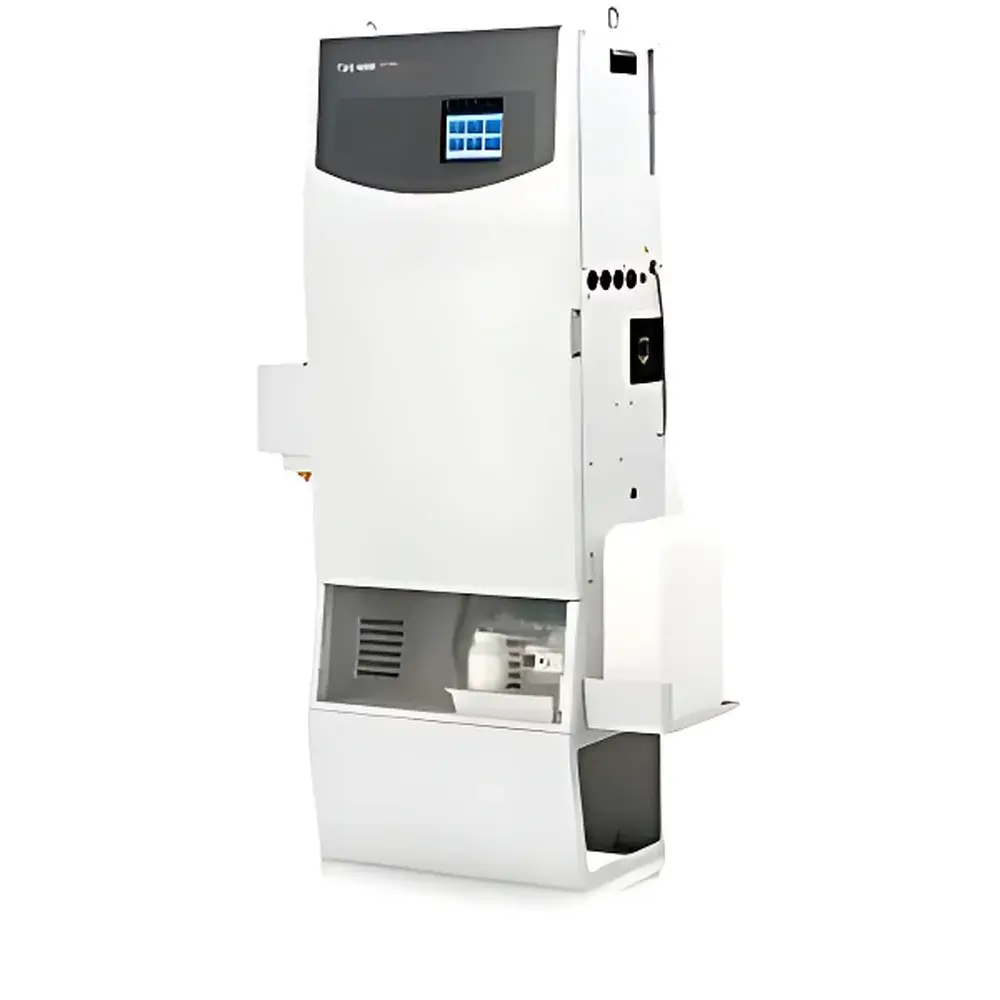
Shimadzu TOC-4200 Online Total Organic Carbon Analyzer
| Brand | Shimadzu |
|---|---|
| Model | TOC-4200 |
| Measurement Principle | Catalytic Combustion Oxidation + NDIR CO₂ Detection |
| Oxidation Temperature | 680 °C |
| Measurement Range | 0–1 ppm to 0–20,000 ppm (selectable) |
| Accuracy | ±1.0% of reading |
| Detection Limit | 0.01 ppm |
| Resolution | 0.001 ppb |
| Repeatability | ≤1% RSD |
| Analysis Cycle | Minimum 4 minutes |
| Carrier Gas | High-purity nitrogen (≥99.99%, 250–300 kPa) |
| Power Supply | 90–260 V AC, 50/60 Hz, 6 A |
| Power Consumption | 200 W (at operating temperature) |
| Operating Environment | 0–40 °C, ≤90% RH, indoor installation only |
Overview
The Shimadzu TOC-4200 Online Total Organic Carbon Analyzer is a high-reliability, continuous-monitoring instrument engineered for real-time quantification of total organic carbon in aqueous matrices across municipal, industrial, and regulatory environments. It operates on the internationally validated catalytic combustion oxidation principle: liquid samples are injected into a high-efficiency quartz combustion tube maintained at a precisely controlled 680 °C, where organic compounds are quantitatively oxidized to CO₂ in the presence of a platinum-based catalyst. The resulting CO₂ gas is swept by high-purity nitrogen carrier gas into a non-dispersive infrared (NDIR) detector, enabling selective, interference-free measurement with inherent stability and long-term baseline integrity. Unlike UV/persulfate or electrochemical methods, this thermal-catalytic approach ensures complete oxidation of refractory and particulate-bound organics—including humic substances, hydrocarbons, and chlorinated compounds—without reagent consumption or pH-dependent bias. Designed for unattended operation in demanding process streams, the TOC-4200 integrates robust fluidic architecture, corrosion-resistant wetted materials (e.g., PFA, quartz, and ceramic), and adaptive sample handling to maintain analytical fidelity under variable flow, temperature, and matrix complexity.
Key Features
- High-temperature catalytic combustion (680 °C) with Pt catalyst for complete, reproducible oxidation of all organic carbon forms
- Eight-port rotary valve system with self-cleaning capability, minimizing carryover and maintenance intervals
- Integrated high-speed vortex homogenizer and automatic backflush filtration using potable water—enabling direct analysis of turbid, suspended-laden, or particulate-rich samples without offline pre-filtration
- Automatic dilution capability up to 50×, supporting seamless transition between ultra-trace (0–1 ppm) and high-concentration (up to 20,000 ppm) measurement ranges
- Multi-point calibration (up to 5 standards) with auto-range selection and intelligent span validation; zero/span verification traceable to NIST-certified standards
- Real-time TOC removal efficiency calculation compliant with U.S. EPA Methods 415.3 and 415.4 (40 CFR Part 141 & 142, 1998), supporting regulatory reporting for drinking water and wastewater treatment compliance
- Configurable acid/base tolerance via programmable reagent dosing and neutralization modules—suitable for aggressive industrial effluents (e.g., caustic cleaning solutions, acidic condensates)
Sample Compatibility & Compliance
The TOC-4200 accommodates a broad spectrum of aqueous samples without manual intervention: raw surface water, clarified drinking water, secondary effluent, reverse osmosis permeate, ultrapure water (UPW), cooling tower blowdown, refinery process condensates, and semiconductor rinse waters. Its modular design supports optional expansion to TC (Total Carbon), IC (Inorganic Carbon), POC (Purgeable Organic Carbon), and NPOC (Non-Purgeable Organic Carbon) speciation when equipped with acidification/gas-sparging accessories. Regulatory alignment includes full support for GLP/GMP data integrity requirements, audit trail logging, electronic signature capability (per FDA 21 CFR Part 11), and traceable calibration records. Instrument performance meets ISO 8245:1999 and ASTM D7573-21 for online TOC determination, with documented repeatability (≤1% RSD) and detection limit (0.01 ppm) verified under field-representative conditions.
Software & Data Management
The analyzer features an embedded Linux-based control platform with a 7-inch color capacitive touchscreen interface, offering intuitive navigation, context-sensitive help, and real-time trend visualization. All operational parameters—including calibration history, alarm logs, maintenance schedules, and diagnostic codes—are stored locally with timestamped metadata. Communication protocols include MODBUS RTU over RS-232/RS-485, 4–20 mA analog output (isolated), dry-contact relays for alarm/status signaling, and optional Ethernet connectivity for HTTP/HTTPS web server access. With the optional WebConnect module, users can remotely monitor live readings, download CSV-formatted datasets, configure alerts via email/SNMP, and integrate seamlessly into SCADA, DCS, or LIMS platforms. Audit trails retain operator actions, method changes, and calibration events for ≥12 months—fully compliant with ISO/IEC 17025 and EU Annex 11 requirements.
Applications
- Municipal Water & Wastewater: Source water surveillance, drinking water treatment plant influent/effluent monitoring, and wastewater discharge compliance per NPDES permits
- Power Generation: Steam condensate leak detection, boiler feedwater purity assurance, and turbine cycle chemistry control
- Pharmaceutical & Biotech: USP and EP 2.2.44-compliant TOC verification of purified water (PW) and water for injection (WFI) distribution loops
- Semiconductor Manufacturing: Real-time UPW monitoring at point-of-use (POU) to prevent wafer contamination and meet SEMI F63 specifications
- Petrochemical & Refining: Monitoring of amine regenerator overheads, sour water strippers, and closed-loop cooling systems for organic fouling indicators
- Environmental Research: Long-term watershed TOC flux studies, landfill leachate characterization, and advanced oxidation process (AOP) efficiency evaluation
FAQ
What sample types can the TOC-4200 analyze without pretreatment?
It handles raw surface water, clarified drinking water, secondary-treated wastewater, RO permeate, and low-conductivity ultrapure water—thanks to integrated filtration, backflushing, and high-temperature oxidation.
Does the instrument support regulatory reporting for drinking water compliance?
Yes—its TOC removal efficiency algorithm aligns with U.S. EPA 40 CFR Part 141 and 142, and it generates audit-ready calibration and validation records per 21 CFR Part 11.
Can the TOC-4200 measure both TC and IC simultaneously?
With the optional acidification and sparging module, it performs sequential TC/IC analysis to derive NPOC and POC fractions.
What carrier gas specifications are required?
High-purity nitrogen (≥99.99%) at 250–300 kPa; compressed air or oxygen is not permitted due to combustion safety and NDIR interference constraints.
Is remote diagnostics and firmware updates supported?
Yes—via secure HTTPS web interface or MODBUS TCP when connected to a corporate network; all updates undergo cryptographic signature verification.







