
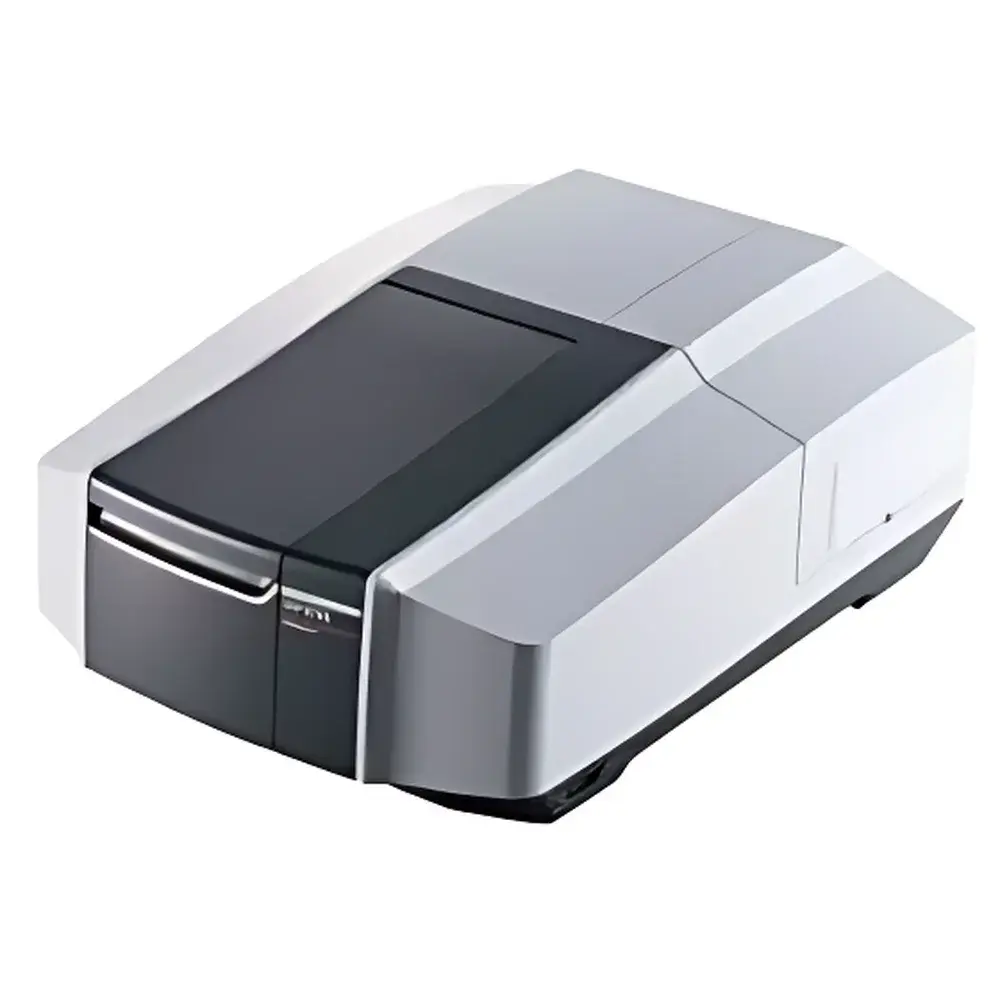
Shimadzu UV-2600i and UV-2700i Ultraviolet-Visible-Near Infrared Spectrophotometers
| Brand | Shimadzu |
|---|---|
| Origin | Japan |
| Manufacturer Status | Authorized Distributor |
| Origin Category | Imported |
| Model | UV-2600i / UV-2700i |
| Instrument Architecture | Double-beam |
| Detector Type | Photodiode Array (PDA) |
| Wavelength Range | 185–1400 nm |
| Automation Level | Automatic Wavelength Scanning |
| Spectral Bandwidth | 0.1–5 nm (variable) |
| Wavelength Accuracy | ±0.1 nm |
| Stray Light | < 0.00002% T |
Overview
The Shimadzu UV-2600i and UV-2700i are high-performance double-beam ultraviolet-visible-near infrared (UV-Vis-NIR) spectrophotometers engineered for precision quantitative and qualitative analysis across academic, pharmaceutical, and industrial laboratories. The UV-2600i employs a single-monochromator optical system optimized for extended wavelength coverage up to 1400 nm—enabling reliable measurement in the near-infrared region without compromising signal-to-noise ratio. Its low-noise PDA detector and optimized optical path support high-fidelity spectral acquisition from deep UV (185 nm) through visible to NIR. In contrast, the UV-2700i integrates a dual-monochromator design with Shimadzu’s proprietary Lo-Ray-Light™ holographic diffraction gratings, delivering exceptional stray light suppression (< 0.00002% T) and extending photometric linearity to 8 Absorbance units—critical for highly concentrated samples or thick optical paths where conventional instruments exhibit deviation.
Key Features
- Extended spectral range: 185–1400 nm covers deep UV, visible, and near-infrared regions—supporting applications such as semiconductor thin-film characterization, polymer degradation analysis, and NIR-based moisture quantification.
- Variable spectral bandwidth: Adjustable from 0.1 nm to 5 nm allows optimization of resolution versus sensitivity depending on sample matrix and analytical objective.
- High wavelength accuracy: ±0.1 nm tolerance ensures compliance with ASTM E275, ISO 9001 calibration traceability requirements, and method validation protocols under GLP/GMP environments.
- Compact footprint: 450 mm width reduces bench space requirement by 28% compared to previous-generation Shimadzu UV instruments—facilitating integration into high-density lab layouts or mobile analytical workstations.
- Energy-efficient operation: 10% lower power consumption relative to predecessor models supports sustainability goals without sacrificing thermal stability or baseline reproducibility.
- Hardware qualification suite: Built-in hardware confirmation software enables automated verification of lamp intensity, wavelength accuracy, photometric linearity, and stray light—fully documenting instrument readiness per FDA 21 CFR Part 11 and ISO/IEC 17025 requirements.
Sample Compatibility & Compliance
Both models accommodate standard 10 mm cuvettes (quartz, fused silica, or NIR-grade glass), microvolume cells (down to 2 µL), solid-sample reflectance accessories (including integrating spheres), and fiber-optic probes for in-situ or remote measurements. The UV-2700i’s ultra-low stray light performance meets stringent specifications outlined in USP , EP 2.2.25, and JP 2.03 for high-absorbance pharmaceutical assays. All optical components—including Lo-Ray-Light™ gratings and PDA detectors—are manufactured and calibrated in Shimadzu’s ISO 9001-certified facilities in Kyoto, Japan, ensuring consistent inter-unit performance and long-term metrological stability.
Software & Data Management
Controlled via Shimadzu’s UV Probe software (v3.x), the systems support multi-user permission levels, audit-trail-enabled data capture, electronic signatures, and export to CSV, XML, or vendor-neutral JCAMP-DX formats. Raw spectral data is stored with full metadata (date/time, operator ID, instrument serial number, parameter settings), enabling full traceability for regulatory submissions. Optional modules include kinetic analysis, multicomponent quantitation using classical least-squares (CLS) or partial least-squares (PLS), and compliance-ready report generation aligned with 21 CFR Part 11 Annex 11 requirements.
Applications
- Pharmaceutical QC/QA: Assay of active pharmaceutical ingredients (APIs), dissolution testing, excipient compatibility studies, and stability-indicating methods.
- Materials science: Bandgap determination of semiconductors, optical density profiling of coatings, and NIR-based compositional analysis of polymers and composites.
- Environmental monitoring: Quantification of nitrate, phosphate, and heavy metal complexes in aqueous matrices per EPA Method 365.3 and ISO 15705.
- Food & beverage: Colorimetric assessment of pigments (e.g., anthocyanins, carotenoids), antioxidant capacity (FRAP/DPPH), and adulterant screening.
- Academic research: Teaching spectroscopy fundamentals, enzyme kinetics (NADH/NADPH monitoring), and ligand-binding studies via spectral titration.
FAQ
What is the difference between the UV-2600i and UV-2700i?
The UV-2600i uses a single-monochromator design optimized for broad wavelength coverage (185–1400 nm), while the UV-2700i employs a dual-monochromator architecture with Lo-Ray-Light™ gratings to achieve ultra-low stray light and 8 Abs linearity—making it suitable for high-absorbance applications.
Can I use legacy Shimadzu accessories with these instruments?
Yes—both models maintain full mechanical and electrical compatibility with existing Shimadzu UV accessories, including temperature-controlled holders, automatic samplers, and solid-sample modules.
Is UV Probe software compliant with 21 CFR Part 11?
Yes—when configured with user authentication, audit trails, and electronic signature modules, UV Probe satisfies Part 11 requirements for electronic records and signatures in regulated environments.
How often should hardware qualification be performed?
Shimadzu recommends daily verification of lamp energy and weekly full hardware confirmation; frequency may be adjusted based on risk assessment and internal SOPs aligned with ISO/IEC 17025 Clause 6.4.10.
Does the instrument support GLP-compliant reporting?
Yes—predefined templates, embedded metadata, and PDF/A export ensure reports meet GLP documentation standards for nonclinical laboratory studies (OECD Principles of GLP, FDA Guidance for Industry).




