
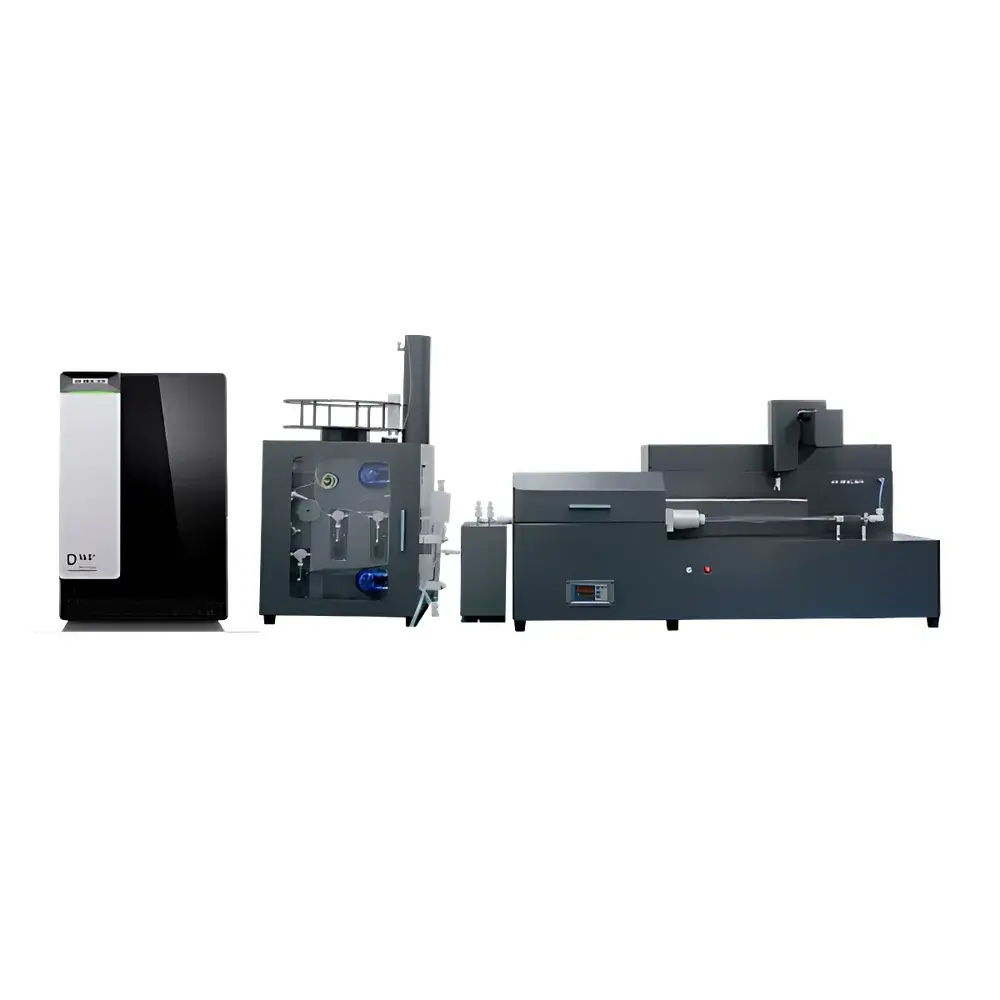
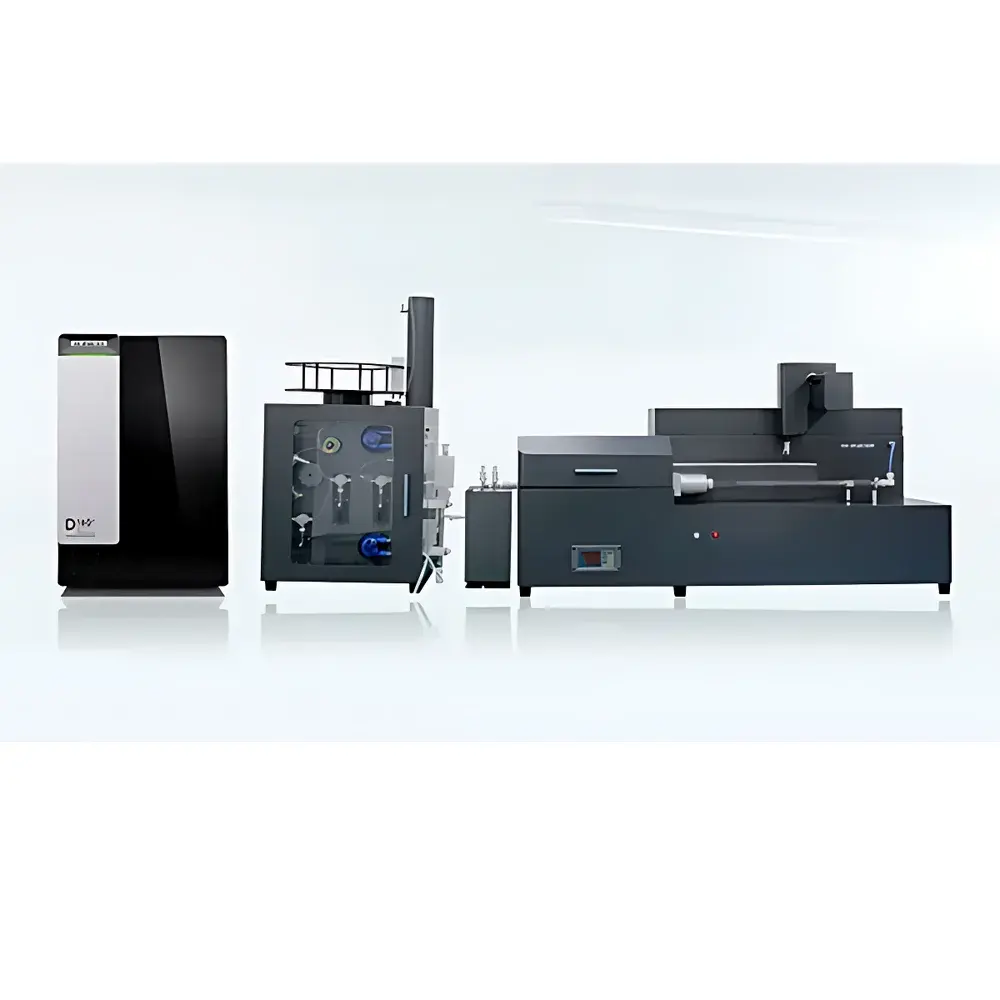
Shine SH-CIC3200 Online Combustion Ion Chromatograph
| Brand | Shine |
|---|---|
| Origin | Shandong, China |
| Manufacturer Type | Manufacturer |
| Product Category | Domestic |
| Model | SH-CIC3200 |
| Instrument Type | Online Analyzer |
| Pump Pressure Rating | 0–35 MPa |
| Flow Rate Range | 0–9.999 mL/min |
| Eluent Flow Rate | 0.1–5.0 mL/min |
| Maximum Operating Pressure | 35 MPa |
| Operating Temperature Range | Ambient +5°C to 60°C |
| Temperature Reproducibility | ±0.2°C |
| Eluent Concentration Range | 0.1–100 mM |
Overview
The Shine SH-CIC3200 Online Combustion Ion Chromatograph is an integrated analytical platform engineered for the quantitative determination of total organic halogens (TOX) — including fluorine, chlorine, bromine, and iodine — and total organic sulfur (TOS) in solid, liquid, and slurry combustible matrices. It combines high-temperature catalytic combustion with post-combustion gas absorption and high-resolution ion chromatography (IC) detection in a fully automated, closed-loop workflow. Unlike conventional offline pyrolysis–IC methods requiring manual sample handling, derivatization, and calibration correction, the SH-CIC3200 executes complete thermal decomposition, gaseous product transfer, aqueous absorption, and IC quantification under software-defined sequences — eliminating operator intervention, internal standard addition, and cross-contamination risks. The system operates on a two-stage combustion principle: initial low-oxygen pyrolysis followed by high-oxygen oxidative combustion, ensuring quantitative release of covalently bound halogens and sulfur as HX (HF, HCl, HBr, HI) and SO2/SO3. These acidic gases are swept by carrier gas into an alkaline absorption solution (e.g., NaOH or KOH), where they convert quantitatively to F−, Cl−, Br−, I−, and SO42− ions prior to injection onto the IC column.
Key Features
- Five-zone programmable combustion furnace with independent temperature control (up to 1100°C per zone), enabling stepwise thermal treatment for optimized halogen liberation from complex matrices such as polymers, resins, and carbonaceous materials.
- Integrated high-pressure water preheating and nebulization system delivering steam-saturated carrier gas, minimizing HF-induced quartz tube corrosion and enhancing combustion efficiency.
- Automated gas absorption module featuring dual rotary valves (10-port + 6-port), supporting both online combustion-derived gas capture and external 10-position autosampling — with auto-refill, auto-rinse, LED status indicators, and audible alarms.
- Modular IC analysis unit based on the Shine CIC-D160 platform: incorporating an online degasser, variable-frequency 3D air-circulation column oven (±0.1°C stability), full-plastic fluidic path, continuous self-regenerating micro-membrane suppressor, and plug-and-play component recognition.
- Embedded firmware with customizable method storage, enabling user-defined combustion protocols, absorption volumes, and IC gradient programs — deployable via secure USB-based update packages.
- Detection capability down to sub-ppb levels for fluoride and other halides, validated per ASTM D7359–22 (Standard Test Method for Total Fluorine, Chlorine and Sulfur in Aromatic Hydrocarbons and Their Mixtures by Oxidative Pyrohydrolytic Combustion followed by Ion Chromatography).
Sample Compatibility & Compliance
The SH-CIC3200 accepts a broad range of combustible samples without pretreatment: printed circuit boards (PCBs), waste plastics (e.g., PVC, PTFE), epoxy resins, cables, insulation materials, coal, coke, ores, cement clinker, activated carbon, graphite, pharmaceutical intermediates, food additives (e.g., carrageenan, cellulose derivatives), and wastewater containing adsorbable organic halides (AOX). Its design conforms to ISO 9001 quality management requirements and supports GLP-compliant operation through audit-trail-enabled software logging (user actions, method parameters, instrument status, calibration events). While not FDA 21 CFR Part 11–certified out-of-the-box, the system’s data integrity framework — including electronic signatures, immutable raw data storage, and version-controlled method files — facilitates validation for regulated environments upon customer-specific qualification.
Software & Data Management
The SH-CIC3200 is controlled via Shine’s proprietary IC-Studio v4.x workstation software, offering bilingual interface support (English/Chinese) and intuitive graphical workflow visualization. Real-time monitoring displays active combustion stage, absorption volume, IC pump pressure, column temperature, and detector signal. The software enables dual-mode operation: fully automated sequence execution or manual step-by-step control for method development and maintenance. All chromatograms, calibration curves, integration reports, and system logs are stored in vendor-neutral .csv and .pdf formats. Raw IC data adhere to ASTM E2687–19 metadata standards, facilitating third-party LIMS integration. Customizable report templates include TOX summation (F+Cl+Br+I), individual halogen mass balance, and sulfur recovery verification — all traceable to NIST-traceable calibration standards.
Applications
- RoHS/REACH compliance screening of brominated flame retardants (BFRs), chlorinated plasticizers, and fluorinated surfactants (PFAS) in electronics and polymer supply chains.
- Quality control of sulfur and halogen impurities in metallurgical feedstocks (e.g., iron ore sintering additives, limestone fluxes) and cement raw meals.
- Environmental monitoring of AOX in industrial effluents, landfill leachates, and municipal wastewater treatment plant discharges — aligned with ISO 9562 and DIN EN 1485 methodologies.
- Pharmaceutical excipient purity testing per USP and EP 2.4.24, particularly for halogenated solvents, catalyst residues, and degradation products.
- Research-grade quantification of organohalogen speciation in biochar, fly ash, and tire-derived fuel — supporting circular economy material certification.
FAQ
What sample types require pre-drying or size reduction before analysis?
Solid samples with >15% moisture content should be dried at 60°C under inert atmosphere to prevent incomplete combustion and condensation in transfer lines. Particulates larger than 2 mm must be homogenized using a ceramic mortar to ensure uniform thermal exposure.
Can the system quantify inorganic halides alongside organic forms?
Yes — the combustion-absorption-IC workflow converts both organic and inorganic halogen species into measurable anions; however, separate blank-corrected calibration is required for accurate speciation when inorganic interferences are suspected.
Is the quartz combustion tube replaceable in-field?
Yes — the tube is designed as a field-serviceable consumable with standardized flange mounting; replacement requires only basic torque tools and does not necessitate recalibration of temperature zones.
How is carryover minimized between high-halogen and low-halogen samples?
The system implements a three-stage cleaning protocol: high-temperature purge (900°C, 5 min), alkaline rinse of absorption loop, and IC column equilibration with high-pH eluent — reducing carryover to <0.5% for Cl− at 100 ppm level.
Does the software support multi-user permission levels?
Yes — administrator, analyst, and viewer roles are configurable with password-protected access to method editing, calibration, and data export functions.
Related Products




