
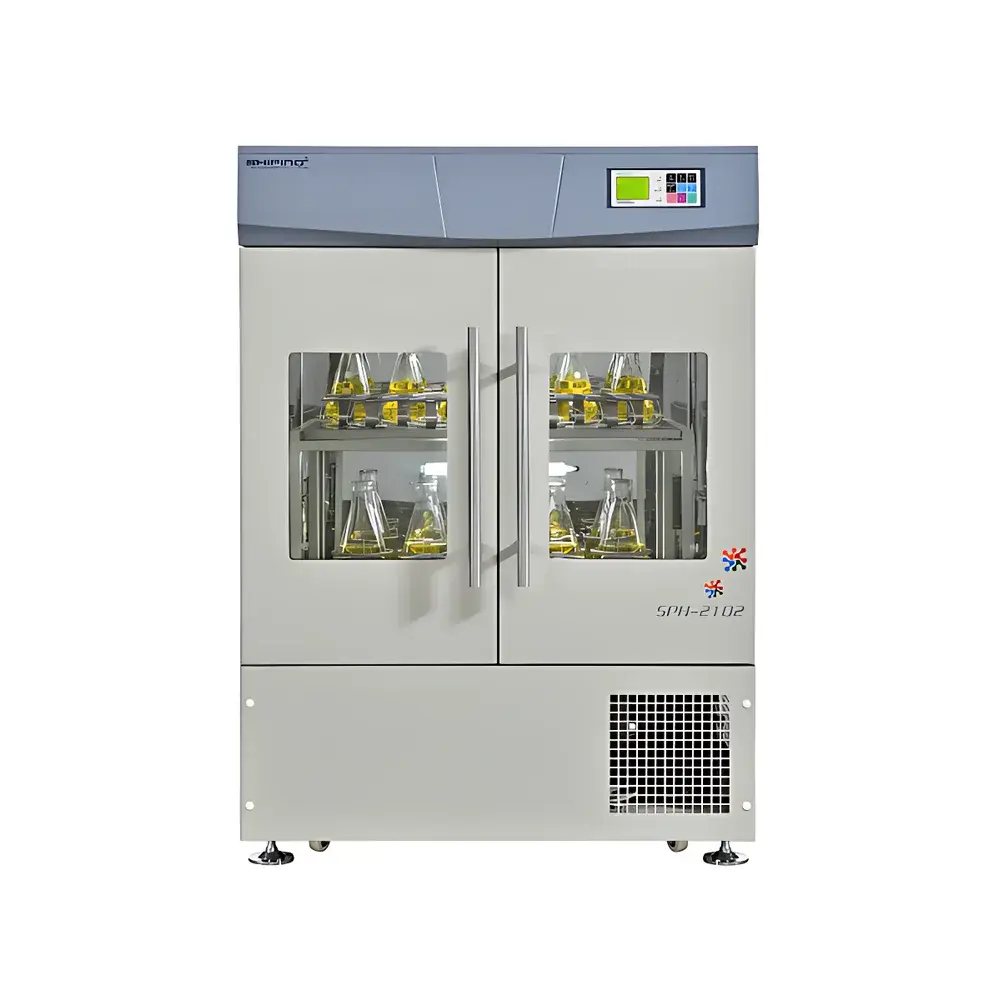
ShiPing SPH-2102 Vertical Dual-Shelf Temperature-Controlled Orbital Shaker
| Brand | ShiPing |
|---|---|
| Origin | Shanghai, China |
| Manufacturer Type | OEM Manufacturer |
| Instrument Category | Laboratory Orbital Shaker |
| Model | SPH-2102 |
| Price Range | USD 2,800–7,000 (FOB Shanghai) |
| Timer Range | 0–999 min 59 sec |
| Oscillation Speed | 30–300 rpm |
| Orbit Diameter | 25 mm |
| Temperature Range | 4–60 °C |
| Shelf Count | 2 |
| Chamber Volume | 365 L |
| Internal Dimensions (W×D×H) | 860 × 520 × 760 mm |
| Shelf Dimensions (W×D) | 734 × 464 mm |
| Max Load Capacity | 30 × 1000 mL or 44 × 500 mL or 56 × 250 mL |
| Heating Power | 1000 W |
| Refrigeration Power | 334 W |
| Motor Power | 250 W |
| Total Power Consumption | 1754 W |
| Noise Level | <45 dB(A) |
| Temperature Uniformity | ±1 °C |
| Temperature Accuracy | ±0.1 °C |
| Ambient Operating Range | 5–35 °C |
| Power Supply | AC 200–240 V, 50–60 Hz |
| Net Weight | 340 kg |
Overview
The ShiPing SPH-2102 Vertical Dual-Shelf Temperature-Controlled Orbital Shaker is an engineered platform for simultaneous incubation and controlled orbital agitation of biological samples under precise thermal and mechanical conditions. Designed around the principle of constant-speed eccentric drive with dynamic parallellogram balance, it delivers stable, low-vibration orbital motion (25 mm diameter) across two independently accessible stainless-steel shelves—enabling high-throughput cultivation of microorganisms, suspension cell lines, enzymatic assays, and biochemical reaction systems. Its integrated refrigeration system—featuring a R134a-free, frost-free compressor—ensures reliable sub-ambient operation down to 4 °C, while PID-controlled heating maintains tight thermal stability (±0.1 °C accuracy, ±1 °C uniformity) across the full 4–60 °C range. The unit complies with core laboratory infrastructure requirements for GMP-aligned environments, including structural integrity, material traceability, and operational repeatability over extended duty cycles.
Key Features
- Vertical dual-shelf architecture (2 × 734 × 464 mm shelves) maximizes volumetric efficiency within a compact footprint (1000 × 730 × 1480 mm H).
- Single-axis balanced drive mechanism utilizing precision-machined ductile iron components and imported double-row bearings rated for >100,000 hours of continuous operation.
- Electropolished 304 stainless-steel interior chamber with seamless arc-corner construction—cleanable, corrosion-resistant, and compliant with ISO 14644-1 Class 7 cleanroom-compatible surface standards.
- Dual independent lighting: 2 × 8 W white LED lamps for visual monitoring and 2 × 8 W UV-C germicidal lamps (254 nm) for routine chamber decontamination.
- Double-glazed, thermally insulated tempered glass door with anti-fog coating—enables real-time observation without thermal disruption across the full operating temperature range.
- Full-spectrum safety architecture: triple-layer protection including independent overtemperature cutoff, overspeed shutdown, motor current monitoring, ground-fault circuit interruption (GFCI), and sensor fault diagnostics.
- LCD interface with eight-segment programmable ramp/soak profiles, parameter encryption, power-loss recovery, and factory-reset functionality.
Sample Compatibility & Compliance
The SPH-2102 accommodates standard laboratory vessels—including Erlenmeyer flasks (up to 1000 mL), test tubes, microtiter plates, and bioreactor bags—via interchangeable mounting options: stainless-steel bottle clamps (304 mirror finish, 360° elasticity, 420 HB hardness), spring-loaded platforms, enzyme-linked immunosorbent assay (ELISA) plate holders, and adhesive silicone mats. All wetted surfaces meet USP Class VI biocompatibility criteria. The unit’s design supports adherence to GLP and GMP documentation workflows, with optional audit-trail-capable software integration (via RS-485 or Ethernet) for FDA 21 CFR Part 11–compliant data logging. It satisfies IEC 61010-1:2010 safety requirements for laboratory equipment and conforms to EN 60335-1 for electrical appliance safety.
Software & Data Management
While the base configuration features embedded PID control with local LCD operation, the SPH-2102 supports external data acquisition via Modbus RTU (RS-485) or TCP/IP protocols. Optional PC-based software enables remote monitoring, multi-unit synchronization, automated calibration logging, and export of time-stamped temperature/speed datasets in CSV or XML format. All parameter changes—including setpoint adjustments, timer activation, and alarm thresholds—are timestamped and stored in non-volatile memory with user ID tagging where enabled. Firmware updates are performed via secure USB interface with cryptographic signature verification to ensure system integrity.
Applications
This shaker serves critical roles in upstream bioprocessing (e.g., seed train expansion, microbial fermentation), molecular biology (plasmid propagation, protein expression in liquid culture), pharmaceutical QC (stability testing per ICH Q1A–Q1E guidelines), food microbiology (pathogen enrichment per ISO 6579), and environmental analysis (BOD incubation per ASTM D5210). Its dual-shelf layout allows parallel condition screening—such as comparative growth kinetics at varying temperatures or agitation rates—without cross-contamination risk. The refrigerated capability supports cold-adapted enzyme studies, cryopreservation media equilibration, and low-temperature hybridization protocols requiring strict thermal control.
FAQ
What is the maximum flask size supported on each shelf?
Each shelf accommodates up to thirty 1000 mL Erlenmeyer flasks using standard stainless-steel clamps; alternative configurations include forty-four 500 mL or fifty-six 250 mL flasks.
Does the unit support validation documentation packages for regulated labs?
Yes—factory-installed IQ/OQ documentation templates are available upon request, aligned with ASTM E2500 and Annex 15 principles; full PQ support requires site-specific protocol development.
Can the UV lamps be operated while the chamber is at elevated temperature?
UV-C irradiation is interlocked with door position and temperature; lamps deactivate automatically if internal temperature exceeds 45 °C or if the door is opened.
Is refrigerant charge serviceable in the field?
The sealed R134a-free refrigeration system is designed for lifetime operation without maintenance; no field recharge ports are provided.
What materials are used for the oscillating drive shaft and bearing housing?
The drive shaft is forged 45# carbon steel (220–250 HBW, quenched and tempered); bearing housings are machined from ASTM A536 Grade 65-45-12 ductile iron.
Related Products



