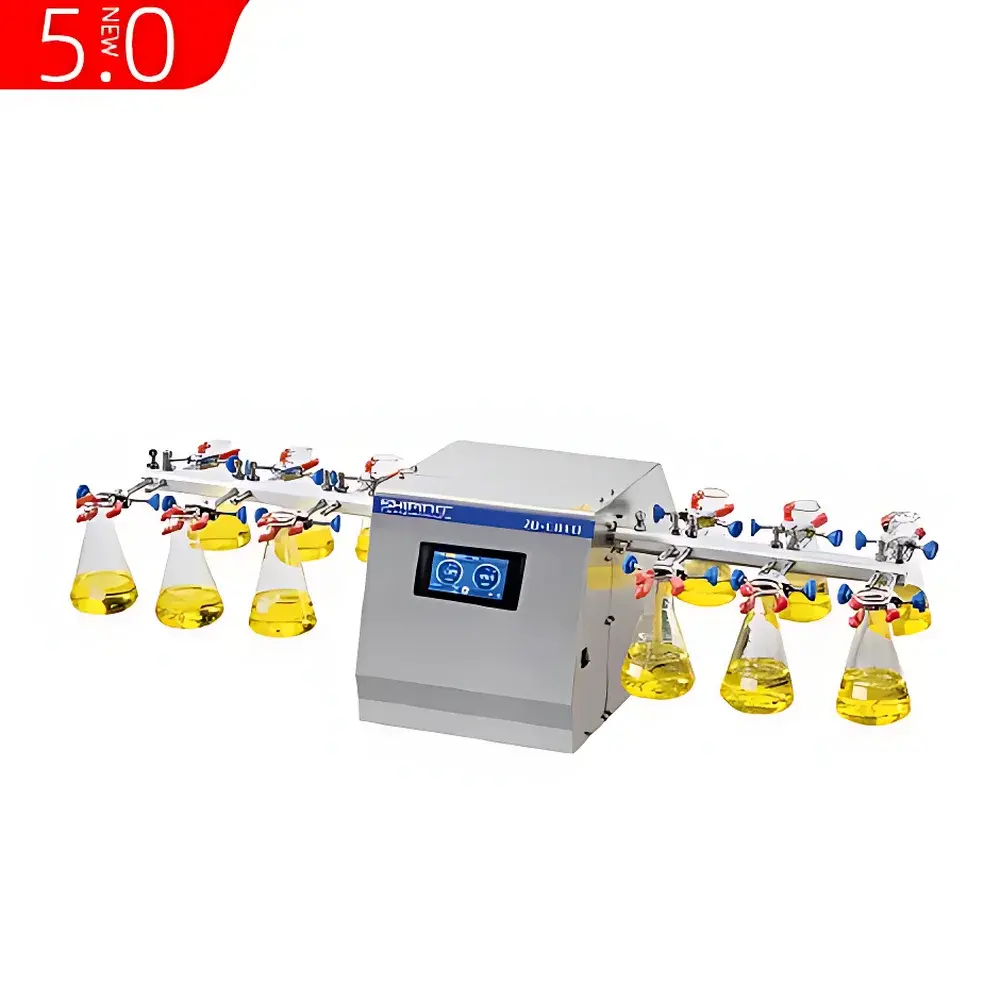
Shiping ZD-C810 Wrist-Action Shaker
| Brand | Shiping |
|---|---|
| Origin | Shanghai, China |
| Manufacturer Type | Direct Manufacturer |
| Product Category | Domestic |
| Model | ZD-C810 |
| Price Range | USD 1,400–2,800 (FOB Shanghai) |
| Instrument Type | Wrist-Action Shaker |
| Timer Range | 0–999.59 h |
| Oscillation Frequency | 30–600 rpm |
| Oscillation Angle | 10° (±0.5°) |
| Amplitude Radius | 13.3 ± 0.4 cm |
| Plate Capacity | 12-position |
| Drive Mechanism | Single-Axis Cam-Driven Wrist Motion |
| Control System | PID Microprocessor with LCD Display |
| Programming | 8-Stage User-Defined Program |
| Safety Features | Independent Over-Speed Audio/Visual Alarm, Leakage Protection, Over-Current Protection, Watchdog Timer |
| Power Supply | AC 200–240 V, 50–60 Hz |
| Power Consumption | 100 W |
| Net Weight | 52 kg |
| Dimensions (H×W×D) | 320 × 272 × 452 mm (Unit) / 320 × 810 × 452 mm (Overall) |
| Construction Materials | 304 Stainless Steel Clamps & Housing, Anodized Aluminum Oscillating Arm, Cast Iron Base |
Overview
The Shiping ZD-C810 Wrist-Action Shaker is an engineered solution for low-shear, biomimetic agitation of liquid samples in pharmaceutical and life science laboratories. Unlike orbital or reciprocating shakers, it replicates the natural arcuate motion of a human wrist—characterized by a fixed oscillation radius of 13.3 ± 0.4 cm and a precise 10° tilt angle—enabling gentle yet reproducible mixing ideal for foam-sensitive assays, emulsion stability testing, and delicate cell suspension protocols. Its mechanical design complies with USP Monograph on Simethicone requirements for foam test methodology, where controlled angular displacement and rotational fidelity are critical to generating consistent bubble nucleation and coalescence dynamics. The unit operates without forced convection or temperature control, making it suitable for ambient-condition applications where thermal perturbation must be avoided.
Key Features
- True wrist-action kinematics: single-axis cam-driven mechanism (Chinese Patent No. ZL2020XXXXXXX) ensures repeatable 10° oscillation at defined radius—critical for pharmacopeial foam testing compliance.
- PID-controlled microprocessor with LCD interface supports eight-stage programmable sequences, including ramp-up/down profiles, pause intervals, and multi-step timing cycles.
- Robust mechanical architecture: 304 stainless steel sample clamps and housing resist corrosion from solvents and cleaning agents; anodized aluminum oscillating arm minimizes inertia while maintaining rigidity.
- Comprehensive safety suite: independent watchdog timer, dual-mode over-speed detection (audible beep + LED flash), earth-leakage circuit breaker, and auto-shutdown on power interruption with parameter retention.
- Flexible operation modes: continuous run, timed cycle (0–999.59 h), auto-restart after power recovery, and memory retention for last-used speed, angle, and program settings.
Sample Compatibility & Compliance
The ZD-C810 accommodates up to twelve standard laboratory vessels simultaneously—including Erlenmeyer flasks (50–500 mL), volumetric flasks, separatory funnels, wide-mouth and narrow-mouth bottles, and graduated cylinders—via adjustable 304 stainless steel universal clamps. Its low-acceleration profile (a ≈ 0.12 g at 300 rpm) prevents shear-induced denaturation of proteins or disruption of fragile aggregates. The device meets mechanical specifications referenced in USP Chapter <724> “Foaming Agents” and aligns with ISO 17025 calibration traceability requirements when used with certified tachometers and angular displacement gauges. While not inherently temperature-controlled, it may be installed inside climate-stabilized enclosures compliant with ICH Q5C storage conditions for stability-indicating studies.
Software & Data Management
The ZD-C810 operates as a standalone instrument with embedded firmware—no external PC connection required. All operational parameters (speed, duration, angle, program stage) are logged internally with timestamped entries retained across power cycles. Audit trail functionality supports GLP-compliant environments through password-protected parameter modification logs and real-time display of elapsed vs. remaining time. For integration into networked lab infrastructures, optional RS-232 or USB-to-serial adapters enable passive data export to LIMS or ELN systems using ASCII-delimited text files. The firmware conforms to FDA 21 CFR Part 11 baseline requirements for electronic records: user authentication, immutable event logging, and system-level access controls.
Applications
- Pharmaceutical quality control: simethicone foam assay per USP monograph; viscosity-sensitive dissolution media conditioning.
- Biochemical reagent preparation: gentle homogenization of antibody conjugates, liposomal suspensions, and polymer-based drug carriers.
- Microbiology: maintenance of low-turbulence aerobic cultures in baffled flasks without vortex formation.
- Environmental testing: extraction efficiency validation for solid-phase microextraction (SPME) vials under standardized agitation kinetics.
- Academic research: comparative studies of interfacial rheology in surfactant-laden systems requiring non-turbulent, orbitally constrained motion.
FAQ
Does the ZD-C810 support temperature control?
No. It is a room-temperature-only shaker. For thermostatic applications, integrate with external incubators or environmental chambers rated for vibration compatibility.
Can I validate the 10° oscillation angle and 13.3 cm radius for regulatory submissions?
Yes. Calibration certificates for angular displacement and radial amplitude are available upon request, traceable to NIM (National Institute of Metrology, China) standards.
Is the 12-position plate configurable for other formats like microtiter plates?
No. The clamp geometry is optimized for cylindrical glassware (diameter range: 25–80 mm). Custom fixture sets for 96-well plates are not supported.
What maintenance is required for long-term reliability?
Annual inspection of cam follower lubrication and clamp spring tension is recommended. No consumables or scheduled replacements are specified under normal use conditions.
How does the ZD-C810 differ from conventional orbital shakers in terms of fluid dynamics?
It generates laminar, pendular flow with minimal radial acceleration—reducing air entrainment and surface shear stress—whereas orbital shakers induce turbulent secondary flows that promote foaming and particle aggregation.