
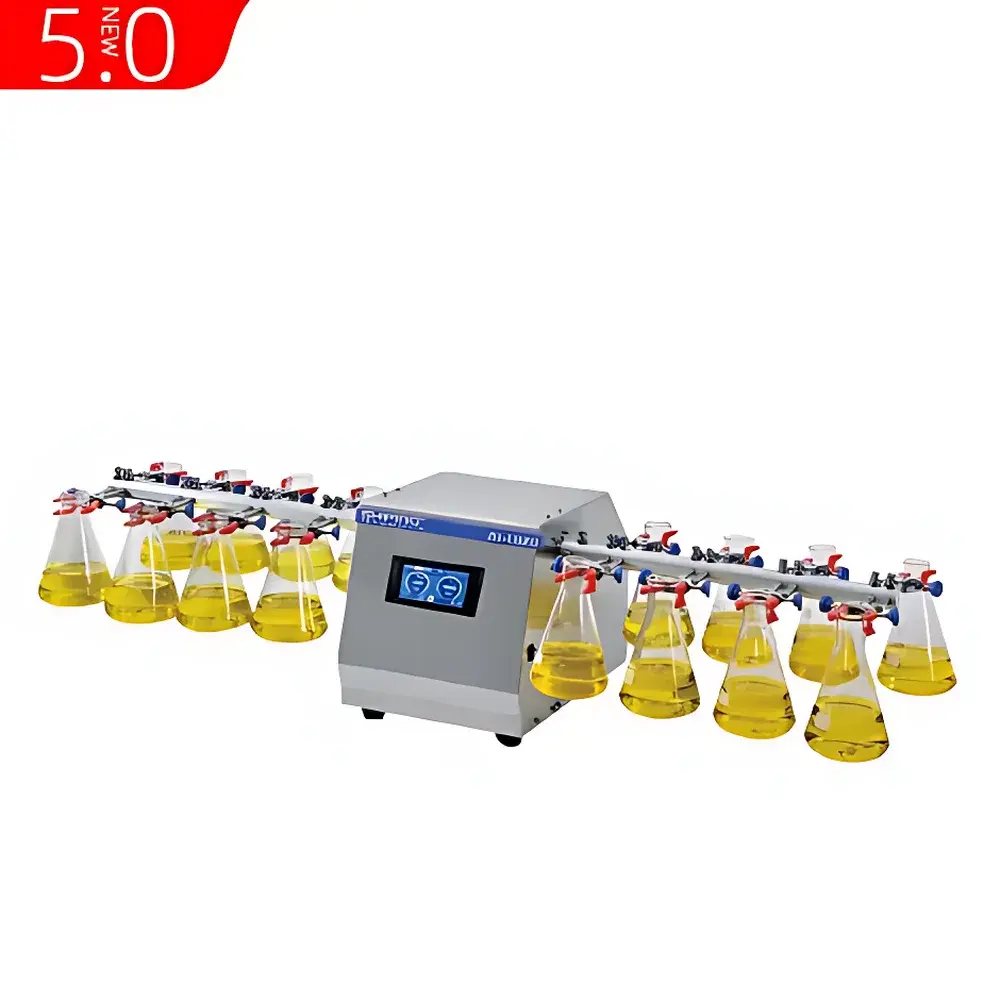
Shiping ZD-C820 Advanced Wrist-Action Shaker
| Brand | Shiping |
|---|---|
| Origin | Shanghai, China |
| Manufacturer Type | Direct Manufacturer |
| Country of Origin | China |
| Model | ZD-C820 |
| Instrument Category | Wrist-Action Shaker |
| Timer Range | 0–999.59 hours |
| Oscillation Speed | 30–600 rpm |
| Oscillation Angle | 10° |
| Plate Capacity | 16-position |
| Rotation Accuracy | ±1 rpm |
| Power Supply | AC 200–240 V, 50–60 Hz |
| Power Consumption | 100 W |
| Net Weight | 53 kg |
| Dimensions (H×W×D) | 272 × 452 × 320 mm (unit only) |
| Construction | 304 stainless steel chassis and clamps |
| Drive Mechanism | Single-axis wrist-action drive (Chinese Patent No. relevant to ultra-low-noise operation) |
| Control System | PID microprocessor with environmental scan logic |
| Display | LCD with real-time parameter feedback |
| Programming | 8-segment user-defined program memory |
| Safety Features | Independent overspeed audio/visual alarm, leakage current protection, overcurrent cutoff, watchdog timer |
| Operational Modes | Continuous, timed, auto-restart after power interruption, parameter retention, speed recall |
Overview
The Shiping ZD-C820 Advanced Wrist-Action Shaker is an engineered solution for standardized, low-shear mixing in pharmaceutical and life science laboratories—specifically designed to meet the mechanical agitation requirements outlined in United States Pharmacopeia (USP) Monograph on Simethicone Foam Test. Unlike orbital or reciprocating shakers, this device replicates human wrist motion via a precisely calibrated single-axis oscillating arm, generating controlled angular displacement (10°) with a fixed radial swing radius of 13.3 ± 0.4 cm. This kinematic profile ensures reproducible foam generation in dimethicone emulsion testing while minimizing shear-induced denaturation or foaming artifact—critical for QC labs performing USP Chapter <724> Foam Test or internal method validation under GLP/GMP frameworks.
Key Features
- USP-compliant wrist-action mechanism with traceable 10° oscillation angle and 13.3 cm effective radius—validated against USP monograph specifications for simethicone foam evaluation.
- High-resolution speed control from 30 to 600 rpm in 1-rpm increments, enabling fine-tuned protocol alignment with pharmacopeial test conditions (e.g., 30–300 rpm range specified for foam volume assessment).
- 16-position universal platform accommodates diverse vessel geometries—including Erlenmeyer flasks (50–1000 mL), narrow-mouth bottles, separatory funnels, volumetric flasks, and test tubes—without requiring adapter kits.
- PID-controlled microprocessor system with environmental scan logic maintains stable rotational velocity across load variations and ambient temperature fluctuations (operational within standard laboratory environments: 10–30°C, ≤80% RH).
- Eight-segment programmable memory supports complex multi-step protocols (e.g., ramped speed sequences, dwell periods, repeated cycles), essential for method development in formulation stability studies.
- Integrated safety architecture includes independent hardware-based overspeed detection, ground-fault circuit interruption (GFCI), thermal cut-off, and watchdog timer—ensuring compliance with IEC 61010-1 safety standards for laboratory equipment.
Sample Compatibility & Compliance
The ZD-C820 is routinely deployed in pharmaceutical quality control labs conducting USP <724> foam testing for antifoaming agents, as well as in bioprocess development where gentle agitation preserves protein conformation and cell viability. Its 10° angular displacement and low-acceleration waveform minimize bubble nucleation artifacts common in high-shear orbital shakers—making it suitable for oxygen-sensitive cultures, viscous polymer solutions, and surfactant-containing formulations. The unit complies with ISO 13485-aligned manufacturing practices, and its stainless steel (304) contact surfaces meet FDA-recommended material compatibility guidelines for non-sterile pharmaceutical equipment. All electronic controls conform to EMC Directive 2014/30/EU and Low Voltage Directive 2014/35/EU.
Software & Data Management
While the ZD-C820 operates via embedded firmware without external PC dependency, its PID controller logs operational metadata—including start/stop timestamps, actual vs. setpoint rpm, elapsed runtime, and fault events—into non-volatile memory. These records support audit-ready documentation for FDA 21 CFR Part 11–aligned workflows when paired with laboratory information management systems (LIMS) via optional RS-232 or USB-to-serial interface (available upon request). Parameter memory retains up to eight user-defined profiles with persistent storage across power cycles, satisfying GLP requirement §58.130(c) for instrument configuration traceability.
Applications
- USP <724> simethicone foam volume determination in excipient and dosage form testing.
- Gentle suspension reconstitution of lyophilized biologics and monoclonal antibody formulations.
- Extraction efficiency optimization for solid-phase assays using solvent-immiscible phases (e.g., chloroform/water separatory funnel shaking).
- Cell culture maintenance during transient transfection protocols requiring intermittent, low-shear mixing.
- Standardization of viscosity-dependent mixing kinetics in polymer-based drug delivery systems.
- Method transfer between R&D and QC labs where mechanical reproducibility is critical for inter-laboratory comparability.
FAQ
Does the ZD-C820 meet USP <724> mechanical specifications for simethicone testing?
Yes—the oscillation radius (13.3 ± 0.4 cm) and fixed 10° angle are factory-calibrated and documented per USP requirements. Certificate of Conformance is provided with each unit.
Can the shaker accommodate vessels larger than 1 L?
The 16-position platform supports vessels up to 1000 mL Erlenmeyer flasks; custom mounting brackets for larger formats (e.g., 2 L carboys) are available under OEM agreement.
Is speed accuracy verified across the full 30–600 rpm range?
Yes—each unit undergoes metrological verification at five points (30, 150, 300, 450, 600 rpm) using NIST-traceable tachometry prior to shipment.
What maintenance is required for long-term reliability?
No scheduled lubrication is needed—the sealed single-axis drive mechanism requires only periodic visual inspection of clamp integrity and cleaning of stainless steel surfaces with ethanol or isopropanol.
Is remote monitoring or network integration supported?
Standard configuration includes local LCD control only; RS-232 communication module and Modbus RTU firmware upgrade are optional accessories for integration into centralized lab automation networks.
Related Products




