
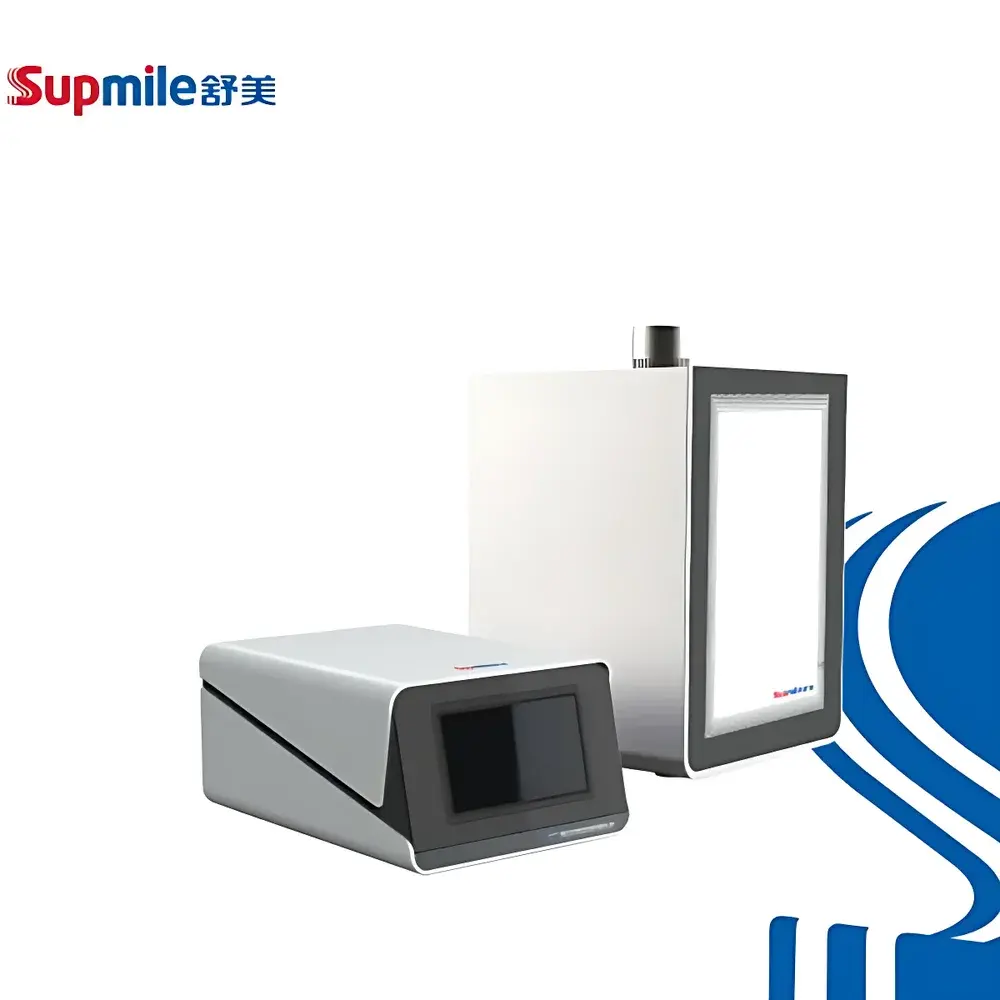
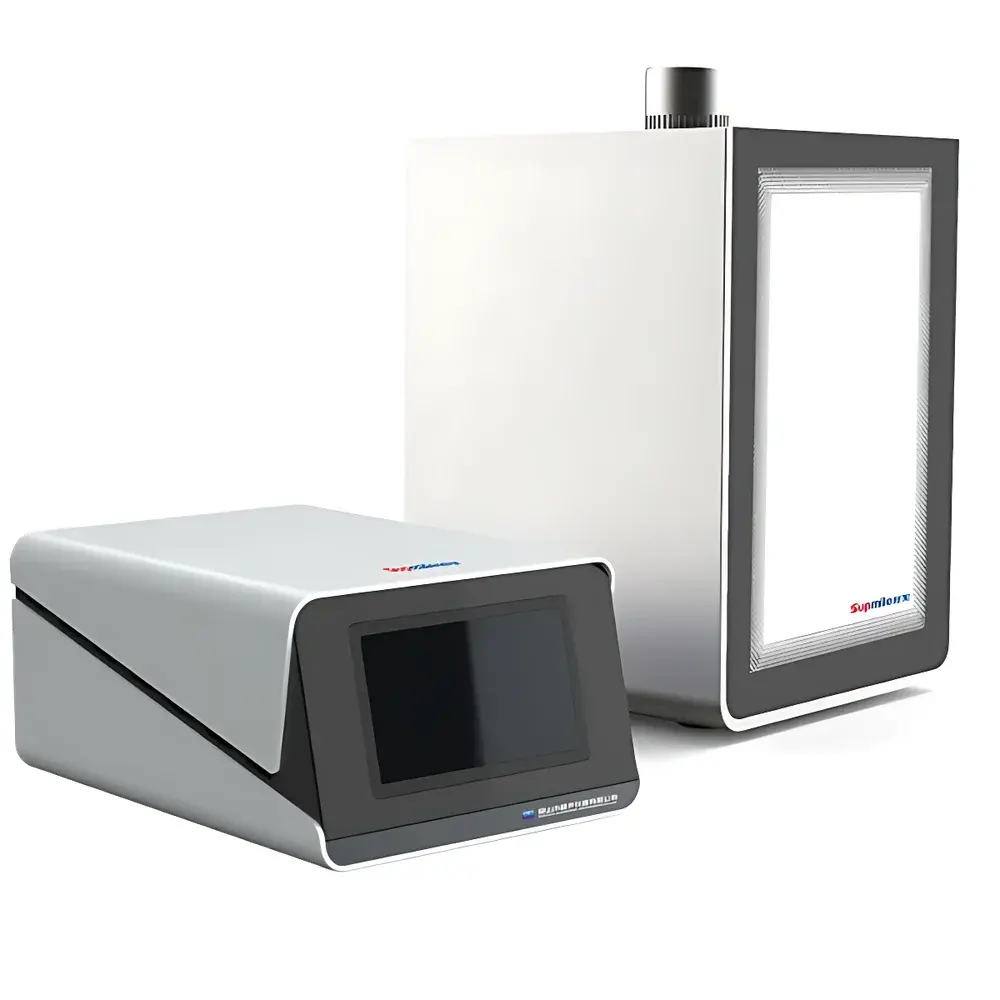
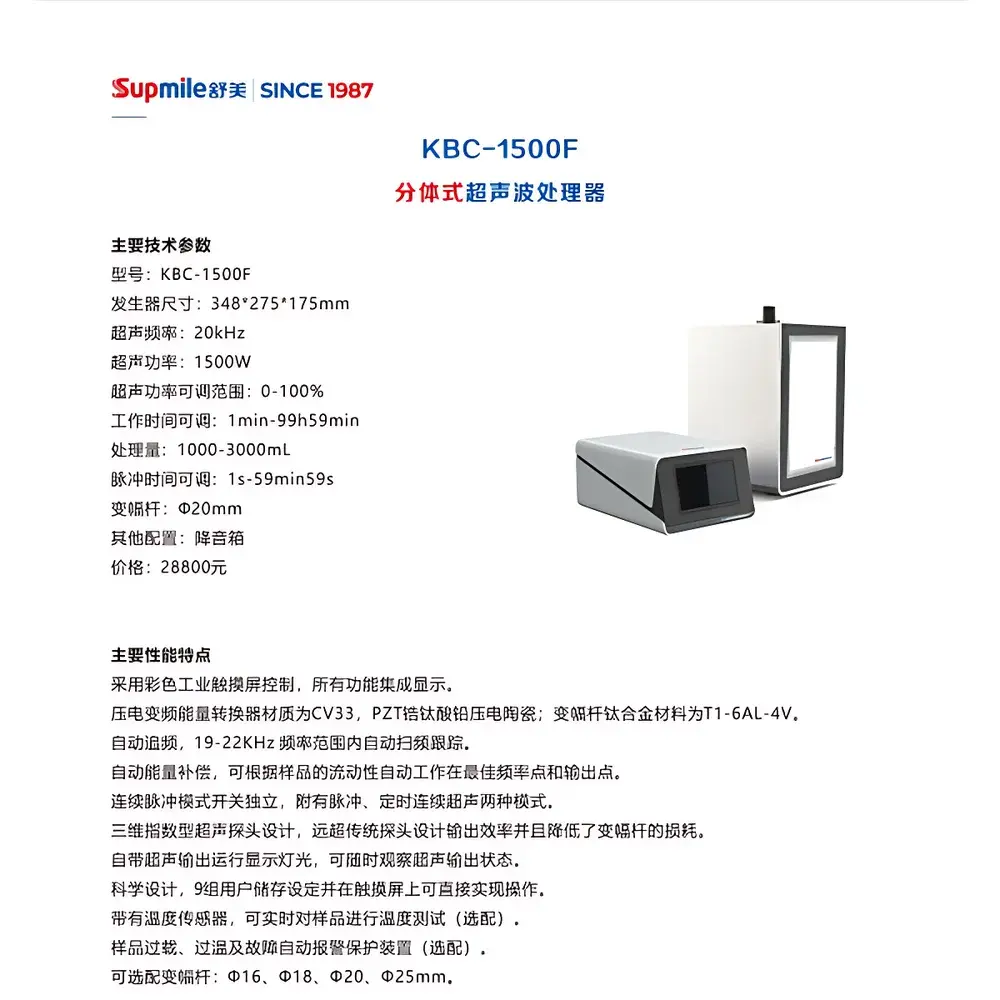
Shumei KBC-1500F Split-System Ultrasonic Processor
| Brand | Shumei |
|---|---|
| Origin | Jiangsu, China |
| Manufacturer Type | OEM Producer |
| Country of Origin | China |
| Model | KBC-1500F |
| Price | USD 4,050 (approx.) |
| Generator Dimensions | 348 × 275 × 175 mm |
| Ultrasonic Frequency | 20 kHz (auto-tracking range: 19–22 kHz) |
| Output Power | 1500 W (0–100% adjustable) |
| Processing Volume | 1000–3000 mL |
| Operating Time Range | 1 min – 99 h 59 min |
| Pulse Duration | 1 s – 59 min 59 s |
| Horn Diameter | Φ20 mm (optional: Φ16 / Φ18 / Φ25 mm) |
| Transducer Material | CV33 piezoelectric stack with PZT (lead zirconate titanate) ceramic |
| Horn Material | Ti-6Al-4V titanium alloy |
| Control Interface | Color industrial touchscreen |
| Modes | Continuous & pulsed ultrasonication |
| Safety Features | Overload, overtemperature, and fault auto-protection (optional) |
| Temperature Monitoring | Integrated RTD sensor (optional) |
| Storage | 9 user-programmable protocols |
Overview
The Shumei KBC-1500F Split-System Ultrasonic Processor is an industrial-grade benchtop sonication platform engineered for high-intensity, reproducible ultrasonic energy delivery in laboratory and pilot-scale applications. It operates on the principle of piezoelectric transduction—converting high-frequency electrical oscillations into mechanical vibrations via a PZT-based ceramic stack (CV33 grade), which are then amplified and transmitted through a precision-machined titanium alloy horn (Ti-6Al-4V). The system delivers 1500 W nominal acoustic output at a nominal frequency of 20 kHz, with real-time auto-frequency tracking across a 19–22 kHz bandwidth to maintain resonance under variable load conditions. Unlike monolithic ultrasonic systems, its split architecture separates the generator from the transducer/horn assembly, enabling flexible integration into custom reactors, flow cells, or jacketed vessels while minimizing electromagnetic interference and thermal coupling between control electronics and active sonication components.
Key Features
- Industrial color touchscreen interface with intuitive graphical workflow navigation and real-time status visualization—including dynamic power output indicator and operational mode feedback.
- Intelligent adaptive control: automatic frequency sweeping and energy compensation algorithms adjust operating point in response to sample viscosity, density, and acoustic impedance changes—ensuring consistent cavitation intensity across heterogeneous or temperature-sensitive matrices.
- Dual-mode operation: independent selection of continuous or pulsed ultrasonication; pulse duration (1 s–59 min 59 s) and interval timing are fully programmable to optimize energy deposition and minimize thermal accumulation.
- Three-dimensional exponential horn geometry enhances acoustic coupling efficiency by >35% compared to conventional cylindrical probes—reducing standing-wave formation, extending horn service life, and improving energy transfer uniformity within the sample volume.
- Nine non-volatile memory slots store complete parameter sets (power, time, pulse profile, temperature thresholds), accessible directly from the touchscreen without external software or configuration files.
- Modular horn compatibility: standard Φ20 mm probe with optional diameters (Φ16 / Φ18 / Φ25 mm) supports scalable processing—from micro-volume cell disruption to large-batch emulsification or nanoparticle dispersion.
Sample Compatibility & Compliance
The KBC-1500F accommodates liquid-phase samples ranging from low-viscosity aqueous buffers to high-viscosity polymer solutions and suspensions containing particulates up to 500 µm in diameter. Its design complies with IEC 61000-6-3 (EMC emission limits) and IEC 61000-6-2 (immunity requirements) for laboratory equipment. While not certified for GMP manufacturing environments per se, the system supports GLP-aligned workflows when paired with optional RTD-based temperature monitoring and digital audit trail logging (via external data acquisition interface). All safety interlocks—including overtemperature cutoff (≥85 °C), current overload detection, and horn detachment sensing—are implemented in hardware-level circuitry per IEC 61010-1 safety standards.
Software & Data Management
The embedded firmware provides local parameter storage, real-time clock synchronization, and timestamped operational logs viewable on-screen. For traceability-critical applications, the RS-485 and analog 0–10 V output ports enable connection to third-party SCADA systems or LIMS platforms. Optional USB-to-serial adapters allow export of run logs (CSV format) including start/stop timestamps, average power, cumulative exposure time, and alarm events. Although no proprietary PC software is bundled, the device responds to Modbus RTU protocol commands—facilitating integration into automated QA/QC sequences compliant with FDA 21 CFR Part 11 when deployed with validated electronic signature and audit trail infrastructure.
Applications
This processor is routinely deployed in academic and industrial laboratories for cell lysis (E. coli, yeast, mammalian suspension cultures), nanoemulsion preparation (e.g., lecithin-stabilized oil-in-water systems), sonochemical synthesis (TiO₂, ZnO nanoparticles), extraction of bioactive compounds (polyphenols, terpenes from plant matrices), and degassing of viscous resins prior to casting or 3D printing. Its stable output and pulse flexibility make it suitable for comparative studies requiring controlled specific energy input (kJ/mL), particularly where thermal management is essential—such as enzymatic reactions or heat-labile protein formulations.
FAQ
What is the maximum recommended sample temperature during continuous operation?
Continuous operation is rated for ambient-to-60 °C sample temperatures; above this threshold, pulsed mode with ≥1:1 duty cycle is advised to prevent thermal denaturation or cavitation collapse.
Is the system compatible with corrosive solvents such as chloroform or concentrated acids?
The Ti-6Al-4V horn exhibits excellent resistance to most organic solvents and dilute mineral acids; however, prolonged exposure to HF, hot HCl (>30%), or bromine-containing media requires custom passivation or alternative horn materials.
Can the KBC-1500F be integrated into a closed-loop recirculation system?
Yes—the split configuration allows direct mounting of the horn into standardized flanged reactor ports (DN25–DN50), and the generator supports remote start/stop via dry-contact TTL signal or Modbus command.
Does the unit include validation documentation for IQ/OQ protocols?
Factory calibration certificates (output power verification at 20 kHz, frequency stability test report) are provided; full IQ/OQ documentation packages are available upon request for regulated environments.
What maintenance intervals are recommended for optimal transducer longevity?
Visual inspection of horn threads and ultrasonic coupling surface every 200 hours; torque verification of horn-to-transducer interface annually; replacement of CV33 stack recommended after 5,000 cumulative operating hours or if frequency drift exceeds ±0.8 kHz.



