
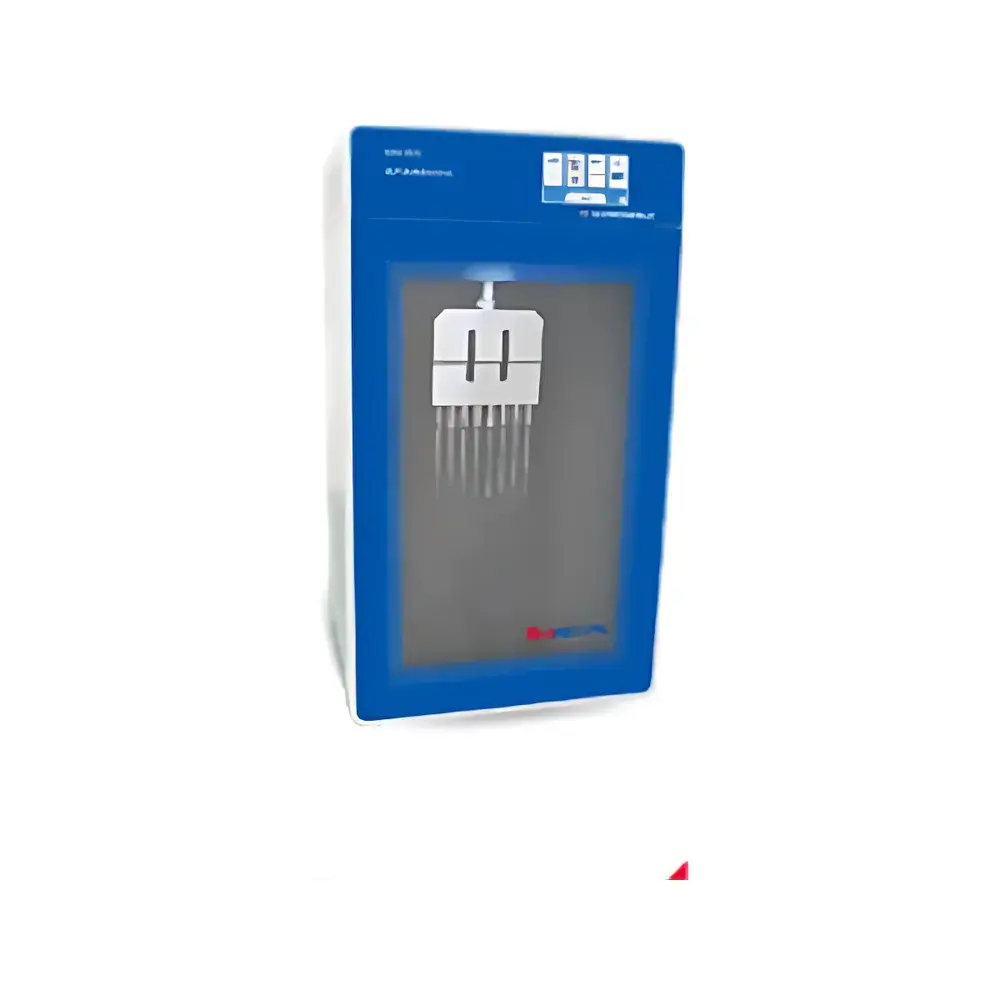
SHUMEI KBC-16TD Multi-Channel Ultrasonic Cell Disruptor
| Brand | SHUMEI |
|---|---|
| Origin | Jiangsu, China |
| Manufacturer Type | Direct Manufacturer |
| Product Category | Domestic |
| Model | KBC-16TD |
| Instrument Type | General-Purpose |
| Ultrasonic Frequency | 20 ± 0.5 kHz |
| Ultrasonic Power Output | 1600 W |
| Power Adjustment Range | 0–100% |
| Time Adjustment Range | 1 min – 99 h 59 min |
Overview
The SHUMEI KBC-16TD Multi-Channel Ultrasonic Cell Disruptor is an engineered solution for high-throughput, reproducible sample lysis and homogenization in life science laboratories. It operates on the principle of high-intensity ultrasonic cavitation—generating controlled microbubble collapse within liquid media to deliver localized mechanical shear forces that disrupt cellular membranes, organelles, and extracellular matrices. Unlike single-probe sonicators, the KBC-16TD integrates 16 synchronized titanium alloy (Ti-6Al-4V) probes mounted on a precision-machined transducer array, enabling parallel processing of up to 16 independent samples under identical acoustic parameters. This architecture eliminates inter-sample variability caused by sequential treatment, making it particularly suitable for applications requiring strict protocol standardization—such as RNA extraction workflows, bacterial lysate preparation for proteomics, or nanoparticle dispersion studies where batch consistency directly impacts downstream assay fidelity.
Key Features
- 16-channel synchronized ultrasonic output with individual probe alignment and uniform energy distribution across all channels
- Ti-6Al-4V titanium alloy sonotrodes (Φ6 mm standard; optional Φ3 mm configuration available) offering high acoustic transmission efficiency and corrosion resistance
- Digital touchscreen interface with intuitive icon-based navigation and real-time parameter feedback
- Motorized vertical lift stage with integrated LED illumination for precise probe immersion depth control and visual monitoring
- Programmable pulse mode (1 s – 59 min 59 s on/off intervals) to mitigate thermal accumulation during extended processing
- Nine user-defined protocol storage slots for rapid recall of validated methods
- Overload protection circuitry and temperature sensor input (optional) with over-temperature alarm threshold (configurable)
- Modular stacking design supporting integration with robotic liquid handlers or benchtop automation platforms
Sample Compatibility & Compliance
The KBC-16TD accommodates a broad range of biological and synthetic samples including mammalian and plant tissues, microbial cultures (E. coli, yeast, Bacillus spp.), viral suspensions, and nanoemulsions. Sample volumes per channel range from 0.5 mL to 20 mL, compatible with standard microcentrifuge tubes, PCR strips, and deep-well plates (e.g., 96-well format via optional adapter). The system complies with IEC 61000-6-3 (EMC emission standards) and IEC 61000-6-2 (immunity requirements). While not certified for clinical diagnostics under ISO 13485, its operational repeatability supports GLP-compliant documentation when paired with audit-trail-enabled software (see Software & Data Management section). All wetted components meet USP Class VI biocompatibility criteria.
Software & Data Management
The embedded firmware logs timestamped operational records—including power level, duration, pulse sequence, and (if equipped) real-time temperature readings—for each run. Data export is supported via USB 2.0 port in CSV format for integration into LIMS or ELN systems. Optional PC-based control software provides remote scheduling, multi-user access control, and electronic signature capability compliant with FDA 21 CFR Part 11 requirements when deployed with validated IT infrastructure. Audit trail functionality captures operator ID, parameter changes, and system events with immutable timestamps.
Applications
- High-throughput cell lysis for genomic DNA, total RNA, and protein isolation
- Preparation of antigenic lysates for immunoassay development
- Disruption of biofilms and filamentous fungi
- Nanomaterial deagglomeration and stable colloidal suspension formulation
- Accelerated solvent-free extraction of phytochemicals from botanical matrices
- Ultrasonic emulsification of oil-in-water and water-in-oil systems
- Homogenization of tissue biopsies prior to mass spectrometry analysis
FAQ
What is the maximum recommended continuous operating time per cycle?
Continuous operation is limited to 99 hours and 59 minutes; however, for thermal management, cycles exceeding 30 minutes are strongly advised to utilize pulse mode (e.g., 5 s on / 5 s off).
Can the KBC-16TD be used with cryogenic sample holders?
Yes—when operated in pulse mode with external cooling (e.g., chilled water bath or dry ice/ethanol jacket), the system maintains probe integrity and sample stability below 4 °C.
Is validation support documentation available for IQ/OQ protocols?
SHUMEI provides a comprehensive User Requirement Specification (URS) template and factory-verified performance qualification data for frequency stability, power linearity, and probe amplitude repeatability—intended for use by qualified laboratory personnel during site-specific validation.
How does the system ensure acoustic uniformity across all 16 channels?
Each transducer is individually impedance-matched and calibrated against a reference hydrophone during final assembly; channel-to-channel power deviation is maintained within ±3% at nominal load conditions.
Are replacement sonotrodes traceable to NIST-certified calibration standards?
Ti-6Al-4V probes are supplied with individual serial numbers and factory test reports referencing ISO 17025-accredited acoustic output verification using calibrated hydrophones per IEC 62127-1.



