
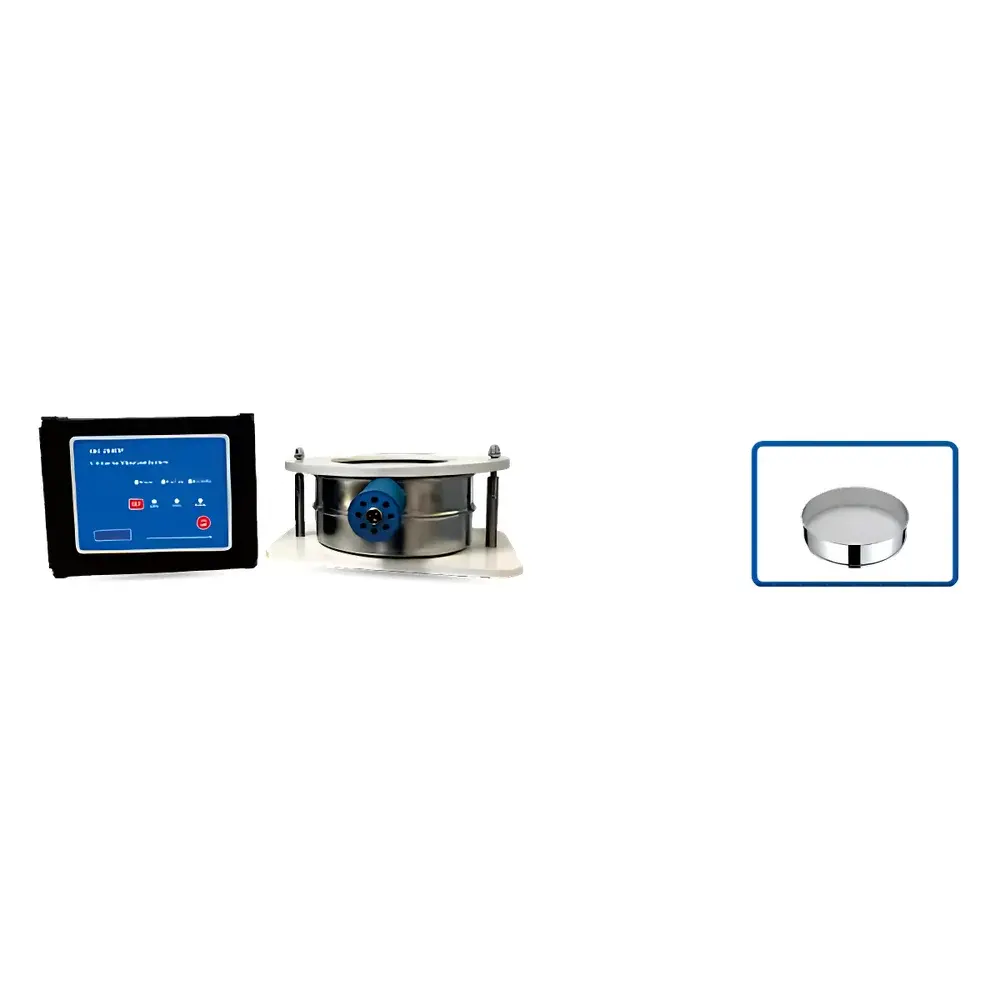
Shumei KBC-2840SF Ultrasonic Sieving System
| Brand | Shumei |
|---|---|
| Origin | Jiangsu, China |
| Manufacturer Type | Direct Manufacturer |
| Product Category | Domestic |
| Model | KBC-2840SF |
| Instrument Type | General-Purpose |
| Ultrasonic Frequency | 33 kHz |
| Ultrasonic Power | 200 W |
| Power Adjustment Levels | 60%, 80%, 100% |
| Sieve Diameter | Φ200 mm |
| Effective Sieving Range | 25 µm – 3 mm |
| Generator Dimensions | 270 × 240 × 130 mm (L×W×H) |
Overview
The Shumei KBC-2840SF Ultrasonic Sieving System is an engineered solution for high-precision dry powder classification and agglomerate dispersion in laboratory and pilot-scale quality control environments. Unlike conventional mechanical sieving, this system employs piezoelectric ultrasonic energy—converted from standard AC input (220 V/50 Hz or 110 V/60 Hz) to stable 33 kHz high-frequency oscillation—to induce controlled micro-vibrations across the sieve mesh surface. This mechanism disrupts interparticle adhesion forces (van der Waals, electrostatic, capillary), enabling consistent passage of fine and cohesive particles without mechanical impact or auxiliary cleaning media (e.g., bouncing balls). The system operates on the principle of resonant energy coupling: a CV33-series PZT (lead zirconate titanate) transducer converts electrical energy into longitudinal mechanical vibration; a Ti-6Al-4V titanium alloy horn amplifies and delivers this energy with minimal thermal loss and high fatigue resistance. Designed for reproducible particle size distribution (PSD) analysis per ISO 2591-1, ASTM E11, and USP , it supports method validation under GLP-compliant workflows.
Key Features
- Auto-frequency tracking within 30–36 kHz range ensures optimal resonance alignment despite load variation, temperature drift, or mesh wear.
- Three-step power modulation (60%, 80%, 100% of 200 W nominal output) enables process optimization for varying material cohesivity and moisture content.
- Integrated pulsed ultrasonic mode minimizes dwell time at full amplitude, reducing heat accumulation and extending transducer service life while maintaining mesh clearance efficiency.
- 3D exponential horn geometry improves energy transfer uniformity across the entire Φ200 mm sieve area—eliminating edge attenuation common in linear rod-type designs.
- No-contact cleaning architecture prevents cross-contamination: no rubber balls, brushes, or air jets are used, preserving sample integrity for pharmaceutical APIs, battery cathode/anode powders, and sterile-grade excipients.
- Real-time energy compensation adjusts both frequency setpoint and drive voltage to sustain peak displacement amplitude as material bed depth changes during continuous operation.
Sample Compatibility & Compliance
The KBC-2840SF is validated for use with challenging particulate systems including metal alloys (stainless steel, molybdenum, cobalt, nickel), ceramic abrasives (silicon carbide, quartz), functional oxides (LiCoO₂, NMC, LFP), conductive additives (carbon black, graphene flakes), and biological micro-powders (spores, malt flour). It complies with IEC 61000-6-3 (EMC emissions) and IEC 61000-6-2 (immunity). While not certified for cleanroom Class 5 operation, its sealed generator housing and non-lubricated mechanical interface meet ISO 14644-1 requirements for installation in ISO Class 7–8 environments. All electrical components conform to GB/T 19001–2016 (equivalent to ISO 9001:2015), and documentation supports audit readiness for FDA 21 CFR Part 11–aligned electronic records when paired with validated third-party data acquisition software.
Software & Data Management
The KBC-2840SF operates as a standalone hardware platform with front-panel digital controls—no embedded OS or proprietary software required. However, it features RS-232 and analog 0–10 V output interfaces for integration into LabView, MATLAB, or MES-controlled workflows. Time-stamped operational logs (power level, duration, frequency lock status) can be captured externally via TTL-triggered data loggers. For GMP traceability, users may implement CSV-based batch reporting using compliant SCADA systems that record start/stop timestamps, operator ID, sieve specification (mesh number, wire diameter), and environmental ambient conditions (temperature/humidity)—all prerequisites for USP and EP 2.9.20 method documentation.
Applications
- Quality assurance of active pharmaceutical ingredients (APIs) and excipients prior to tablet compression or inhalation formulation.
- Routine PSD verification of cathode materials (e.g., NCA, LCO) and anode graphite/silicon composites in lithium-ion battery R&D labs.
- Validation of metal powder flowability and packing density for additive manufacturing feedstock qualification (per ASTM F3049).
- Particle liberation assessment in mineral processing research, especially for ultrafine tungsten and molybdenum concentrates.
- Contamination-free sizing of laser sintering powders where oxide layer integrity and spherical morphology must remain unaltered.
- Method development for regulatory submissions requiring sieve-based fractionation data (e.g., FDA ANDA filings for generic solid oral dosage forms).
FAQ
Is the KBC-2840SF compatible with standard ASTM E11 or ISO 3310-1 test sieves?
Yes—it accepts any commercially available woven-wire or electroformed mesh sieve with Φ200 mm frame diameter and standard 25 mm depth, provided the mesh tension and flatness meet ISO 3310-1 tolerances.
Can the system be integrated into automated sample handling lines?
Yes—via programmable relay outputs (dry contact) and analog voltage feedback, enabling synchronization with robotic arms, vibratory feeders, or balance-triggered start/stop sequences.
What maintenance intervals are recommended for the ultrasonic transducer and horn assembly?
Under normal lab use (≤4 hrs/day), inspect mounting torque and horn surface finish every 500 operating hours; replace PZT elements only after measured displacement amplitude drops >15% below baseline (verified with laser vibrometer).
Does the unit include calibration certification?
No factory calibration certificate is supplied by default, but traceable verification protocols—including frequency accuracy (±0.2 kHz), power output (±3% full scale), and mesh displacement amplitude (using ISO 5347-12 reference sensors)—can be performed onsite by qualified metrology partners.
Is explosion-proof configuration available?
Not as standard; however, ATEX Zone 22 or IECEx HD-certified enclosures and intrinsically safe drivers can be commissioned as OEM options upon request.
Related Products



