
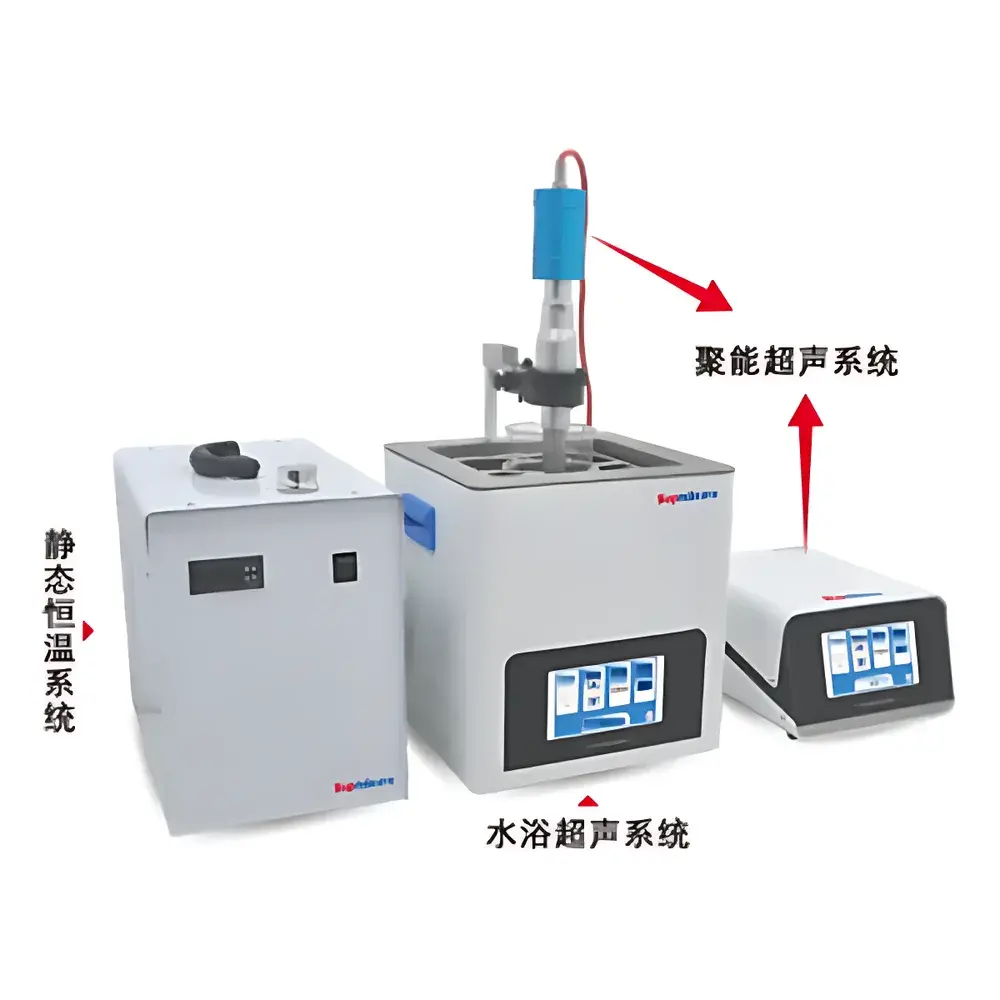
SHUMEI KBC-300ZH Tri-Mode Ultrasonic Processing System (Static Temperature Control + Water Bath Ultrasonication + Probe Sonication)
| Brand | SHUMEI |
|---|---|
| Origin | Jiangsu, China |
| Manufacturer Type | OEM Manufacturer |
| Country of Origin | China |
| Model | KBC-300ZH |
| Instrument Type | General-Purpose Ultrasonic Processor |
| Ultrasonic Frequency | 20 kHz ±1 kHz |
| Total Ultrasonic Power Output | 800 W (Probe Mode), 300 W (Water Bath Mode) |
| Power Adjustment Range | 0–100% (Continuous, Digital Control) |
| Timer Range | 1 min – 99 h 59 min (Water Bath & Probe Modes, Independent Control) |
| Temperature Control Range | −10 °C to 60 °C (Static Circulating Bath, ±0.3 °C Stability) |
| Cooling Method | Recirculating Liquid (Tap Water or External Chiller) |
| Heating Power | 3000 W |
| Refrigeration Power | 600 W |
| Flow Rate | 10 L/min |
| Probe Tip Diameter | Φ10 mm |
| Compatible Vessel Volume | 150–1000 mL (Probe Mode), 10 L Tank Capacity (Bath Mode) |
Overview
The SHUMEI KBC-300ZH Tri-Mode Ultrasonic Processing System is an integrated laboratory platform engineered for precise, reproducible, and multi-modal ultrasonic sample treatment under controlled thermal conditions. It combines three functionally distinct ultrasonic modalities—static temperature-controlled water bath sonication, high-intensity probe-based sonication (also known as “horn” or “tip” sonication), and independent thermal regulation via a recirculating chiller-heater unit—within a single, modular architecture. Unlike conventional ultrasonic cleaners or standalone sonicators, the KBC-300ZH implements Couette-flow-stabilized bath geometry and active temperature feedback control to eliminate thermal drift during prolonged processing, enabling consistent cavitation intensity across time-sensitive applications such as nanoparticle dispersion, enzymatic digestion, and cell lysis. Its dual-frequency stability (20 kHz ±1 kHz) ensures repeatable acoustic energy delivery, while the static bath design minimizes fluid turbulence that otherwise attenuates cavitation efficiency in dynamic water baths.
Key Features
- 7-inch TFT capacitive touchscreen interface with intuitive icon-driven navigation and real-time parameter monitoring (temperature, power %, elapsed time, fault codes)
- Stainless steel powder-coated chassis with corrosion-resistant internal tank (304 stainless steel) and IP54-rated electronics enclosure
- Dual-mode ultrasonic operation: independent activation of water bath (300 W, 10 L capacity) and probe sonication (800 W, Φ10 mm titanium alloy horn) with simultaneous or sequential control
- Static temperature control system featuring PID-regulated recirculating bath (−10 °C to +60 °C range, ±0.3 °C setpoint stability, 10 L/min flow rate)
- Digital power regulation with linear 0–100% output scaling and real-time current/voltage/temperature safety interlocks (over-temp, over-current, over-voltage cutoff)
- Pulse mode functionality (1 s – 59 min 59 s adjustable on/off intervals) for heat-sensitive samples and controlled energy input
- Modular design supporting field-upgradable components including optional dual/tri-frequency generators (28/40/80 kHz), auxiliary cooling units, and custom probe geometries
Sample Compatibility & Compliance
The KBC-300ZH supports diverse sample formats—from microcentrifuge tubes and glass vials (150–1000 mL in probe mode) to standard ultrasonic tanks (250 × 250 × 150 mm internal dimensions). Its static bath configuration eliminates convective mixing, preserving delicate aggregates during dispersion or extraction protocols. The system complies with IEC 61000-6-3 (EMC emissions) and IEC 61010-1 (safety requirements for laboratory equipment). While not certified for GMP production environments, its digital logging capability (timestamped power, temperature, and duration data) supports GLP-aligned documentation for method validation, particularly in academic, environmental, and preclinical research settings. All firmware operations adhere to ALCOA+ principles for raw data integrity, and audit trail export (CSV) is available for regulatory review.
Software & Data Management
The embedded controller records all operational parameters—including start/stop timestamps, setpoints, actual temperature curves, and power modulation profiles—with automatic local storage (internal 4 GB flash memory). Data export is supported via USB 2.0 port in comma-separated values (CSV) format, compatible with LIMS integration and statistical process analysis tools (e.g., JMP, Minitab). No proprietary software installation is required; exported logs contain column headers compliant with ISO/IEC 17025 reporting standards. Remote monitoring is not natively supported, but RS-232 serial output enables third-party SCADA integration for centralized lab instrumentation networks.
Applications
- Nanomaterial Processing: Stable dispersion of graphene oxide, carbon nanotubes, and metal-organic frameworks (MOFs) without re-agglomeration, enabled by synchronized temperature suppression and localized probe cavitation
- Biomolecular Extraction: Chromatin immunoprecipitation (ChIP) shearing with reduced DNA fragmentation bias compared to pulsed bath-only systems
- Phytochemical Isolation: Accelerated solvent-assisted extraction of thermolabile alkaloids and flavonoids from botanical matrices under sub-ambient temperature control
- Environmental Analysis: COD degradation kinetics studies in wastewater sludge, with real-time temperature compensation to isolate acoustic vs. thermal reaction contributions
- Cell Disruption: Gram-negative bacterial lysis (e.g., E. coli) and mammalian cell membrane permeabilization at defined energy densities (J/mL), traceable via logged power-time integrals
- Emulsion & Reaction Engineering: In situ monitoring of oil-in-water emulsion stability and heterogeneous catalytic synthesis where thermal homogeneity directly affects selectivity
FAQ
Is the KBC-300ZH suitable for Good Laboratory Practice (GLP) documentation?
Yes—its built-in timestamped parameter logging and CSV export support traceable recordkeeping aligned with GLP Annex 11 and FDA 21 CFR Part 11 data integrity expectations for non-GMP research environments.
Can the water bath and probe operate simultaneously?
No—the system enforces hardware interlock logic to prevent concurrent activation, ensuring operator safety and transducer longevity. Sequential use (e.g., bath pre-treatment followed by probe sonication) is fully supported.
What is the maximum recommended continuous duty cycle for probe operation?
At 800 W output, continuous operation is rated for ≤15 minutes per cycle; ≥10-minute cooldown between cycles is advised to maintain piezoelectric crystal thermal stability and avoid frequency drift.
Does the static temperature control system require external coolant?
It operates with tap water as default coolant; for sustained sub-10 °C operation or ambient >30 °C environments, connection to an external recirculating chiller (e.g., −20 °C capable) is recommended.
Are calibration certificates provided for temperature and power output?
Factory calibration reports (NIST-traceable temperature sensor, calibrated power meter) are included with shipment; user-performed verification protocols are documented in the technical manual.



