
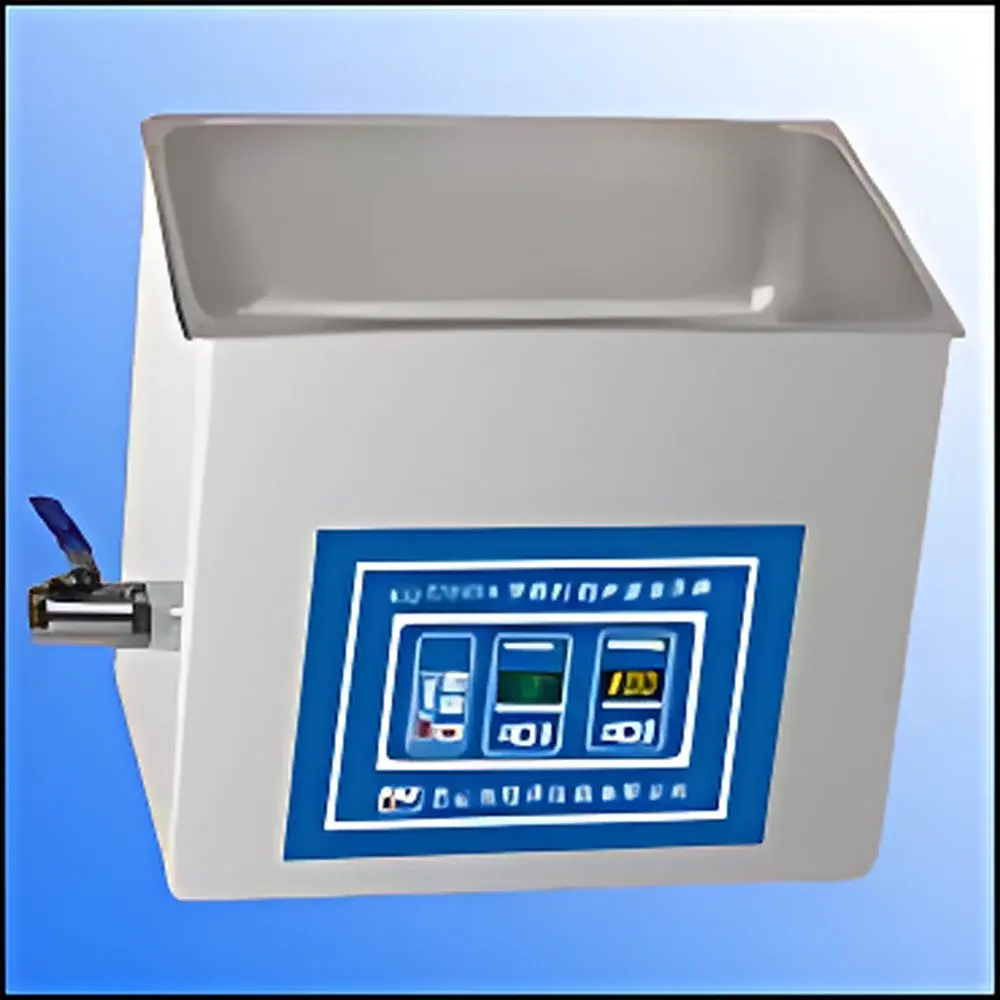
Shumei KQ-2200DB.DE.DV / KQ-3200DB.DE.DV Digital Ultrasonic Cleaner
| Brand | Shumei |
|---|---|
| Origin | Jiangsu, China |
| Model | KQ-2200DB.DE.DV / KQ-3200DB.DE.DV |
| Capacity | 3 L / 6 L |
| Ultrasonic Frequency | 40 kHz |
| Ultrasonic Power | 100 W / 150 W |
| Power Adjustment | Yes (40–100%) |
| Heating Power | 600 W |
| Temperature Range | 20–80 °C |
| Timer Range | 1–480 min |
| Lid with Sound Dampening | Yes |
| Drain Valve | Manual |
| Compliance | CE-marked design for laboratory use |
Overview
The Shumei KQ-2200DB.DE.DV and KQ-3200DB.DE.DV are benchtop digital ultrasonic cleaners engineered for precision cleaning, degassing, and sample preparation in regulated laboratory environments. These units operate on the principle of piezoelectric transduction: high-frequency electrical signals (40 kHz) drive ceramic transducers bonded to the stainless-steel tank base, generating controlled cavitation in aqueous or compatible solvent media. The resulting microbubble implosion delivers mechanical energy at the microscopic level—effectively removing particulate contaminants, organic residues, and adsorbed films from delicate instrumentation parts, glassware, surgical tools, semiconductor wafers, and biological substrates without abrasion or thermal degradation. Designed for reproducibility and operational safety, both models integrate a unified ultrasonic generator and tank assembly, minimizing signal loss and ensuring consistent energy distribution across the cleaning volume. Their compact footprint and modular control architecture make them suitable for QC labs, university research facilities, and GMP-compliant manufacturing support areas where trace-free surface integrity is critical.
Key Features
- Digital microprocessor control with dual LED displays for independent monitoring of ultrasonic duration (1–480 minutes) and heating temperature (20–80 °C)
- Adjustable ultrasonic power output (40–100% of rated power) to optimize cleaning intensity for sensitive samples or heavily soiled components
- Integrated 600 W heating system with PID temperature regulation, enabling controlled warm cleaning cycles that enhance detergent efficacy and reduce surface tension
- Acoustically damped hinged lid with sealing gasket to suppress airborne noise (≤55 dB(A) at 1 m) and minimize solvent evaporation during extended operation
- Stainless-steel 304 tank construction (KQ-2200: 230 × 140 × 100 mm; KQ-3200: 300 × 150 × 150 mm) with rounded corners for uniform cavitation field and easy decontamination
- Manual drain valve located at tank base for safe, residue-free fluid evacuation—compatible with waste solvent recovery protocols
- Overheat protection, timer auto-shutdown, and dry-run prevention circuitry aligned with IEC 61010-1 safety requirements
Sample Compatibility & Compliance
These cleaners accommodate a broad range of sample types—including borosilicate glassware, stainless-steel instruments, quartz cuvettes, MEMS devices, printed circuit boards, and polymer-based labware—provided compatibility with aqueous or low-volatility solvents (e.g., isopropanol, ethanol, or specialized ultrasonic detergents). The 40 kHz frequency balances penetration depth and cavitation density, making it appropriate for general-purpose cleaning rather than high-resolution nano-scale decontamination (which may require ≥80 kHz systems). Units conform to CE marking directives for electromagnetic compatibility (EMC Directive 2014/30/EU) and low-voltage safety (LVD Directive 2014/35/EU). While not certified to ISO 13485 or FDA 21 CFR Part 11 out-of-the-box, their deterministic timer and temperature logging capability supports GLP/GMP documentation when integrated into validated lab workflows using external audit-trail software.
Software & Data Management
The KQ-2200DB.DE.DV and KQ-3200DB.DE.DV operate via embedded firmware without proprietary PC software or USB connectivity. All operational parameters are set and retained locally via front-panel membrane keys and non-volatile memory—ensuring repeatable cycle execution without dependency on external computing infrastructure. For laboratories requiring electronic record retention, optional RS-232 or analog voltage outputs (available on select OEM variants) can interface with Lab Information Management Systems (LIMS) or programmable logic controllers (PLCs) for time-stamped cycle logging. Temperature and timer settings are manually recorded per batch, satisfying basic ALCOA+ data integrity principles when paired with standardized SOPs and operator training.
Applications
- Cleaning of HPLC vials, pipette tips, and electrophoresis combs prior to analytical use
- Removal of polishing compounds and metal fines from precision optics and metrology fixtures
- Preparation of TEM grids and AFM substrates for nanomaterial deposition
- Cell lysate homogenization and DNA shearing in molecular biology workflows
- Degassing of solvents prior to GC or LC mobile phase preparation
- Debonding of adhesive residues from reusable microfluidic chips
- Supporting ASTM D2621 (ultrasonic cleaning validation for automotive parts) and ISO 14971 risk management frameworks
FAQ
What is the recommended cleaning solution for routine laboratory use?
Aqueous alkaline detergent solutions (pH 9–11) at 40–60 °C are optimal for most organic and particulate contamination. Avoid chlorinated solvents, strong acids, or undiluted ethanol due to corrosion or flash-point risks.
Can these units be used for sterilization?
No. Ultrasonic cleaning removes bioburden but does not achieve sterility assurance levels (SAL ≤ 10⁻⁶). Post-cleaning autoclaving or chemical sterilization is required for sterile applications.
Is the heating function necessary for all cleaning tasks?
Not universally. Warm cleaning improves surfactant activity and reduces surface tension, but cold ultrasonication is preferred for heat-sensitive polymers or enzymatic residues.
How often should the tank solution be replaced?
Daily replacement is recommended for high-throughput labs; otherwise, change when turbidity increases, foaming diminishes, or cleaning efficiency declines—typically every 4–8 hours of cumulative operation.
Does the unit include a basket or rack?
Yes—a perforated stainless-steel mesh basket is supplied standard to suspend items above tank bottom, preventing direct contact with transducers and ensuring uniform exposure to acoustic energy.



