
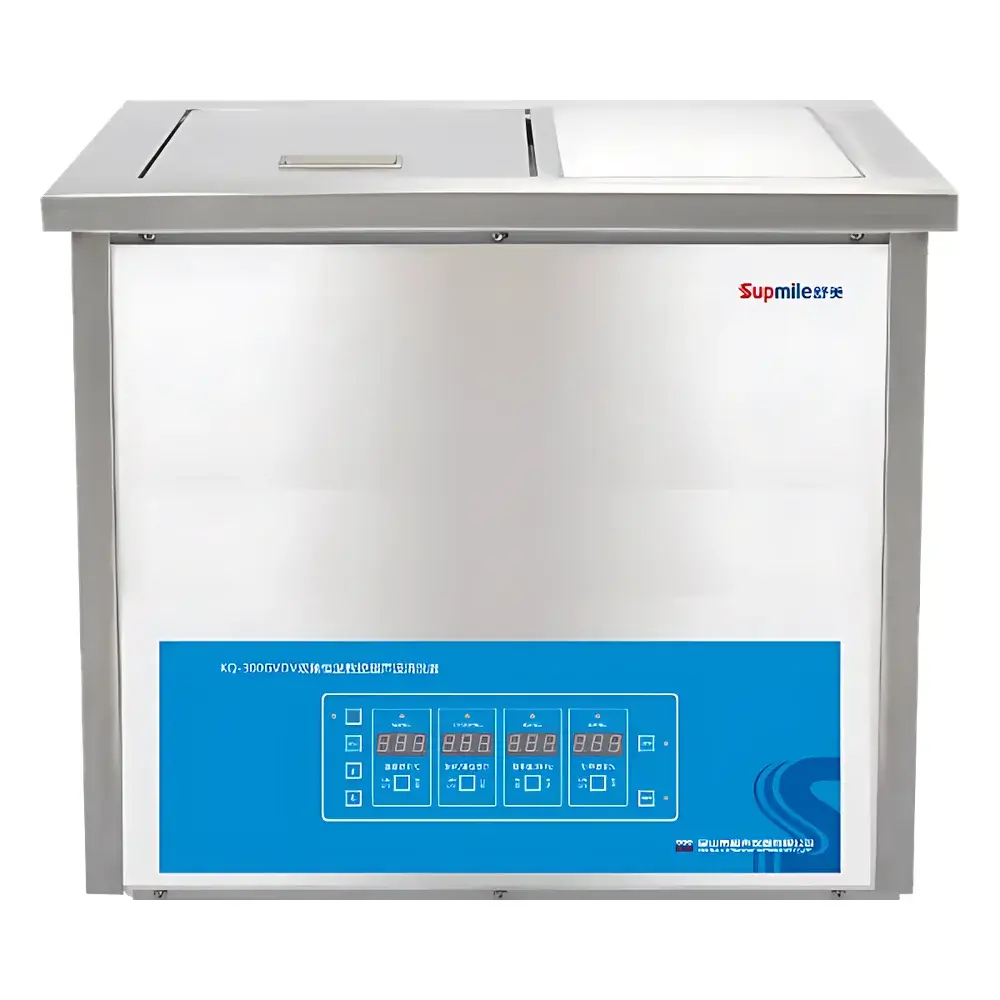
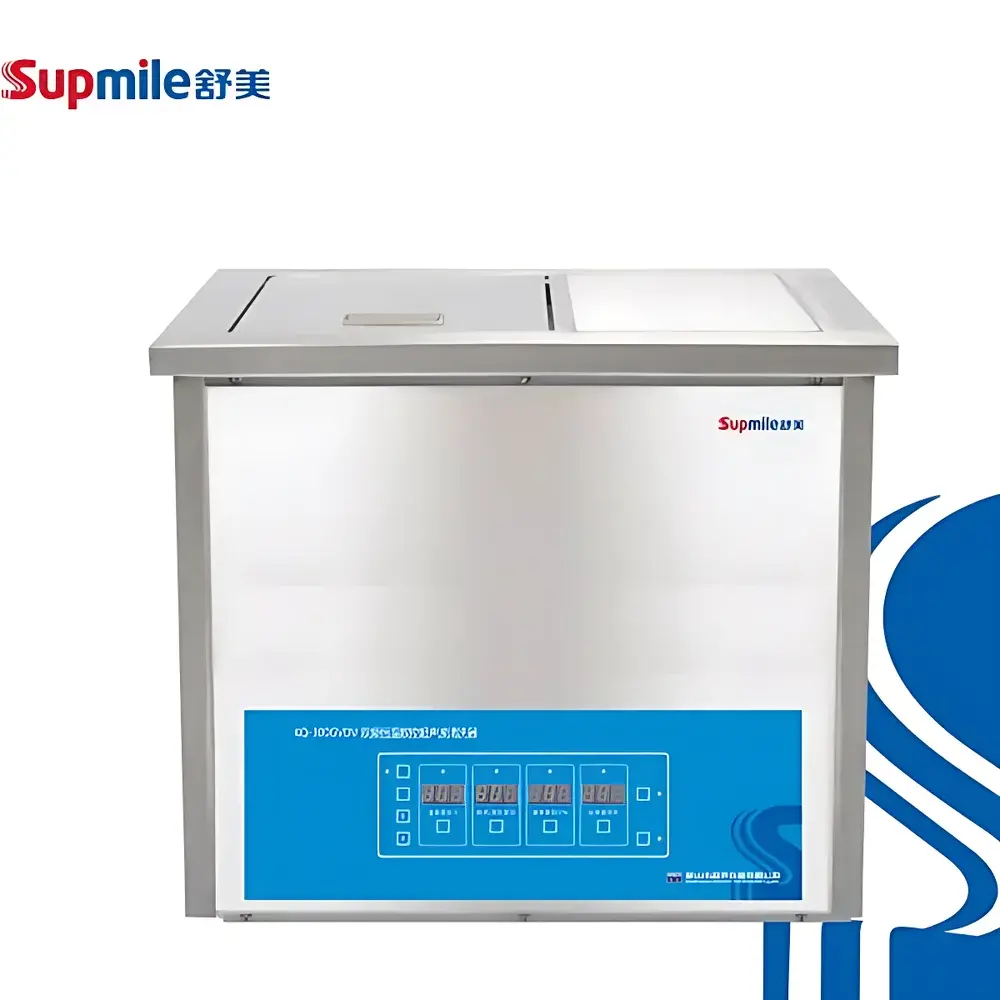
Shumei KQ-300GVDV Dual-Frequency Temperature-Controlled Digital Ultrasonic Cleaner
| Brand | Shumei |
|---|---|
| Origin | Jiangsu, China |
| Manufacturer Type | Direct Manufacturer |
| Instrument Type | General-Purpose Ultrasonic Cleaner |
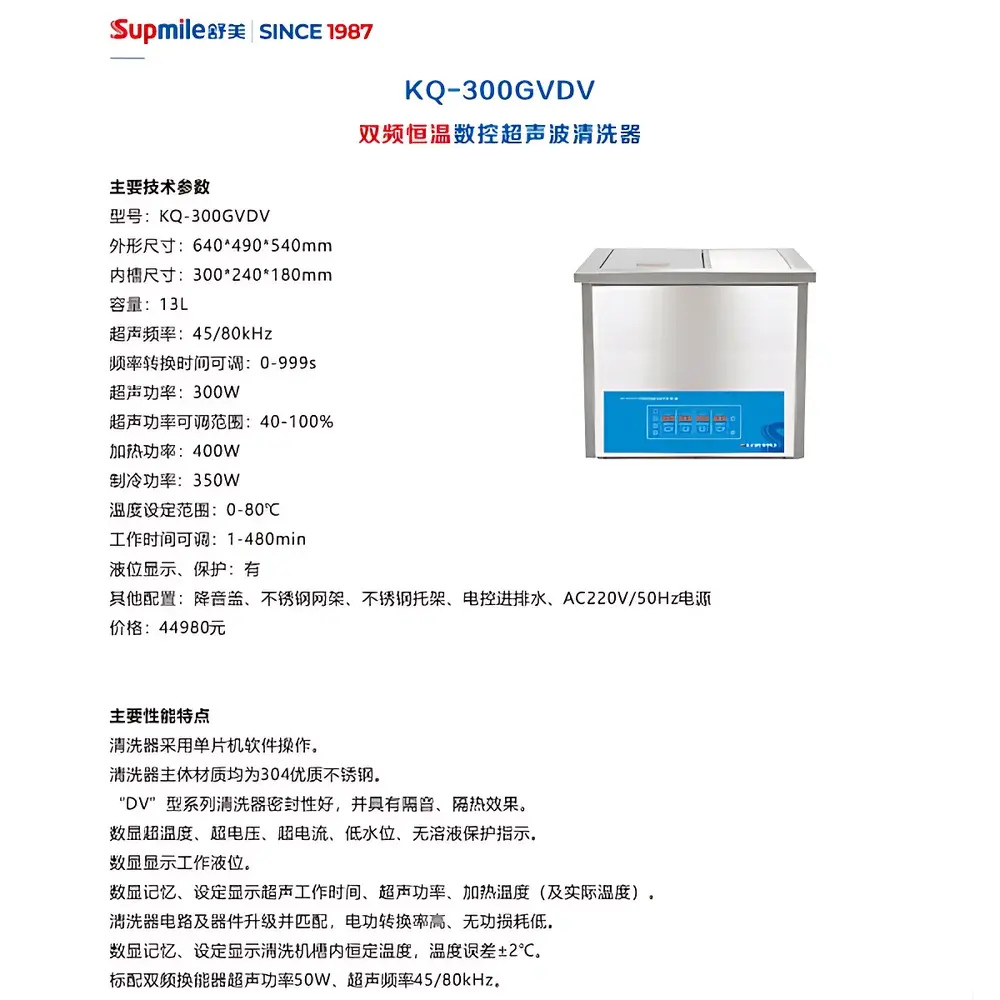
| Tank Capacity | 13 L |
| Ultrasonic Frequencies | 45 kHz / 80 kHz |
| Ultrasonic Power Output | 300 W |
| Power Adjustment Range | 40–100% |
| Temperature Control Range | 0–80 °C |
| Timer Range | 1–480 min |
| Sound-Dampening Lid | Included |
| Automatic Fill/Drain | Electrically Controlled |
Overview
The Shumei KQ-300GVDV is a dual-frequency, digitally controlled ultrasonic cleaner engineered for precision cleaning of delicate laboratory components, optical elements, microfluidic devices, and analytical instrumentation parts. It operates on the principle of cavitation—generating high-intensity acoustic pressure waves in liquid media to dislodge particulate contaminants, organic residues, and biofilms from surfaces. The dual-frequency capability (45 kHz and 80 kHz) enables selective optimization: lower frequency delivers higher energy for robust particle removal from coarse or heavily soiled substrates, while the higher frequency provides finer, more uniform cavitation for sensitive samples such as semiconductor wafers, HPLC columns, or MEMS devices. Integrated temperature control (0–80 °C) enhances cleaning efficacy by accelerating solvent activity and reducing surface tension, particularly critical when using aqueous or mild detergent-based solutions. All internal tank surfaces are constructed from AISI 304 stainless steel, ensuring corrosion resistance, chemical compatibility with common lab solvents (e.g., isopropanol, ethanol, alkaline detergents), and long-term structural integrity under repeated thermal cycling.
Key Features
- Dual-frequency ultrasonic generation (45 kHz and 80 kHz) with user-selectable frequency switching and adjustable dwell time per frequency (0–999 s)
- Digital microcontroller-based operation with real-time display of set and actual values for temperature, ultrasonic power (%), elapsed time, and liquid level
- Precise temperature regulation via integrated heating (400 W) and active cooling (350 W), maintaining ±2 °C stability across the full 0–80 °C range
- Adjustable ultrasonic power output (40–100% of 300 W nominal), enabling process optimization for fragile vs. rugged sample types
- Electrically actuated fill-and-drain system with automatic low-level cutoff and overflow protection
- Acoustically insulated lid with ergonomic latch mechanism, reducing ambient noise to <65 dB(A) at 1 m distance
- Comprehensive safety monitoring: over-temperature, over-current, over-voltage, dry-run, and low-liquid-level detection with visual alarm indicators
- Stainless steel mesh basket and support tray included as standard accessories
Sample Compatibility & Compliance
The KQ-300GVDV accommodates a broad spectrum of laboratory sample formats—including glassware (vials, cuvettes, pipette tips), metal components (syringe needles, filters, sensor housings), ceramic substrates, and polymer-based microdevices—within its 300 × 240 × 180 mm (L × W × H) stainless steel tank. Its design conforms to general safety requirements outlined in IEC 61010-1 for electrical equipment used in laboratory environments. While not certified to ISO 13485 or FDA 21 CFR Part 11 out-of-the-box, the device supports GLP/GMP-aligned workflows through deterministic parameter logging (time-stamped temperature, power, and duration settings), repeatable program recall, and non-volatile memory retention of up to 10 user-defined cleaning protocols. It is suitable for use in QC laboratories performing ASTM D2616-compliant cleaning validation studies and meets baseline mechanical reliability standards expected in ISO/IEC 17025-accredited facilities.
Software & Data Management
The KQ-300GVDV features an embedded digital control interface with no external PC dependency. All operational parameters—including frequency selection, power level, temperature setpoint, timer duration, and frequency-switching interval—are stored in non-volatile memory and retained after power cycle. The unit records the last 20 cleaning cycles with timestamps, allowing manual audit trail reconstruction. Although it lacks USB or Ethernet connectivity, its deterministic digital control architecture ensures protocol reproducibility—a prerequisite for method transfer between instruments and inter-laboratory comparability. For integration into validated cleaning SOPs, users may document parameter settings and cycle logs manually or via external LIMS interfaces using standardized metadata templates (e.g., “Temp_Set=65°C; Power=75%; Time=180s; Freq=80kHz”).
Applications
- Cleaning of HPLC, GC, and IC sample vials and autosampler components prior to trace-level analysis
- Preparation of TEM/SEM grids and electron microscopy specimens requiring particle-free surfaces
- Removal of photoresist residue and etch byproducts from silicon wafers and mask blanks
- Decontamination of reusable surgical instruments and dental tools in research-grade biosafety labs
- Routine maintenance of viscometers, rheometers, and particle size analyzers with removable flow cells
- Surface activation of PDMS chips and microfluidic devices prior to plasma bonding or surface functionalization
FAQ
What is the maximum recommended operating temperature for aqueous cleaning solutions?
The unit supports stable operation up to 80 °C; however, for aqueous solutions containing volatile organics or surfactants, we recommend limiting temperature to ≤65 °C to minimize evaporation and foam formation.
Can the KQ-300GVDV be used with flammable solvents?
No. This model is not explosion-proof and must not be operated with flammable solvents such as acetone, ether, or hexane without additional engineering controls (e.g., inert gas purging, external ventilation)—which are outside its certified scope.
Is calibration documentation available for temperature and timer functions?
Factory calibration certificates for temperature sensor accuracy (±2 °C) and timer linearity (±0.5%) can be provided upon request at time of purchase; field recalibration requires certified metrology service.
How often should the ultrasonic transducers be inspected for performance degradation?
We recommend quarterly verification of cavitation intensity using aluminum foil test or hydrophone-based mapping, especially after >500 hours of cumulative operation or following exposure to highly corrosive cleaning agents.
Does the unit meet CE or UL safety certification requirements?
The KQ-300GVDV complies with GB 4793.1–2007 (China’s equivalent to IEC 61010-1); CE marking is not applied, and UL listing is not available. Customers requiring CE/UL must consult local regulatory representatives for conformity assessment pathways.



