
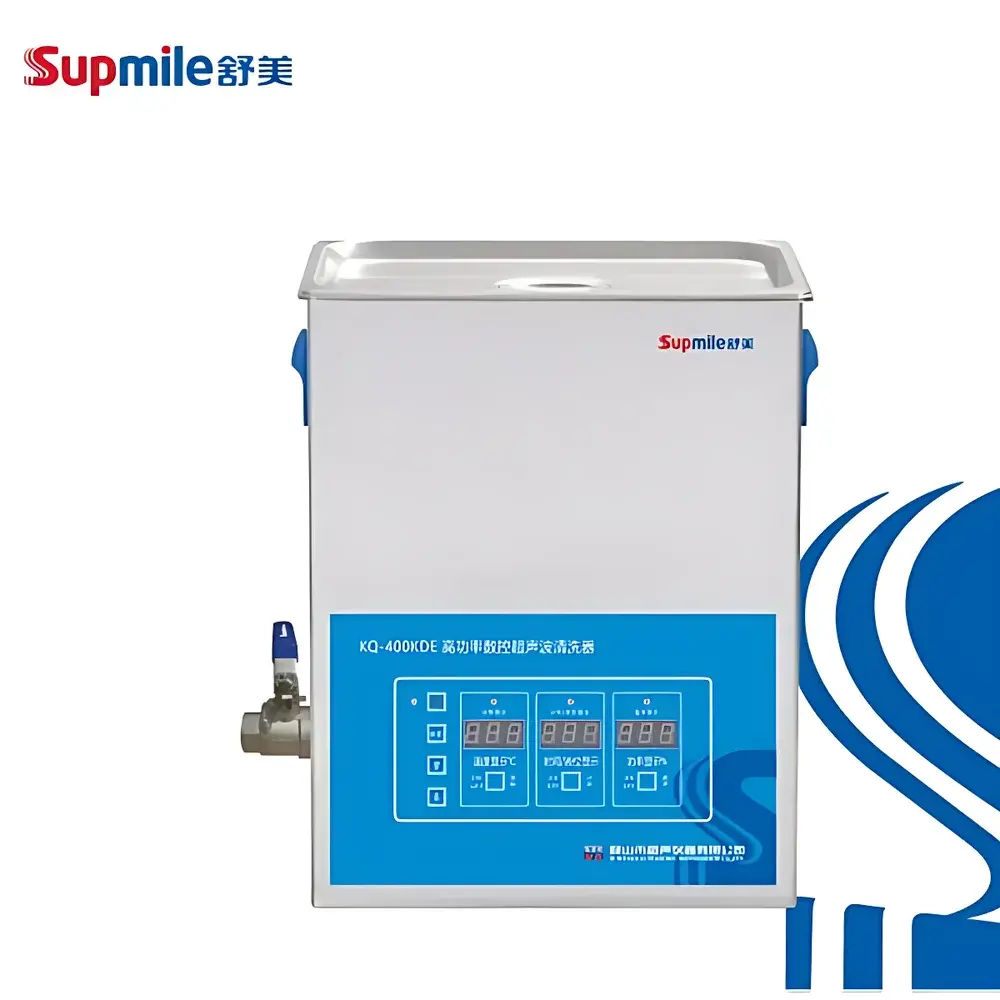
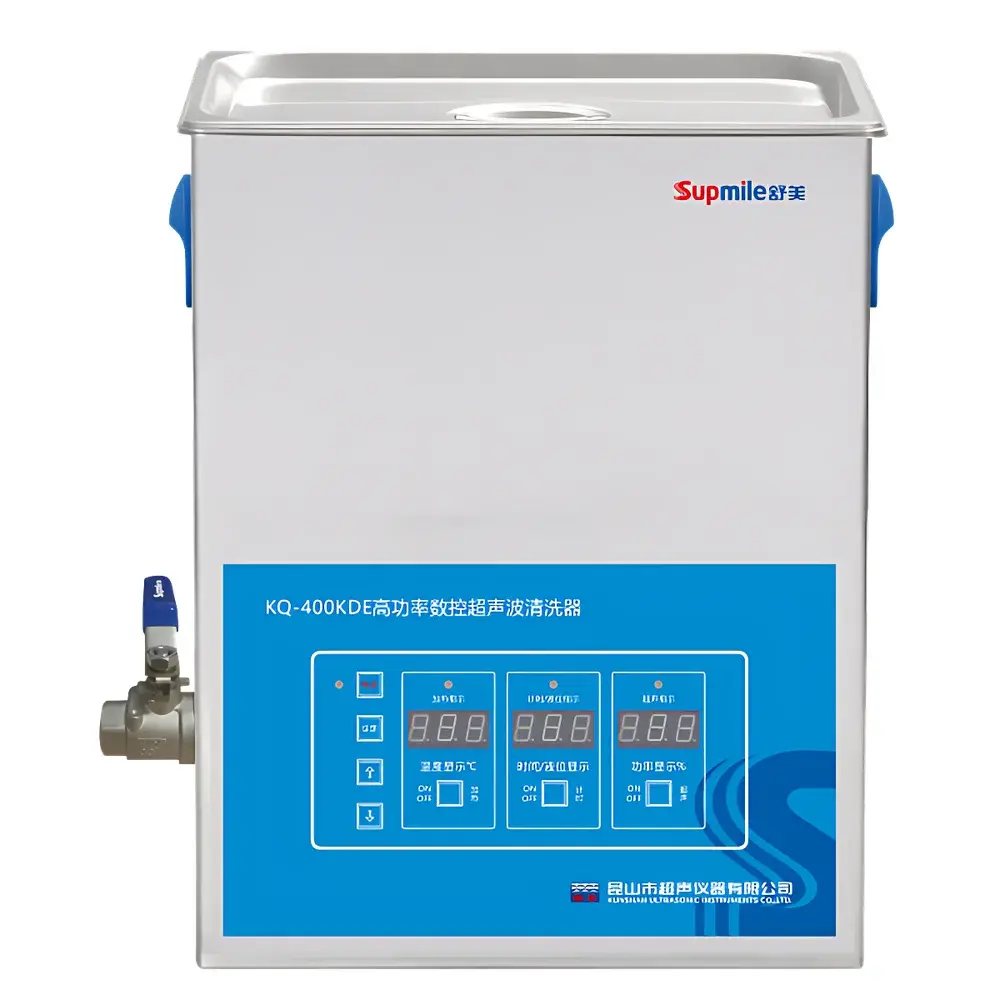
Shumei KQ-400KDE Benchtop High-Power Digital Ultrasonic Cleaner
| Brand | Shumei |
|---|---|
| Origin | Jiangsu, China |
| Manufacturer Type | Direct Manufacturer |
| Instrument Type | General-Purpose Ultrasonic Cleaner |
| Tank Capacity | 10 L |
| Ultrasonic Frequency | 40 kHz |
| Ultrasonic Power Output | 400 W |
| Power Adjustment Range | 40–100% |
| Heating Power | 400 W |
| Temperature Control Range | Ambient to 80 °C |
| Timer Range | 1–480 min |
| Sound-Dampening Lid | Included |
| Drain/Inlet | Manual Valve |
| Input Voltage | AC 220 V / 50 Hz |
| Tank Material | 304 Stainless Steel |
| Safety Protections | Low-Level Liquid Detection, Over-Temperature, Over-Voltage, Over-Current, Empty-Tank Auto-Shutoff |
| Display | Digital LED (Time, Power %, Temp Set/Actual, Water Level Indicator) |
| Standard Accessories | Stainless Steel Mesh Basket, Stainless Steel Rack, Sound-Dampening Lid |
Overview
The Shumei KQ-400KDE is a benchtop digital ultrasonic cleaner engineered for precision cleaning of delicate laboratory components—including glassware, pipette tips, filtration membranes, optical lenses, microfluidic chips, and precision metal parts—under controlled acoustic cavitation conditions. It operates on the principle of piezoelectric transduction at a fixed frequency of 40 kHz, generating uniform cavitation fields within the stainless steel tank to remove particulate contaminants, organic residues, and weakly adhered biofilms without mechanical abrasion. Its 400 W nominal ultrasonic output—adjustable from 40% to 100%—enables process optimization across diverse sample types and soil loadings. Integrated resistive heating (400 W) supports temperature-assisted cleaning protocols up to 80 °C, enhancing solubilization kinetics for waxy, greasy, or polymerized residues. Designed for routine QC/QA, R&D, and preparatory workflows in analytical, pharmaceutical, and materials science laboratories, the KQ-400KDE complies with general electrical safety requirements per IEC 61010-1 and incorporates fail-safe interlocks aligned with GLP-aligned operational integrity.
Key Features
- Benchtop footprint (325 × 265 × 375 mm) with 10 L capacity tank (300 × 240 × 150 mm internal dimensions) optimized for high-volume batch processing
- Digital microcontroller-based interface with real-time LED display of set/actual temperature, elapsed time, power level (%), and liquid level status
- Multi-layer safety architecture: automatic shutoff on low water level, over-temperature (>82 °C), over-voltage (>242 V), over-current, and dry-run detection
- High-efficiency piezoelectric transducer array mounted directly to the tank bottom, delivering consistent energy distribution and minimizing standing-wave artifacts
- 304 stainless steel construction throughout wetted surfaces—tank, lid, basket, and rack—for corrosion resistance and cleanroom-compatible durability
- Sound-dampening hinged lid reduces ambient noise to ≤65 dB(A) at 1 m distance, meeting ISO 15710 occupational exposure guidelines for continuous lab operation
- Manual inlet and drain valves enable flexible integration into lab water management systems without reliance on permanent plumbing
Sample Compatibility & Compliance
The KQ-400KDE accommodates a broad range of substrates including borosilicate glass, fused silica, anodized aluminum, titanium alloys, silicon wafers, and PTFE-coated tools. Its non-aggressive cleaning mechanism preserves dimensional tolerances and surface finish integrity—critical for calibration standards, reference materials, and metrology-grade components. While not certified to specific ISO 13485 or FDA 21 CFR Part 11 requirements as a standalone device, its programmable parameters (time, temperature, power), audit-ready digital logs (via optional RS232/USB data export), and deterministic process repeatability support validation under ISO 17025-accredited quality systems. The unit meets CE marking directives for electromagnetic compatibility (EMC Directive 2014/30/EU) and low-voltage safety (LVD Directive 2014/35/EU).
Software & Data Management
The embedded firmware supports parameter retention across power cycles, enabling reproducible method recall without reconfiguration. All user-defined settings—including timer duration, power percentage, and target temperature—are stored in non-volatile memory. Optional serial communication (RS232) allows remote triggering and timestamped parameter logging into LIMS or ELN platforms. While no proprietary PC software is bundled, ASCII-formatted output enables straightforward parsing for CSV-based traceability records required under GMP Annex 11 or USP analytical instrument qualification frameworks.
Applications
- Pretreatment of HPLC vials, autosampler needles, and flow-cell components prior to chromatographic analysis
- Decontamination of reusable surgical instruments and endoscopic accessories in research animal facilities
- Cleaning of electron microscopy grids, TEM sample holders, and AFM cantilevers prior to imaging
- Removal of photoresist residuals and etch byproducts from semiconductor wafers during process development
- Preparation of ceramic and metallic dental prostheses for bonding surface characterization
- Routine maintenance of viscometers, densitometers, and refractometer prisms in physical testing labs
FAQ
Is the ultrasonic frequency adjustable?
No—the KQ-400KDE operates exclusively at 40 kHz, a frequency selected for optimal balance between cavitation intensity and penetration depth in aqueous and mild solvent-based media.
Can this unit be used with flammable solvents?
Not recommended. The heater and electronic controls are not explosion-proof; only water-based detergents or non-flammable, low-volatility cleaning solutions (e.g., isopropanol/water blends below 40% v/v) should be used.
What is the warranty coverage?
Shumei provides a standard 12-month limited warranty covering parts and labor for defects in materials and workmanship under normal laboratory use.
Does it support continuous operation mode?
Yes—when the timer is set to maximum (480 min), the unit will run uninterrupted until manually stopped or interrupted by a safety event.
How often should the transducers be serviced?
Under typical usage (≤4 hrs/day), no scheduled transducer maintenance is required; however, visual inspection of tank bottom adhesion and periodic performance verification using aluminum foil test (ASTM D2603-19 Annex A1) is advised quarterly.



