
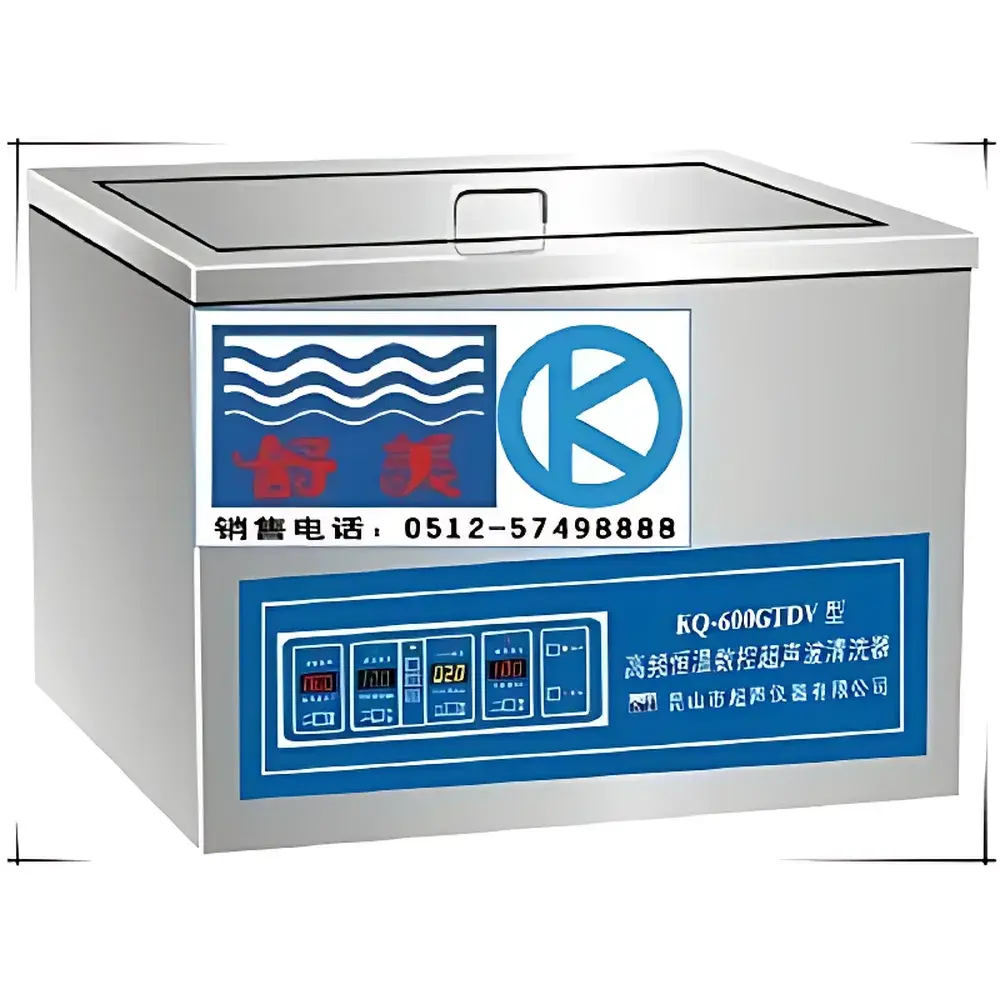
Shumei KQ-600GTDV Desktop High-Frequency Temperature-Controlled Ultrasonic Cleaner
| Brand | Shumei |
|---|---|
| Origin | Jiangsu, China |
| Manufacturer Type | Direct Manufacturer |
| Model | KQ-600GTDV |
| Dimensions (W×D×H) | 840×410×400 mm |
| Tank Internal Dimensions | 500×300×180 mm |
| Tank Capacity | 27 L |
| Ultrasonic Frequency | 80 kHz |
| Ultrasonic Power Output | 600 W |
| Power Adjustment Range | 40–100 % |
| Heating Power | 800 W |
| Refrigeration Power | 350 W |
| Temperature Control Range | 0–80 °C |
| Timer Range | 1–480 min |
| Cumulative Operating Time Counter | Up to 999,999 h |
| Liquid Level Detection Range | 1–140 mm |
| Construction | Stainless Steel Tank & Housing |
| Optional Frequencies | 50 / 60 / 70 / 100 kHz |
| Features | Automatic Water Inlet/Drain, Vapor Recovery System, Acoustic Lid, Microcontroller-Based Control System |
Overview
The Shumei KQ-600GTDV is a desktop high-frequency temperature-controlled ultrasonic cleaner engineered for precision laboratory and industrial cleaning applications where thermal stability, acoustic consistency, and process repeatability are critical. Unlike conventional ultrasonic cleaners that rely solely on passive heat dissipation or intermittent heating, the KQ-600GTDV integrates active dual-mode thermal regulation—switching automatically between electric heating (800 W) and thermoelectric or compressor-based refrigeration (350 W)—to maintain solution temperature within ±0.5 °C across extended operational cycles. This closed-loop thermal control eliminates drift-induced cavitation instability, ensuring consistent energy transfer to the cleaning medium. Operating at a fixed 80 kHz frequency, the unit delivers high-density, low-cavitation-threshold ultrasound ideal for delicate substrates and sub-micron contaminant removal. Its monolithic design integrates transducer array, tank, and control electronics into a single compact chassis, minimizing mechanical coupling losses and enhancing acoustic efficiency.
Key Features
- Integrated dual-mode thermal management system enabling stable temperature maintenance from 0–80 °C during continuous ultrasonic operation
- Microprocessor-controlled interface with real-time digital display of liquid level (1–140 mm), actual and setpoint temperature, elapsed time, cumulative operating hours (up to 999,999 h), and power output (40–100 %)
- Stainless steel tank (500 × 300 × 180 mm internal) and housing fabricated from corrosion-resistant 304 stainless steel; seamless deep-drawn construction ensures structural integrity and long-term chemical compatibility
- Acoustic lid with integrated vapor recovery system to minimize solvent loss and reduce ambient exposure to volatile organic compounds (VOCs)
- Automated water inlet and drain valves controlled via pressure-sensing logic, eliminating manual filling errors and improving workflow safety
- Over-current, over-voltage, low-level, and dry-run protection circuits compliant with IEC 61000-6-2 electromagnetic compatibility standards
- Optional frequency configuration available (50 / 60 / 70 / 100 kHz) to match application-specific requirements for particle detachment, emulsification, or cell lysis
Sample Compatibility & Compliance
The KQ-600GTDV supports a wide range of sample types including glassware, metal components, semiconductor wafers, optical lenses, medical instruments, and biological tissue carriers. Its 27 L capacity and precise liquid-level sensing accommodate both immersion-only and basket-supported configurations. The system meets ISO 13485 design control principles for medical device cleaning validation and aligns with ASTM D2603 (Standard Test Method for Sonic Shear Stability of Lubricants) for performance benchmarking. All electrical subsystems conform to CE marking requirements under the Low Voltage Directive (2014/35/EU) and EMC Directive (2014/30/EU). The microcontroller firmware implements non-volatile parameter storage with timestamped event logging, supporting GLP-compliant audit trails when used in regulated environments.
Software & Data Management
While the KQ-600GTDV operates as a standalone instrument, its embedded microcontroller records and retains all user-defined parameters—including temperature setpoints, power levels, timer values, and cumulative runtime—in non-volatile memory. Each operational cycle generates a local log entry with date/time stamp, duration, and thermal deviation metrics. Optional RS-232 or USB-to-serial interface modules enable external data acquisition for integration into LIMS or MES platforms. The firmware architecture supports firmware updates via secure bootloader protocol and includes built-in diagnostics for transducer impedance monitoring and thermal sensor calibration verification—critical for maintaining traceability under FDA 21 CFR Part 11 requirements when paired with appropriate electronic signature controls.
Applications
- Precision cleaning of analytical instrumentation components (HPLC injectors, GC liners, mass spectrometer ion sources)
- Decontamination of surgical tools and endoscopic accessories prior to sterilization
- Removal of photoresist residues and particulate contaminants from silicon wafers and MEMS devices
- Cell disruption and homogenization in preparative biochemistry workflows
- Accelerated solvent extraction of plant metabolites and environmental analytes
- Degassing of viscous solvents prior to chromatographic analysis or coating processes
- Dispersing nanomaterials and stabilizing colloidal suspensions for material science research
FAQ
What is the purpose of the dual heating/refrigeration system?
It actively maintains bath temperature within ±0.5 °C during prolonged ultrasonic operation—preventing thermal runaway and preserving cavitation intensity and reproducibility.
Can the unit operate continuously for more than 8 hours?
Yes; the cumulative timer supports up to 999,999 hours, and thermal regulation enables uninterrupted operation at full 600 W output without exceeding 80 °C.
Is the stainless steel tank compatible with aggressive solvents such as acetone or chlorinated hydrocarbons?
The 304 stainless steel construction resists corrosion from most common organic solvents; however, prolonged exposure to halogenated solvents requires verification per ASTM G150 and may necessitate optional passivation.
Does the system support automated validation protocols for regulated labs?
It provides timestamped operational logs and parameter retention suitable for IQ/OQ documentation; full 21 CFR Part 11 compliance requires integration with validated third-party software and access control infrastructure.
How does the liquid-level sensing improve cleaning consistency?
Real-time level detection ensures optimal transducer coupling and acoustic field uniformity—deviations outside the 1–140 mm range trigger automatic shutdown to prevent transducer damage and inconsistent cavitation.



