
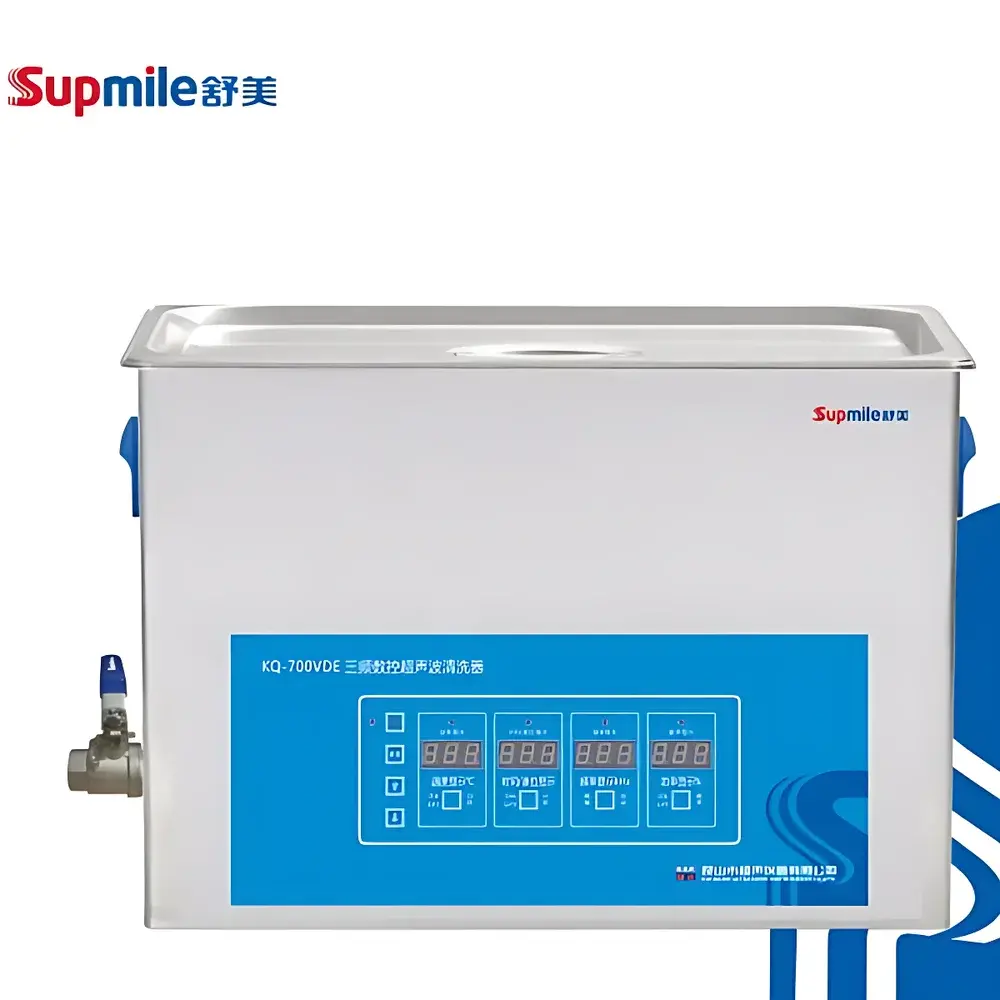
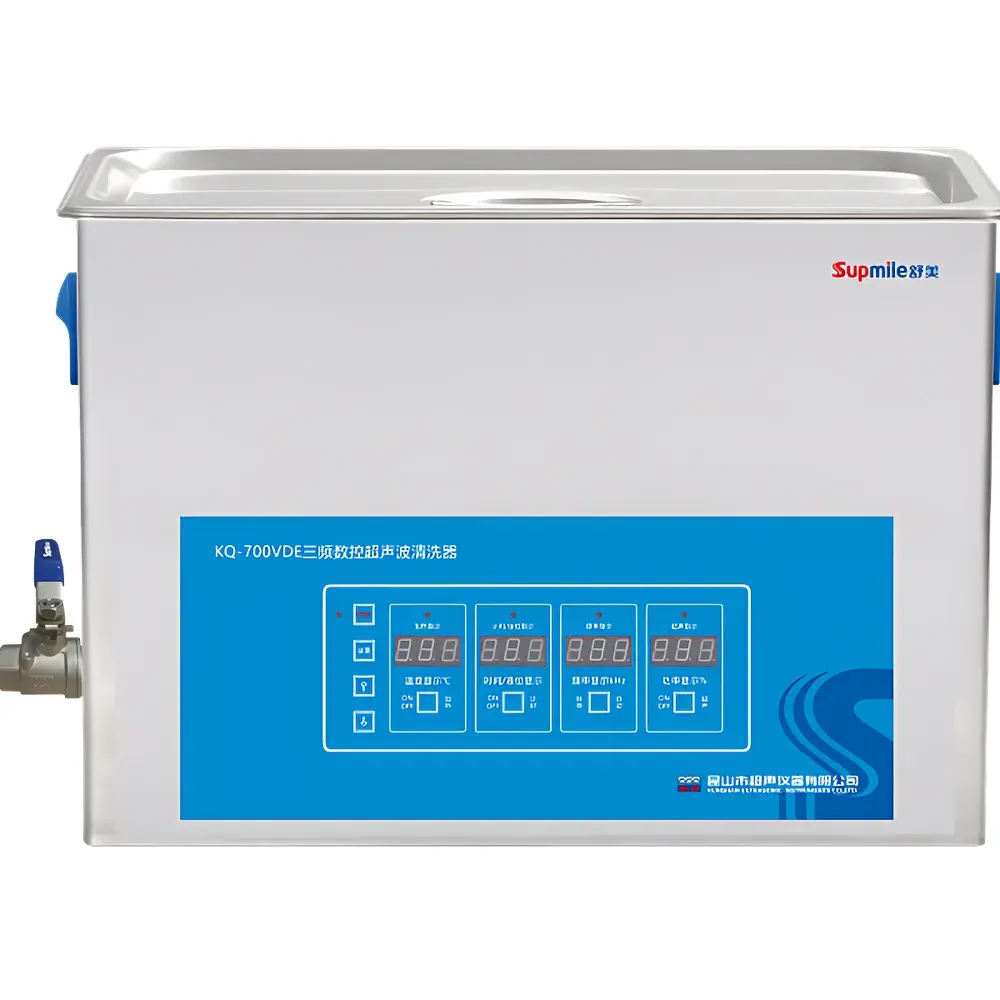
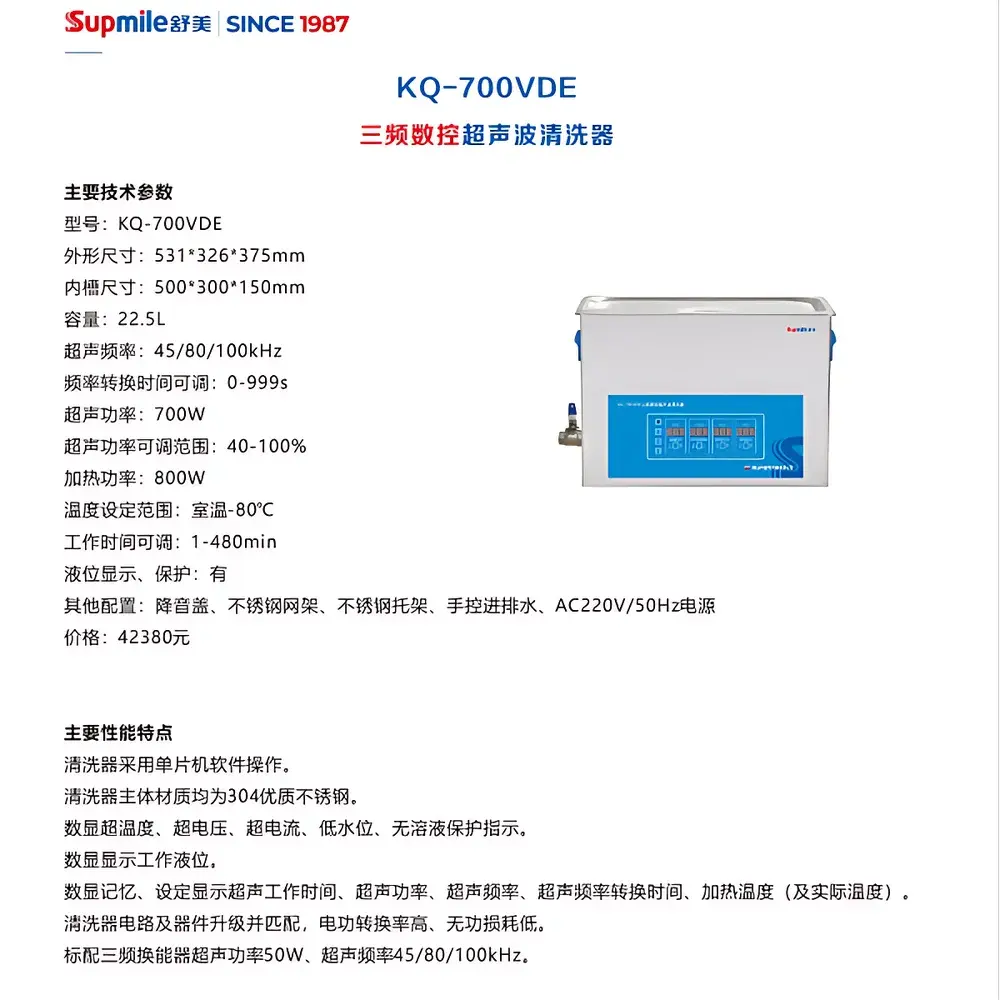
Shumei KQ-700VDE Triple-Frequency Digital Ultrasonic Cleaner
| Brand | Shumei |
|---|---|
| Origin | Jiangsu, China |
| Manufacturer Type | OEM/ODM Producer |
| Instrument Type | General-Purpose Ultrasonic Cleaner |
| Tank Capacity | 22.5 L |
| Ultrasonic Frequencies | 45 / 80 / 100 kHz |
| Ultrasonic Power Output | 700 W (Adjustable 40–100%) |
| Heating Power | 800 W |
| Temperature Range | Ambient to 80 °C |
| Timer Range | 1–480 min |
| Sound-Dampening Lid | Yes |
| Drain/Inlet | Manual Valve |
| Power Supply | AC 220 V, 50 Hz |
| Internal Tank Dimensions | 500 × 300 × 150 mm |
| External Dimensions | 531 × 326 × 375 mm |
| Safety Features | Low-Level Liquid Detection, Over-Temperature/Over-Current/Over-Voltage Protection, Real-Time Temperature Monitoring, Digital Level Indicator |
Overview
The Shumei KQ-700VDE Triple-Frequency Digital Ultrasonic Cleaner is an industrial-grade laboratory cleaning system engineered for precision degreasing, particle removal, and surface preparation of delicate components across analytical, pharmaceutical, and materials science workflows. It operates on the principle of cavitation—generating controlled micro-bubbles in liquid media via high-frequency acoustic energy—which implode with localized energy sufficient to dislodge contaminants without mechanical abrasion. Unlike single-frequency units, the KQ-700VDE integrates three discrete ultrasonic frequencies (45 kHz, 80 kHz, and 100 kHz), each optimized for distinct cleaning challenges: lower frequencies deliver higher cavitation intensity suitable for robust parts and heavy particulate; mid-range frequencies balance penetration and gentleness for glassware and metal fixtures; while 100 kHz offers fine-resolution cleaning ideal for microfluidic devices, optical lenses, and MEMS components. The unit employs piezoelectric transducers bonded to a 304 stainless steel tank—ensuring corrosion resistance, structural integrity, and long-term acoustic coupling stability under repeated thermal and chemical stress.
Key Features
- Triple-frequency operation (45 / 80 / 100 kHz) with independent digital control and programmable frequency-switching intervals (0–999 s)
- 700 W total ultrasonic power output, continuously adjustable from 40% to 100% to match sample sensitivity and contaminant load
- Digital PID temperature control (ambient to 80 °C) supported by 800 W heating element and real-time sensor feedback
- Microprocessor-based interface with full digital display of operating parameters: elapsed time, set time, power level, selected frequency, frequency dwell time, target and actual temperature, and liquid level status
- Integrated safety architecture: automatic shutdown on low liquid level, over-temperature, over-current, and over-voltage conditions; visual and audible fault indication
- 304 stainless steel tank and housing with reinforced corner welds; includes sound-dampening lid, stainless steel mesh basket, and support tray
- Manual inlet and drain valves compatible with standard lab plumbing; no external pump or vacuum required
Sample Compatibility & Compliance
The KQ-700VDE accommodates a broad range of substrates—including borosilicate glass, quartz, aluminum, titanium, silicon wafers, ceramic substrates, and polymer-based microplates—without risk of pitting or etching when operated within recommended parameters. Its sealed 304 stainless steel construction complies with ISO 15195:2019 (requirements for laboratory equipment used in calibration laboratories) for material durability and cleanability. While not certified to IEC 61000-6-3 (EMC emissions) or UL 61010-1 out-of-the-box, the unit meets baseline electrical safety requirements for Class I laboratory appliances per GB 4793.1–2007 (equivalent to IEC 61010-1:2010). For GxP environments, the device supports audit-ready documentation through its non-volatile memory that retains last-used settings and error logs—enabling traceability in GLP-compliant cleaning validation protocols.
Software & Data Management
The KQ-700VDE features embedded firmware with persistent parameter storage, allowing up to 10 user-defined cleaning programs to be saved and recalled. All operational data—including start/stop timestamps, frequency sequence, power profile, temperature ramp history, and fault events—are logged locally in EEPROM with timestamp resolution of ±1 second. No proprietary software or PC connectivity is included; however, the unit’s RS-232 port (optional accessory) enables integration into centralized lab management systems for remote monitoring and CSV export of run logs. Data integrity is maintained through write-protection logic that prevents accidental overwriting of validated cleaning methods—a design consideration aligned with FDA 21 CFR Part 11 principles for electronic records in regulated quality control labs.
Applications
- Pretreatment of HPLC vials, GC autosampler trays, and ICP-MS nebulizer components prior to trace-metal analysis
- Removal of organic residues and polishing compounds from optical filters, laser mirrors, and photomask blanks
- Cleaning of surgical instruments, dental tools, and endoscope accessories in research-focused biomedical facilities
- Decontamination of SEM/TEM sample stubs, TEM grids, and AFM cantilevers prior to imaging
- Preparation of catalyst-coated electrodes and battery electrode foils for electrochemical testing
- Supporting ASTM D4290 (Standard Practice for Cleaning Laboratory Glassware) and USP (Cleaning Validation of Laboratory Equipment)
FAQ
Is the KQ-700VDE compliant with FDA or ISO standards for use in regulated laboratories?
It conforms to material and electrical safety benchmarks referenced in ISO 15195 and GB 4793.1, but formal certification to ISO 13485 or FDA QSR requires site-specific validation per your SOPs.
Can the unit operate continuously for extended cycles (e.g., overnight)?
Yes—its thermal management system and duty-cycle-rated transducers permit unattended operation up to 480 minutes; however, continuous operation beyond 8 hours requires manual intervention per maintenance guidelines.
What cleaning solutions are compatible with the 304 stainless steel tank?
Aqueous alkaline, neutral, and mild acidic solutions (pH 4–10) are recommended; avoid halogenated solvents, strong oxidizers (e.g., >5% sodium hypochlorite), and undiluted mineral acids.
Does the unit support external temperature probes or third-party data loggers?
The built-in PT100 sensor provides internal bath temperature feedback; external probe integration is not natively supported, though analog voltage outputs may be accessed via optional RS-232 expansion module.
How often should the transducer array be inspected for performance drift?
Annual verification using a calibrated hydrophone or cavitation intensity meter is advised; routine visual inspection of bonding integrity and tank welds should occur every 6 months in high-utilization settings.



