
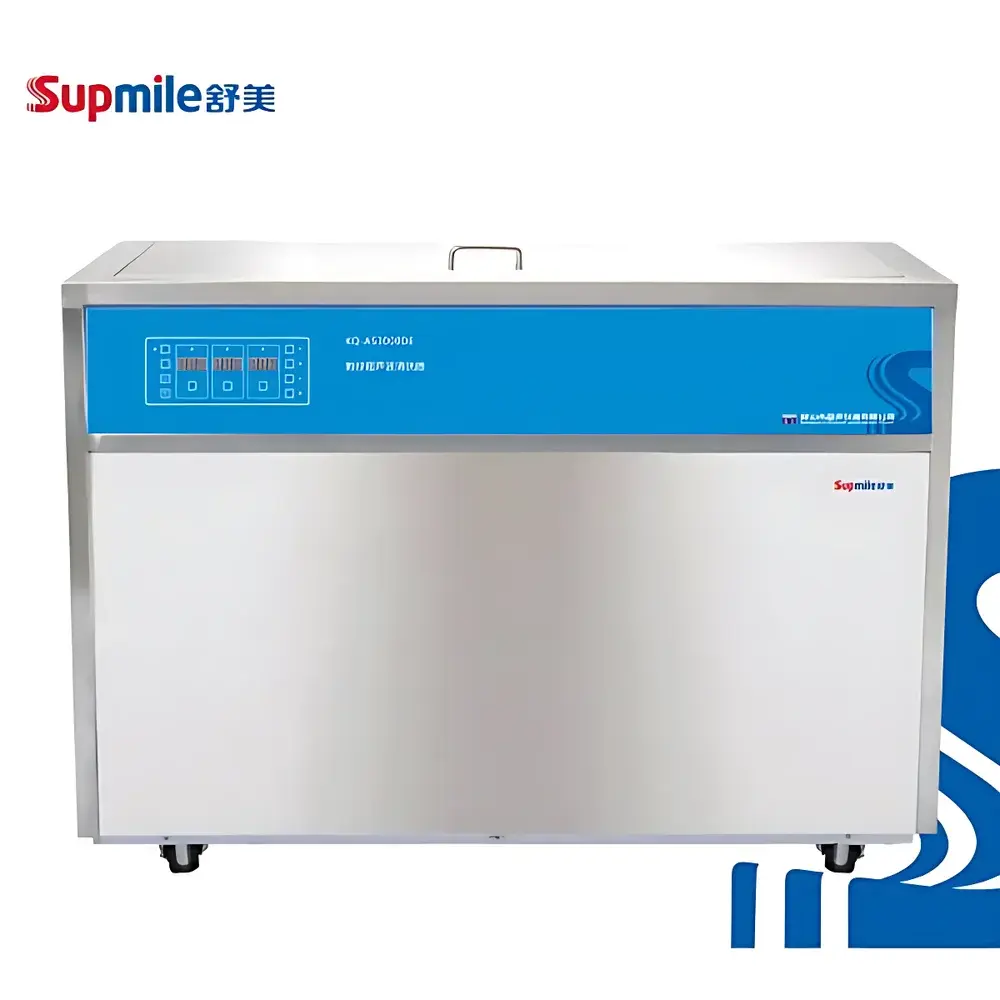
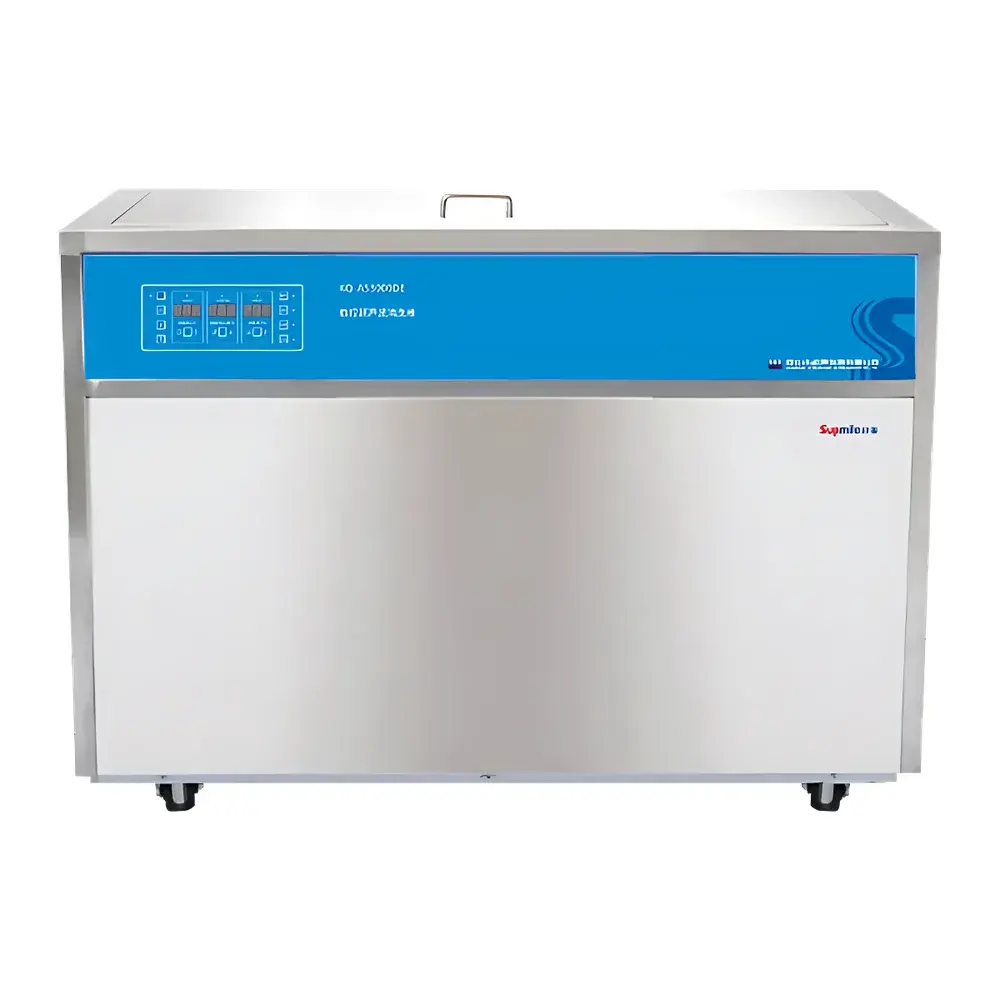
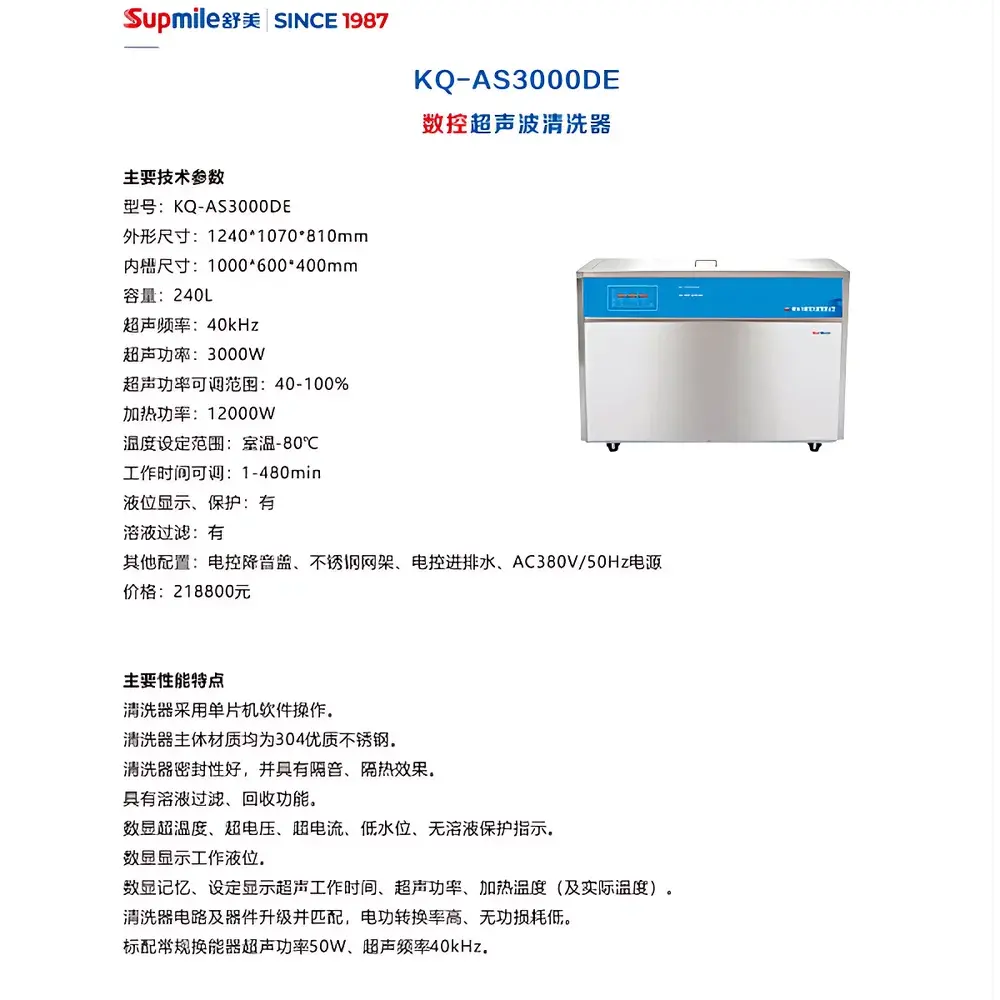
Shumei KQ-AS3000DE Digital Ultrasonic Cleaner
| Brand | Shumei |
|---|---|
| Origin | Jiangsu, China |
| Manufacturer Type | Direct Manufacturer |
| Equipment Type | General-Purpose Ultrasonic Cleaner |
| Tank Capacity | 240 L |
| Ultrasonic Frequency | 40 kHz |
| Ultrasonic Power Output | 3000 W |
| Adjustable Ultrasonic Power Range | 40–100% |
| Heating Power | 12 kW |
| Temperature Control Range | Ambient to 80 °C |
| Timer Range | 1–480 min |
| Acoustic Lid | Electrically Actuated, Integrated Noise-Dampening |
| Automatic Fill/Drain | Electrically Controlled |
| Power Supply | AC 380 V / 50 Hz |
| Internal Tank Dimensions | 1000 × 600 × 400 mm |
| External Dimensions | 1240 × 1070 × 810 mm |
| Construction Material | 304 Stainless Steel |
| Liquid Level Monitoring & Protection | Yes |
| Filtration System | Integrated Recirculating Filter |
| Safety Protections | Over-Temperature, Over-Voltage, Over-Current, Low-Liquid-Level, and Dry-Run Detection |
Overview
The Shumei KQ-AS3000DE Digital Ultrasonic Cleaner is an industrial-grade, general-purpose cleaning system engineered for reproducible, high-efficiency removal of particulate contaminants, organic residues, and loosely adhered films from precision components, laboratory glassware, medical instruments, and semiconductor substrates. It operates on the principle of cavitation-induced acoustic energy transfer: high-frequency (40 kHz) ultrasonic waves generate controlled microbubble implosion within the cleaning medium—typically aqueous or solvent-based solutions—producing localized shear forces and transient high-pressure zones that dislodge surface-bound contaminants without mechanical abrasion. Designed for continuous operation in QC laboratories, R&D facilities, and regulated manufacturing environments, the KQ-AS3000DE integrates robust thermal management, programmable process control, and fail-safe monitoring systems to ensure consistent cleaning performance across extended duty cycles.
Key Features
- High-power ultrasonic generation with 3000 W total output, distributed across multiple high-reliability piezoelectric transducers mounted on the tank bottom and side walls for uniform energy distribution.
- Digital microcontroller-based interface enabling independent, real-time adjustment of ultrasonic intensity (40–100%), heating temperature (ambient to 80 °C), and cycle duration (1–480 minutes), with non-volatile memory for up to 10 user-defined protocols.
- Full 304 stainless steel construction—including tank, lid, and internal support structures—ensuring corrosion resistance, structural integrity, and compliance with ISO 15190:2020 requirements for laboratory equipment materials.
- Electrically actuated, insulated acoustic lid with integrated sealing gasket reduces airborne noise to ≤65 dB(A) at 1 m distance and minimizes heat loss during heated cycles.
- Integrated recirculating filtration system with replaceable cartridge filter (nominal pore size: 5 µm) enables continuous solution clarification and extends bath life—critical for applications requiring low particle carryover, such as optics cleaning or pre-sterilization preparation.
- Comprehensive electronic protection suite: automatic shutdown triggered by over-temperature, over-current, over-voltage, low liquid level, or dry-run conditions; all status indicators displayed via dual-line LED screen with fault-code diagnostics.
- Automated fill-and-drain function with solenoid valves and level sensors ensures repeatable bath volume control and eliminates manual handling risks—particularly advantageous in GLP/GMP-aligned workflows where procedural consistency is auditable.
Sample Compatibility & Compliance
The KQ-AS3000DE accommodates a broad range of sample geometries and material classes—including metal alloys, borosilicate glass, ceramic substrates, and polymer components—without risk of surface etching or dimensional distortion under standard operating parameters. Its large 240 L capacity supports batch processing of oversized items (e.g., chromatography columns, reactor vessels, or surgical instrument trays) while maintaining stable cavitation density. The unit complies with IEC 61000-6-3 (EMC emission limits) and IEC 61000-6-2 (immunity standards), and its electrical architecture meets IP54 ingress protection rating. While not certified to UL/CSA safety standards out-of-the-box, it is configured for straightforward third-party certification per customer site requirements. Documentation includes full electrical schematics, CE-conformity declarations (for export configurations), and traceable calibration records for temperature and timer functions.
Software & Data Management
The embedded digital controller provides local parameter logging with timestamped event history (e.g., start/stop times, temperature deviations, power fluctuations) stored in non-volatile memory for ≥10,000 cycles. Optional RS-485 Modbus RTU interface enables integration into centralized lab automation platforms (e.g., LabVantage, Thermo Fisher SampleManager) for remote monitoring, SOP enforcement, and audit-ready data export. All temperature and time setpoints adhere to ASTM D2621-21 guidelines for ultrasonic cleaning validation, and the system supports 21 CFR Part 11-compliant electronic signatures when paired with validated external software modules—facilitating use in pharmaceutical and medical device manufacturing environments subject to FDA inspection.
Applications
- Precision cleaning of HPLC/GC components (injector ports, column frits, detector cells) prior to revalidation.
- Removal of photoresist residues and metalorganic precursors from silicon wafers and MEMS devices.
- Decontamination of reusable surgical instruments in hospital central sterile supply departments (CSSD), aligned with AAMI ST79:2023 recommendations for ultrasonic pretreatment.
- Preparation of electron microscopy specimens requiring sub-micron particulate-free surfaces.
- Batch cleaning of calibration standards, reference materials, and volumetric glassware in metrology labs accredited to ISO/IEC 17025.
FAQ
What is the recommended cleaning solution for this unit?
Aqueous alkaline detergents (pH 9–11) are optimal for general metal and glassware cleaning; ethanol or isopropanol may be used for hydrophobic residue removal—always verify solvent compatibility with tank seals and transducer housings.
Can the unit operate continuously for extended periods?
Yes—thermal management and duty-cycle monitoring allow uninterrupted operation up to 8 hours per cycle; for >24 h cumulative daily use, periodic transducer cooling intervals are advised.
Is validation documentation available for GxP environments?
Factory-provided IQ/OQ protocols are included; PQ execution requires site-specific challenge testing using calibrated test soils (e.g., bovine serum albumin, carbon black) per ISO 15883-5 Annex C.
Does the filtration system require scheduled maintenance?
Filter cartridges must be replaced every 200 operational hours or after 10 full-bath turnovers—whichever occurs first—to maintain flow rate and particle retention efficiency.
How is temperature accuracy verified?
A calibrated PT100 probe (±0.2 °C tolerance) is factory-installed; users may perform in-situ verification using a NIST-traceable thermistor or digital thermometer inserted at three standardized tank locations.



