
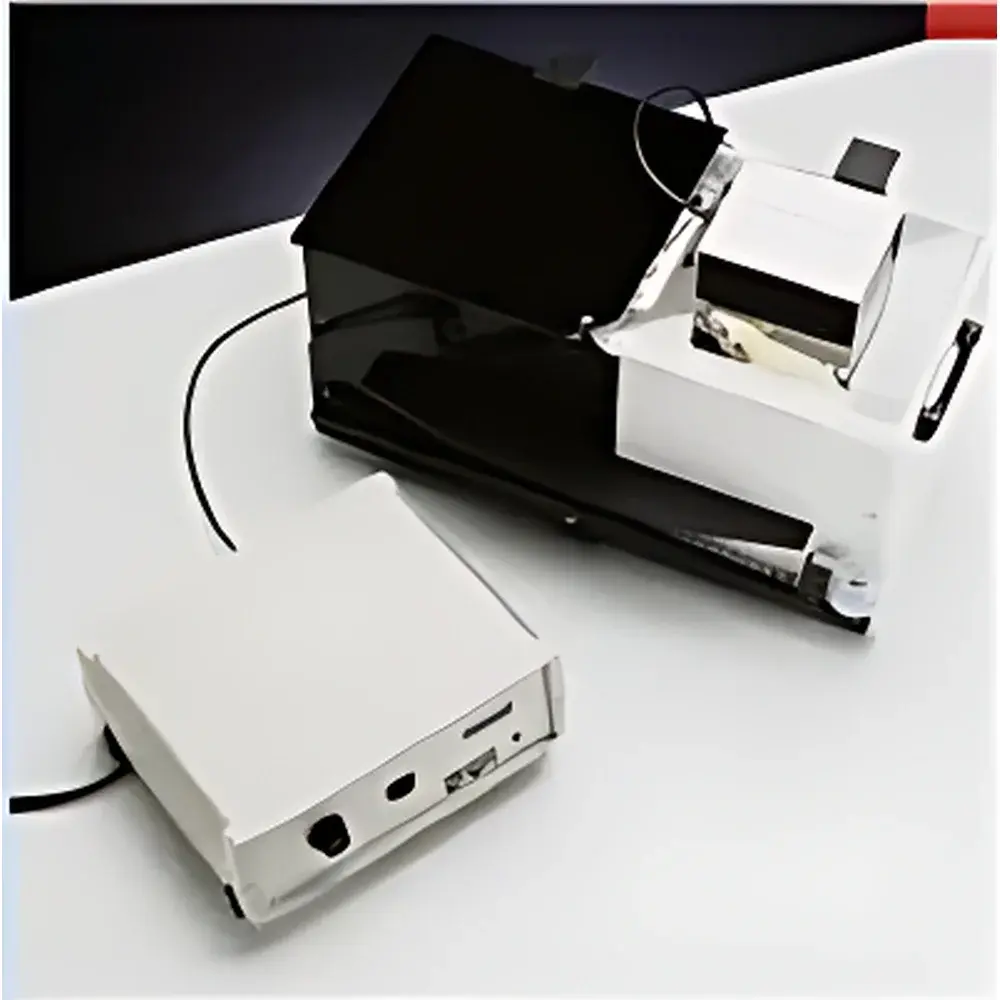
Shuttle Box Passive Avoidance System for Mice and Rats
| Origin | Brazil |
|---|---|
| Manufacturer Type | Authorized Distributor |
| Origin Category | Imported Instrument |
| Model | Shuttle Box Passive Avoidance System |
| Pricing | Available Upon Request |
Overview
The Shuttle Box Passive Avoidance System for Mice and Rats is a standardized, ethologically grounded behavioral apparatus designed to assess associative learning and short- to medium-term memory retention in rodent models through passive avoidance paradigms. Based on the well-established step-through protocol, the system leverages natural aversion to dark, enclosed spaces and mild foot shock as an unconditioned stimulus to evaluate acquisition, consolidation, and retrieval of aversive memory. The apparatus consists of two physically segregated compartments — a brightly illuminated, open-field “light chamber” and a dark, enclosed “dark chamber” — separated by a retractable guillotine or automated sliding door. During training, the animal is placed in the light chamber; upon crossing into the dark chamber, a brief, calibrated foot shock (typically 0.1–0.5 mA, 1–3 s duration) is delivered via stainless-steel grid flooring. In the subsequent retention test (conducted 24 h or 48 h later), latency to re-enter the dark chamber is measured as the primary endpoint — longer latencies indicate intact memory retention. This paradigm is rooted in classical conditioning principles and has been validated across decades of neuropharmacological, genetic, and aging-related studies.
Key Features
- Modular dual-chamber design with optically isolated light/dark compartments (light chamber: ≥500 lux illumination; dark chamber: <5 lux)
- Programmable, adjustable foot shock delivery unit with precise current control (0.05–1.0 mA range, ±0.01 mA resolution) and configurable pulse duration (0.1–5.0 s)
- Automated door actuation with programmable opening/closing timing (0.5–5 s delay options) to minimize experimenter interference
- Digital latency timer with millisecond resolution, synchronized with door position and shock onset
- Non-invasive infrared beam arrays at the inter-compartment threshold for reliable, contact-free entry detection
- Stainless-steel shock grid floor with removable, autoclavable acrylic side panels for rapid cleaning and cross-animal hygiene compliance
- Integrated USB data logging interface supporting timestamped event export (entry time, shock delivery, door state) in CSV format
Sample Compatibility & Compliance
The system is validated for use with adult C57BL/6, BALB/c, CD-1, and Sprague-Dawley mice (20–35 g) and Wistar or Long-Evans rats (200–350 g). Chamber dimensions are scalable per species (mouse: 25 × 25 × 25 cm light chamber; 20 × 20 × 25 cm dark chamber; rat: scaled +30% volume). All electrical components comply with IEC 61010-1 safety standards for laboratory equipment. The shock delivery module meets ISO 14155:2020 guidelines for preclinical stimulus calibration and repeatability. Experimental protocols align with NIH Office of Laboratory Animal Welfare (OLAW) recommendations and support adherence to ARRIVE 2.0 reporting standards. Optional GLP-compliant audit trail firmware (with user login, parameter lockout, and electronic signature) is available for regulated toxicology and CNS drug development studies.
Software & Data Management
The system operates via standalone embedded firmware or optional PC-based control software (Windows 10/11 compatible). Software modules include protocol builder (customizable training/retention intervals, shock parameters, door logic), real-time monitoring dashboard, and automated report generation. Raw data files include full event logs with ISO 8601 timestamps, animal ID tagging, operator ID, and session metadata. Export formats include CSV, Excel (.xlsx), and XML for integration with downstream statistical platforms (e.g., GraphPad Prism, R, SAS). Audit trail functionality satisfies FDA 21 CFR Part 11 requirements when enabled, including electronic signatures, change history, and read-only archival modes.
Applications
- Preclinical evaluation of nootropic, amnestic, or neuroprotective compounds (e.g., scopolamine-induced amnesia models)
- Genetic screening of learning/memory phenotypes in transgenic/knockout mouse lines (e.g., APP/PS1, CaMKIIα-Cre)
- Age-related cognitive decline studies in senescent rodent cohorts
- Validation of non-invasive neuromodulation interventions (e.g., tDCS, focused ultrasound)
- Standardized behavioral phenotyping in core facilities supporting multi-lab consortia (e.g., IMPC, ENGRAM)
- Teaching laboratories requiring reproducible, low-variability passive avoidance protocols
FAQ
What is the difference between step-through and step-down passive avoidance paradigms?
The step-through variant uses spatial transition between two distinct chambers, relying on innate photophobia; the step-down variant places the animal on an elevated platform above a shock grid, measuring latency to descend. Both assess passive avoidance but engage partially divergent neural circuits — the former more dependent on hippocampal-prefrontal engagement, the latter on amygdala-mediated fear conditioning.
Can the same apparatus be used for both mice and rats without hardware modification?
Yes — the base chassis accommodates interchangeable chamber inserts and grid spacing adjustments. Rat-specific configurations require optional extended-height dark chamber inserts and reinforced door actuators, included in the dual-species package.
Is shock intensity calibrated per animal weight or strain?
Calibration follows published literature thresholds (e.g., 0.3 mA for C57BL/6 mice, 0.5 mA for Wistar rats) and is verified using a certified current meter prior to each experimental block. No automatic weight-based scaling is applied, as fixed-intensity protocols ensure inter-subject comparability.
Does the system support integration with video tracking systems like EthoVision or ANY-maze?
Yes — TTL output triggers synchronize shock onset and door motion with third-party video acquisition. Frame-accurate event markers are embedded in exported video metadata when using supported SDKs.
How is data integrity ensured during long-term multi-site studies?
Each unit ships with a unique hardware ID and encrypted firmware signature. Data files contain embedded checksums (SHA-256), and optional cloud-sync mode provides version-controlled, time-stamped backups compliant with FAIR data principles.




