
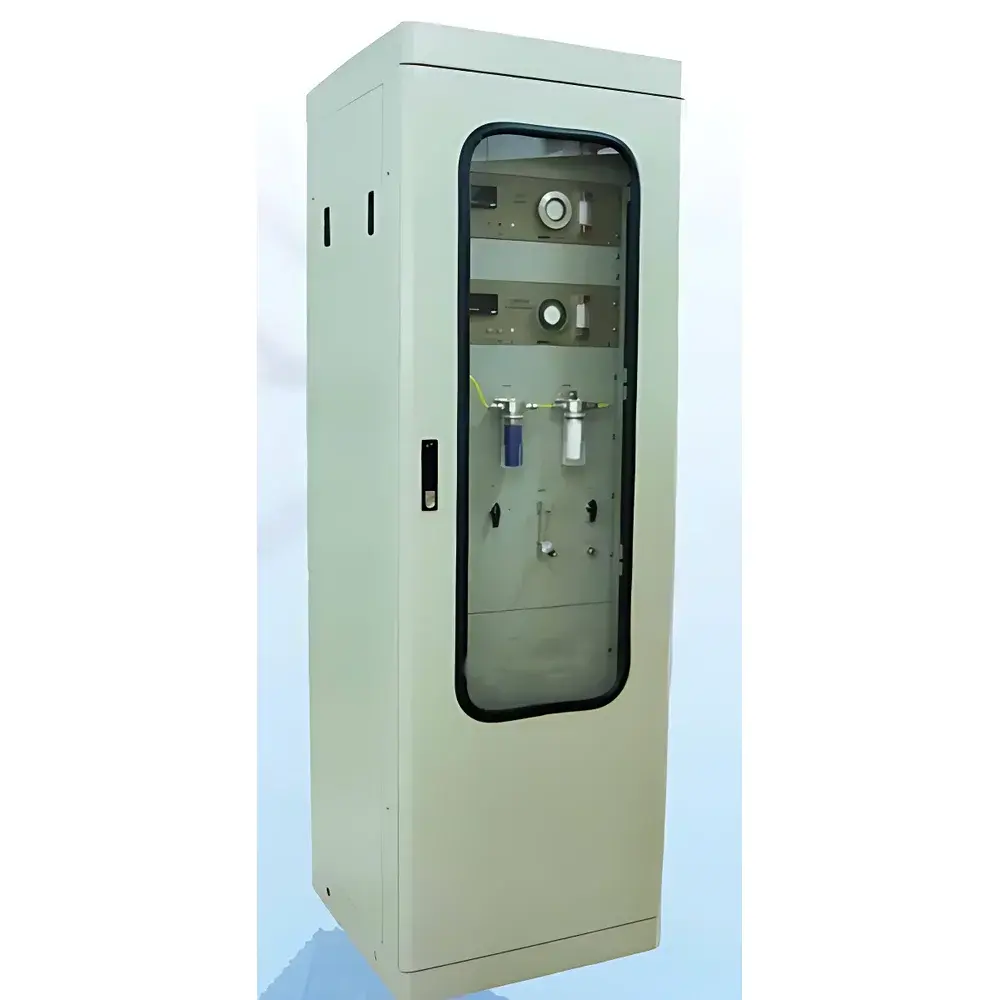
SIELINS XLZ-801 Fertilizer Process Gas Analysis System
| Brand | SIELINS |
|---|---|
| Origin | Beijing, China |
| Manufacturer Type | Authorized Distributor |
| Country of Origin | China |
| Model | XLZ-801 |
| Pricing | Available Upon Request |
| Measured Components & Detection Ranges | O₂: 0–1% vol |
| CO | 0–100 ppm |
| CO₂ | 0–100 ppm |
| H₂ | configurable ranges — 35–37%, 40–80%, 0–1%, or 90–100% vol |
| CH₄ | 0–500 ppm |
| NH₃ | 0–500 ppm |
Overview
The SIELINS XLZ-801 Fertilizer Process Gas Analysis System is an industrial-grade, multi-component online gas analyzer engineered for continuous, real-time monitoring and closed-loop process control in nitrogenous fertilizer production facilities. Designed specifically for integration into syngas generation and purification trains—including coal- or hydrocarbon-based gasification, acid gas removal (e.g., amine scrubbing), water-gas shift conversion, and ammonia synthesis loops—the system employs a combination of non-dispersive infrared (NDIR), electrochemical (EC), thermal conductivity (TCD), and tunable diode laser absorption spectroscopy (TDLAS) detection modules, selected and calibrated per target analyte and concentration range. Its architecture supports high-temperature, high-humidity, and particulate-laden sample streams typical of raw syngas, with integrated heated sample lines, condensate management, and multi-stage filtration to ensure long-term stability and measurement integrity under demanding plant conditions.
Key Features
- Modular sensor configuration: Independent, field-replaceable detection units for O₂ (electrochemical), CO/CO₂ (NDIR), H₂ (TCD or paramagnetic, depending on range), CH₄ and NH₃ (TDLAS), enabling application-specific optimization and minimizing cross-sensitivity.
- Configurable H₂ measurement: Supports four distinct calibration ranges—35–37% (for shift reactor exit), 40–80% (for purified syngas feed to synthesis loop), 0–1% (for trace leak detection), and 90–100% (for high-purity hydrogen streams)—each with dedicated zero/span validation protocols.
- Robust sample conditioning system: Includes 180 °C heated sampling probe, PTFE-lined stainless-steel transport line, thermoelectric cooler with dew point control (<5 °C), and sintered metal particulate filter (1 µm rating) to prevent fouling and maintain representative gas composition.
- Industrial-grade enclosure: IP66-rated NEMA 4X housing with explosion-proof option (ATEX II 2G Ex d IIB T4 Gb / IECEx d IIB T4 Gb) for installation in Zone 1 hazardous areas adjacent to process headers.
- Real-time diagnostics and self-monitoring: Continuous verification of optical path integrity, detector drift compensation, flow rate stability alerts, and automatic zero-check cycles every 4 hours—fully logged with timestamps and event codes.
Sample Compatibility & Compliance
The XLZ-801 accommodates gas matrices containing up to 40% H₂O vapor (saturated at 60 °C), total hydrocarbons ≤1000 ppmv (as methane equivalent), and particulate loading ≤5 mg/m³. It complies with IEC 61511 for functional safety in Safety Instrumented Systems (SIS) when deployed for H₂ or NH₃ high-level alarms in synthesis loop interlocks. All sensor outputs meet EN 61000-6-2/6-4 EMC immunity and emission requirements. Calibration traceability follows ISO/IEC 17025 via certified reference gases (NIST-traceable, uncertainty <2% relative), and data records satisfy FDA 21 CFR Part 11 audit trail requirements when paired with optional secure logging firmware.
Software & Data Management
The embedded controller runs a deterministic real-time OS with dual-channel Ethernet (one for Modbus TCP/RTU, one for redundant OPC UA server). The web-based HMI provides live trend plots, alarm history with cause-and-effect matrix visualization, and configurable setpoint logic for DCS integration. Historical data is stored locally (16 GB industrial SSD) with automatic rollover and export via SFTP or USB 3.0. Optional cloud gateway enables remote diagnostic access, predictive maintenance alerts (based on sensor aging models), and batch-wise correlation with DCS historian tags (e.g., reactor temperature, pressure, catalyst bed delta-T). All software modules support GLP/GMP audit trails, electronic signatures, and role-based access control (RBAC) with three-tier permissions.
Applications
- Coal/oil gasification effluent monitoring: Quantifying residual O₂ (to avoid explosion risk), CO/CO₂ ratio (for shift catalyst efficiency assessment), and H₂ purity pre-shift conversion.
- Amine scrubber inlet/outlet analysis: Tracking NH₃ slip across absorber/desorber columns and verifying CO₂ removal efficiency.
- Water-gas shift reactor optimization: Real-time H₂/CO ratio feedback for steam-to-gas ratio adjustment and catalyst health trending.
- Ammonia synthesis loop feed qualification: Verifying H₂:N₂ ratio (3:1 ±0.05), detecting NH₃ recycle contamination, and identifying CH₄ buildup indicating purge inefficiency.
- Emergency shutdown interlock: Providing SIL 2-certified H₂ high-high (≥95%) or NH₃ high (≥200 ppm) signals to safety systems per IEC 61511.
FAQ
What sample gas preparation is required prior to connection to the XLZ-801?
Minimal upstream conditioning is needed: the system includes full hot-wet sampling capability. A pressure-regulated source (2–5 bar(g)) with coarse particulate filtration (≤50 µm) upstream is sufficient; all further conditioning (heating, cooling, fine filtration) occurs within the XLZ-801’s integrated sample handling module.
Can the XLZ-801 be integrated with Emerson DeltaV or Honeywell Experion DCS platforms?
Yes—native Modbus TCP and OPC UA (compliant with OPC Foundation UA Specification Part 14) are standard. Pre-tested interface templates and FDI device packages are available for DeltaV v14+ and Experion PKS R510.
How often must calibration gases be introduced, and what certification is required?
Zero and span checks are recommended every 72 hours for critical control loops; quarterly full calibration is advised for compliance reporting. Certified reference gases must be ISO 6141-compliant, with NIST or BIPM traceability and stated expanded uncertainty (k=2) documented per cylinder lot.
Is remote firmware update supported, and does it require system downtime?
Firmware updates are performed over secure HTTPS with dual-image partitioning; the active runtime remains uninterrupted during download and validation. Switchover occurs during the next scheduled maintenance window or via operator-initiated warm reboot (typical downtime <45 seconds).
Does the system support redundant power and communication paths?
Yes—dual 24 VDC inputs with automatic failover and dual Ethernet ports configured for link aggregation or separate control/monitoring networks are standard. Optional 110/220 VAC backup UPS interface is available.
Related Products







