
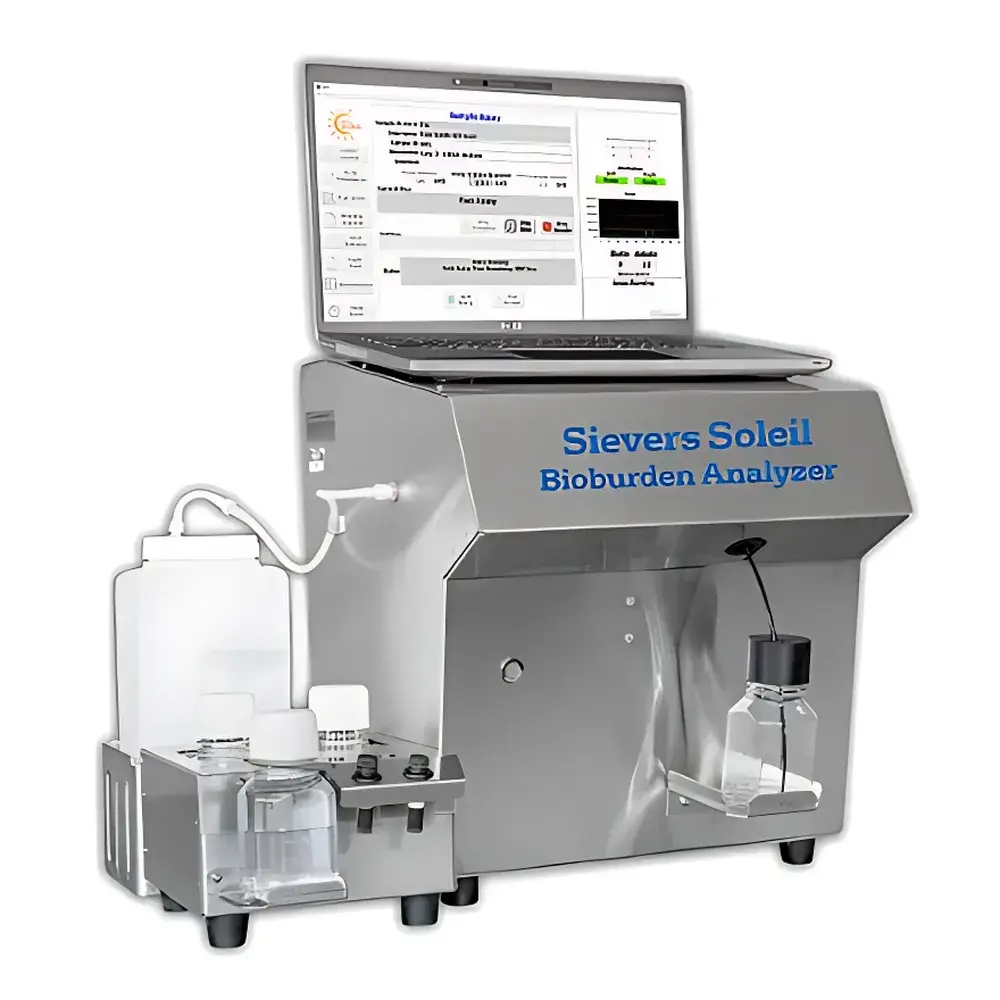
Sievers SOLEIL Rapid Bioburden Analyzer
| Brand | Sievers (Veolia) |
|---|---|
| Origin | USA |
| Manufacturer Status | Authorized Distributor |
| Product Category | Imported Instrument |
| Model | SIEVERS SOLEIL |
| Instrument Type | Fully Automated Microbial Enumeration System |
| Detection Range | 1–10,000 biotics per 100 mL |
| Sample Aspiration Rate | 8 mL/min |
| Dimensions (W×D×H, without laptop) | 48.3 cm × 43.2 cm × 43.2 cm (19 in × 17 in × 17 in) |
Overview
The Sievers SOLEIL Rapid Bioburden Analyzer is a fully automated, non-culture-based microbial enumeration system engineered for real-time, quantitative assessment of low-level bioburden in ultra-pure water systems, pharmaceutical process streams, and cleanroom environmental monitoring samples. Unlike traditional membrane filtration and colony-forming unit (CFU) enumeration—methods requiring 3–7 days for results—the SOLEIL platform employs proprietary laser-induced fluorescence (LIF) coupled with microfluidic sample concentration and high-sensitivity optical detection to deliver validated, quantitative bioburden data in under 30 minutes. The system operates on the principle of detecting intrinsic fluorescent biomarkers (e.g., NAD(P)H, riboflavin, and aromatic amino acids) in viable microorganisms without reliance on growth media, incubation, or labeling reagents. This enables rapid, culture-independent enumeration across the clinically and industrially relevant range of 1 to 10,000 biotics per 100 mL—making it suitable for routine monitoring of Water for Injection (WFI), Purified Water (PW), and clean steam condensate in regulated biopharmaceutical manufacturing environments.
Key Features
- Fully integrated automation: From sample aspiration (8 mL/min) through microfluidic concentration, optical interrogation, and result reporting—no manual intervention required.
- Low-volume, high-fidelity detection: Optimized for ultra-pure water matrices with minimal background interference; validated down to 1 biotic/100 mL with ≤15% coefficient of variation (CV) at ≥10 biotics/100 mL.
- Modular hardware architecture: Compact footprint (48.3 cm W × 43.2 cm D × 43.2 cm H) designed for benchtop deployment in QC labs or near-point-of-use locations within Grade A/B cleanrooms.
- Regulatory-ready design: Built-in audit trail, electronic signatures, and user access controls compliant with FDA 21 CFR Part 11 and EU Annex 11 requirements.
- Self-diagnostic calibration: Integrated reference standards and daily performance verification protocols ensure measurement consistency across shifts and operators.
Sample Compatibility & Compliance
The SOLEIL analyzer is validated for use with aqueous samples meeting USP and EP 2.6.12 specifications for purified and sterile waters. It accommodates direct analysis of filtered and unfiltered water samples, as well as rinsates from component surfaces and filter housings. Method suitability has been demonstrated per ICH Q5C and USP , supporting its qualification as an alternative microbiological method under FDA Guidance for Industry (2022) and EMA Reflection Paper on Rapid Microbiological Methods (2020). All system software and firmware are developed under ISO 13485-certified processes, and hardware meets IEC 61010-1 safety standards for laboratory equipment.
Software & Data Management
The SOLEIL Control Software (v3.x) provides a secure, role-based interface for method configuration, run execution, and report generation. Data integrity is maintained via time-stamped, immutable records stored in an embedded SQL database with automatic backup to network drives. Each assay generates a comprehensive PDF report including raw fluorescence traces, concentration curves, statistical summaries, and pass/fail determinations against configurable acceptance criteria. The software supports structured data export (CSV, XML) for integration with LIMS and MES platforms, and includes full 21 CFR Part 11 compliance features—including electronic signatures, audit trail review tools, and configurable retention policies aligned with GMP documentation requirements.
Applications
- Real-time release testing of WFI and PW in pharmaceutical manufacturing suites.
- Investigation of bioburden excursions during system sanitization validation (e.g., ozone, steam, or hydrogen peroxide cycles).
- Monitoring of point-of-use bioburden in isolator glove ports and filling line rinse solutions.
- Supporting risk-based environmental monitoring programs under ISO 14644-2 and EU GMP Annex 1.
- Accelerated stability studies involving microbial ingress evaluation in single-use bioprocess containers.
FAQ
What regulatory standards does the SOLEIL system support for RMM validation?
The SOLEIL platform is designed to meet the method validation requirements outlined in PDA Technical Report No. 33, USP , and ISO 11133, with documented equivalence studies available for comparison to pharmacopeial membrane filtration methods.
Can the SOLEIL detect spores and stressed/viable-but-non-culturable (VBNC) organisms?
Yes—the LIF detection principle responds to metabolically active cellular fluorophores, enabling enumeration of VBNC cells and bacterial endospores that retain intrinsic fluorescence, though differentiation between vegetative and spore forms requires orthogonal confirmation.
Is the system compatible with existing facility SCADA or MES infrastructure?
Yes—via OPC UA and RESTful API interfaces, the SOLEIL Control Software supports bidirectional data exchange with industrial automation platforms for automated alarm escalation and trend dashboarding.
What maintenance is required to sustain analytical performance?
Routine maintenance includes weekly optical path cleaning, quarterly microfluidic cartridge replacement, and annual factory calibration verification—documented in the included Preventive Maintenance Logbook and supported by Veolia-certified field service engineers.






