
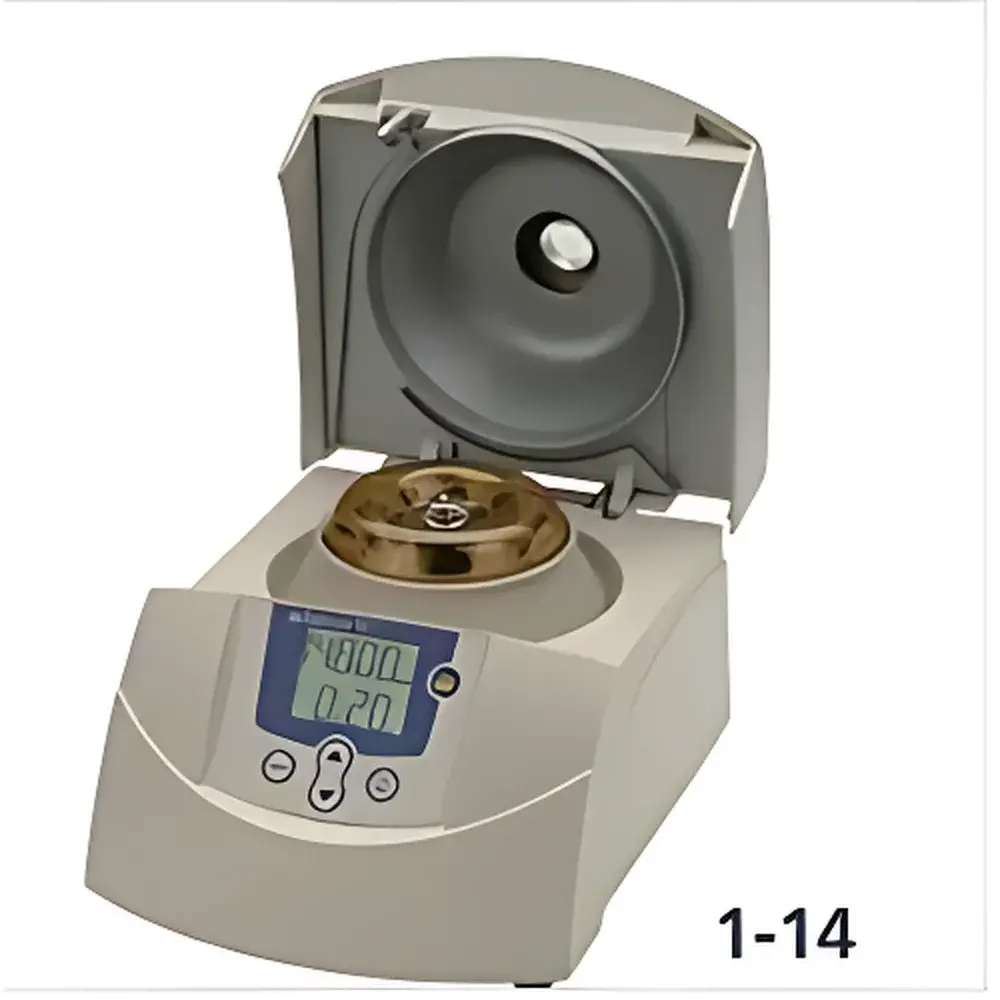
Sigma 1-14 High-Speed Compact Benchtop Centrifuge
| Origin | USA |
|---|---|
| Manufacturer Type | Authorized Distributor |
| Origin Category | Imported |
| Model | 1-14 |
| Instrument Type | Benchtop Centrifuge |
| Speed Range | High-Speed Centrifuge (10,000–30,000 rpm) |
| Function | General-Purpose Centrifuge |
| Configuration | Fixed-Angle Rotor Centrifuge |
| Separation Class | Cellular & Bacterial Pelletization |
| Maximum Capacity | 24 × 2.2 mL |
| Maximum Speed | 14,800 rpm |
| Maximum RCF | 16,163 × g |
| Dimensions (H × W × D) | 176 × 226 × 212 mm |
| Power Supply | 230 V, 50/60 Hz |
| Power Consumption | 95 W |
| Minimum Speed | 200 rpm (2 × g) |
| Acceleration Time (0–14,800 rpm) | 13 s |
| Deceleration Time (14,800 rpm → 0) | 11 s |
| Noise Level (at Max Speed) | 58 dB(A) |
| Electromagnetic Compatibility | Compliant with EN 61326 |
| Safety Interlock | Motor stops and lid unlocks only when rotor is fully stationary |
| Rotor Detection | Automatic recognition of compatible fixed-angle rotors |
| Weight (without rotor) | 5.4 kg |
| Kinetic Energy | 1721 N·m |
Overview
The Sigma 1-14 is a high-speed, compact benchtop centrifuge engineered for precision separation of small-volume biological samples in research, clinical, and quality control laboratories. Designed around a brushless frequency-controlled motor, it eliminates carbon brush wear—ensuring long-term rotational stability, minimal maintenance, and consistent torque delivery across its full speed range (200–14,800 rpm). Its operational principle relies on radial acceleration to generate relative centrifugal force (RCF), enabling efficient pelleting of cells, bacteria, subcellular organelles, and precipitated nucleic acids or proteins from microcentrifuge tubes (0.2–2.2 mL). With a maximum RCF of 16,163 × g and a kinetic energy rating of 1721 N·m, the instrument meets mechanical safety thresholds defined in IEC 61010-2-020 for laboratory centrifuges. Its compact footprint (176 × 226 × 212 mm) and lightweight construction (5.4 kg net weight) make it suitable for laminar flow hoods, biosafety cabinets, and shared instrumentation benches without compromising structural rigidity or vibration damping.
Key Features
- Brushless DC motor with integrated frequency control—no scheduled brush replacement, reduced thermal drift, and extended service life
- Dual programmable acceleration/deceleration profiles: “Soft” (for sensitive pellets) and “Fast” (for time-critical protocols)
- Flexible timing modes: 99-minute continuous run, short-time “pulse” operation, or indefinite hold at set speed
- Electromechanical lid interlock system—lid release is physically inhibited until rotor angular velocity reaches zero, verified by optical encoder feedback
- Low-speed capability down to 200 rpm (2 × g), enabling gentle resuspension or density gradient equilibration
- EN 61326-compliant electromagnetic interference (EMI) shielding ensures reliable operation in multi-instrument lab environments
- Integrated rotor identification—detects certified Sigma fixed-angle rotors (e.g., 24-place 2.2 mL rotor) and enforces speed limits per rotor certification
Sample Compatibility & Compliance
The Sigma 1-14 is validated for use with standard polypropylene and polycarbonate microcentrifuge tubes (0.2–2.2 mL), including PCR strip tubes and low-retention formats. It supports ISO 22174:2021-compliant workflows for molecular diagnostics sample preparation and aligns with CLSI EP17-A2 guidelines for centrifugation reproducibility in clinical testing. All mechanical and electrical safety features conform to IEC 61010-1 and IEC 61010-2-020. The device carries CE marking under the EU Machinery Directive 2006/42/EC and Low Voltage Directive 2014/35/EU. No hazardous substances are used in compliance with RoHS Directive 2011/65/EU. Routine operation requires no GLP/GMP-specific audit trail functionality; however, manual logbook entries satisfy basic regulatory traceability requirements for non-validated applications.
Software & Data Management
The Sigma 1-14 operates via an intuitive front-panel interface with LED display and tactile membrane keys—no external software or PC connection required. All parameters (speed, time, acceleration/deceleration mode) are stored in non-volatile memory and retained after power cycling. While the unit lacks USB or Ethernet connectivity, its parameter recall function allows up to 10 user-defined protocols to be saved and recalled instantly. For laboratories implementing 21 CFR Part 11 compliance, external electronic lab notebooks (ELNs) or LIMS systems may capture operator ID, timestamp, and run parameters manually. Firmware updates—when released—are performed exclusively by authorized Sigma service centers using proprietary diagnostic hardware.
Applications
- Routine pelleting of bacterial cultures (E. coli, Bacillus spp.) and yeast suspensions prior to lysis or genomic DNA extraction
- Clarification of cell lysates and supernatant recovery in protein purification workflows
- Concentration of viral particles or exosomes from conditioned media (paired with appropriate ultracentrifuge-grade tube compatibility)
- Spin-down of enzymatic reaction mixtures (e.g., restriction digests, ligations) before electrophoresis or sequencing library prep
- Microfiltration support—spinning filter devices (e.g., 0.22 µm PVDF) for sterile filtration of small-volume buffers or reagents
- Pre-analytical sample stabilization in clinical chemistry, where rapid serum/plasma separation minimizes analyte degradation
FAQ
Is the Sigma 1-14 compatible with refrigerated operation?
No—the instrument is designed for ambient-temperature operation only and does not include a refrigeration unit.
Can I use swing-bucket rotors with this model?
No—only Sigma-certified fixed-angle rotors are mechanically and electronically supported; swing-bucket configurations are not available for the 1-14 platform.
What safety certifications apply to this centrifuge?
It complies with IEC 61010-1 (general safety), IEC 61010-2-020 (particular requirements for centrifuges), EN 61326 (EMC), and carries CE, RoHS, and REACH declarations.
Does the centrifuge retain settings after power loss?
Yes—user-programmed parameters and protocol memories are preserved in EEPROM and remain intact following power interruption.
Is routine calibration required by the manufacturer?
Sigma recommends annual verification of speed accuracy and RCF output using a traceable tachometer and calibration certificate, per ISO/IEC 17025 guidelines for accredited labs.



