
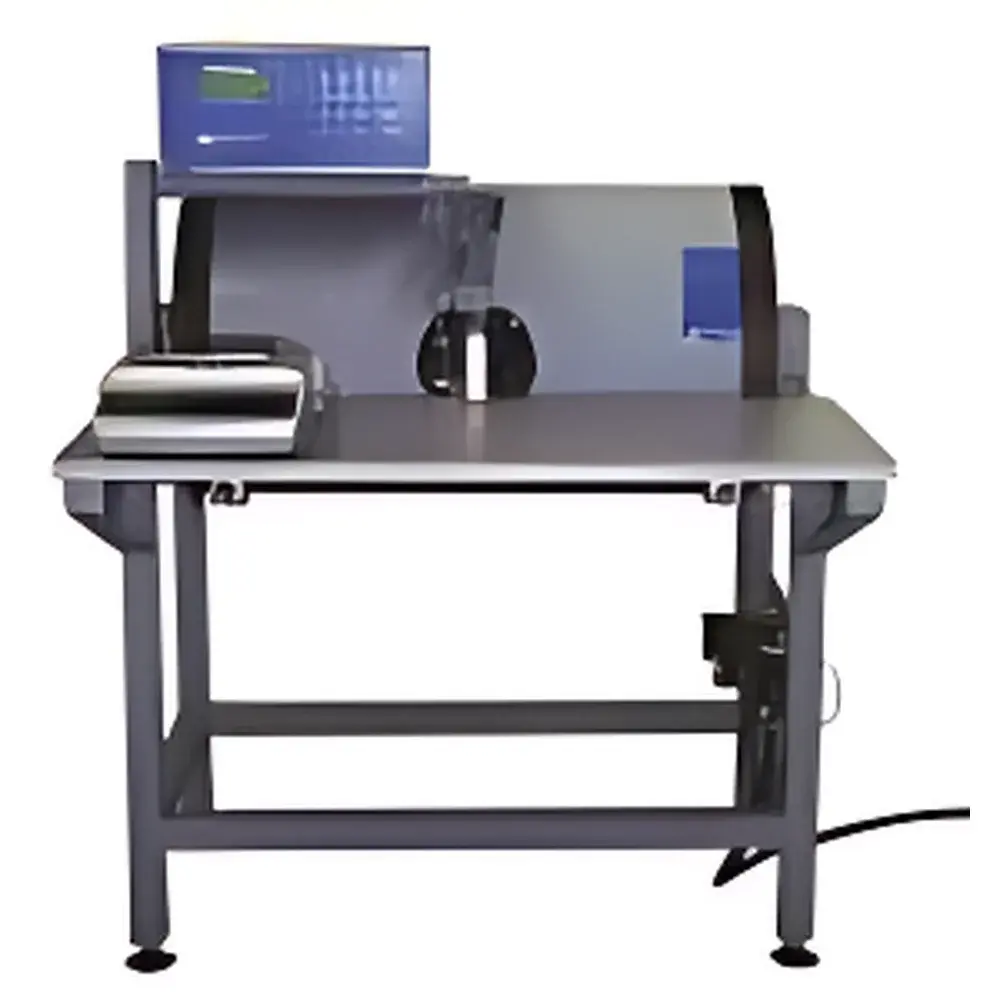
Sigmameter Cobalt Magnetometer for Saturation Magnetization Measurement
| Brand | SETARAM |
|---|---|
| Origin | France |
| Model | Sigmameter |
| Sample Max Dimension | Ø30×20 mm |
| Magnetic Field Gap | 800 kA·m⁻¹ (10,000 Oe) |
| Sensitivity | 1 mg Co |
| Accuracy | ±1% |
| Measurement Time | 5 s |
| Units Supported | emu·g⁻¹ (Gauss·cm³·g⁻¹), SI (µT·m³·kg⁻¹), Co wt% |
| Automation | Fully Automated |
| Maintenance | Maintenance-Free Design |
| Compliance | Designed for ISO/IEC 17025-aligned QC labs |
Overview
The Sigmameter Cobalt Magnetometer, developed jointly by SETARAM (France) and Sandvik (Sweden), is a dedicated magnetic susceptibility instrument engineered for the rapid, non-destructive quantification of cobalt content via saturation magnetization measurement in hardmetal and cemented carbide materials. It operates on the principle of Faraday force-based magnetic balance: a precisely controlled, high-uniformity air-gap magnetic field (up to 800 kA·m⁻¹ / 10,000 Oe) induces magnetization in cobalt-containing samples; the resulting magnetic moment is measured as a mechanical force on a precision microbalance, calibrated directly against certified cobalt standards. This method exploits the linear relationship between cobalt mass fraction and saturation magnetization in WC–Co composites—where cobalt acts as the binder phase and exhibits predictable, temperature-stable ferromagnetic behavior—enabling trace-level quantification without dissolution, digestion, or spectral interference. The system is optimized for routine quality control in high-throughput production environments, delivering results in ≤5 seconds per sample with metrological traceability aligned with ISO 11171 and ASTM B940 practices for magnetic characterization of cemented carbides.
Key Features
- Fully automated measurement cycle—from sample placement to report generation—minimizing operator dependency and inter-lab variability.
- High-field air-gap electromagnet delivering stable, homogeneous flux density (800 kA·m⁻¹) across the full sample volume, ensuring reproducible magnetization conditions compliant with ISO 5754 Annex A.
- Integrated high-resolution microbalance with 1 mg cobalt sensitivity, calibrated using NIST-traceable cobalt reference materials (e.g., certified WC–Co pellets).
- Multi-unit output capability: results displayed simultaneously in emu·g⁻¹ (Gauss·cm³·g⁻¹), SI units (µT·m³·kg⁻¹), and direct cobalt weight percent (wt%), facilitating cross-standard reporting and internal specification alignment.
- Robust mechanical architecture with passive thermal stabilization and vibration-damped base—designed for factory-floor deployment without environmental enclosures or active cooling.
- Self-diagnostic routines and automatic zero-point correction ensure long-term stability and eliminate manual recalibration between shifts.
Sample Compatibility & Compliance
The Sigmameter accepts solid, powdered, and fragmented specimens without geometric constraints—ideal for irregular sintered blanks, ground inserts, milling chips, or atomized powders (Ø ≤ 30 mm × 20 mm max). No surface preparation, coating removal, or size reduction is required. Its methodology is referenced in industry specifications including ISO 3252 (cemented carbides – determination of cobalt content), ASTM B940 (standard test method for cobalt content in tungsten carbide–cobalt composites), and internal QC protocols of Sandvik Coromant, Ceratizit, and Kennametal. The instrument’s measurement uncertainty (±1%) meets GLP requirements for raw material release testing and satisfies audit readiness for ISO 9001:2015 and IATF 16949 manufacturing systems.
Software & Data Management
The embedded firmware supports configurable measurement templates, user-defined pass/fail thresholds, and batch reporting with CSV/Excel export. Audit trails record operator ID, timestamp, calibration status, and environmental metadata (ambient temperature, humidity). Data integrity complies with FDA 21 CFR Part 11 requirements when deployed with optional networked authentication and electronic signature modules. Raw force vs. field curves are archived for retrospective analysis, supporting root-cause investigations during process deviations or supplier qualification audits.
Applications
- Final QC release testing of sintered WC–Co cutting tools and wear parts.
- In-process verification of cobalt binder homogeneity in green compacts prior to sintering.
- Supplier incoming inspection for cobalt powder batches used in P/M metallurgy.
- Failure analysis of delaminated or decarburized hardmetal components.
- Research-grade correlation studies between magnetic response, grain size (via SEM), and mechanical properties (HV, TRS).
FAQ
Is the Sigmameter suitable for measuring cobalt in non-WC matrices, such as Fe–Co or Ni–Co alloys?
Yes—though calibration must be performed using matrix-matched standards, as saturation magnetization varies with crystalline phase and alloying elements.
Does the instrument require periodic recalibration with certified reference materials?
Annual verification using SETARAM-certified cobalt reference samples is recommended; daily zero checks are automated.
Can it distinguish between metallic cobalt and cobalt oxides?
No—the method measures total ferromagnetic cobalt contribution; oxide phases (e.g., Co₃O₄) exhibit significantly lower saturation magnetization and require complementary XRD or XRF for speciation.
What environmental conditions are required for optimal operation?
Ambient temperature range: 15–30 °C; relative humidity < 70%; non-condensing; no magnetic shielding needed beyond standard lab steel furniture.
Is remote diagnostics and software update support available?
Yes—via secure HTTPS-enabled firmware portal with TLS 1.2 encryption and version-controlled release notes.



