
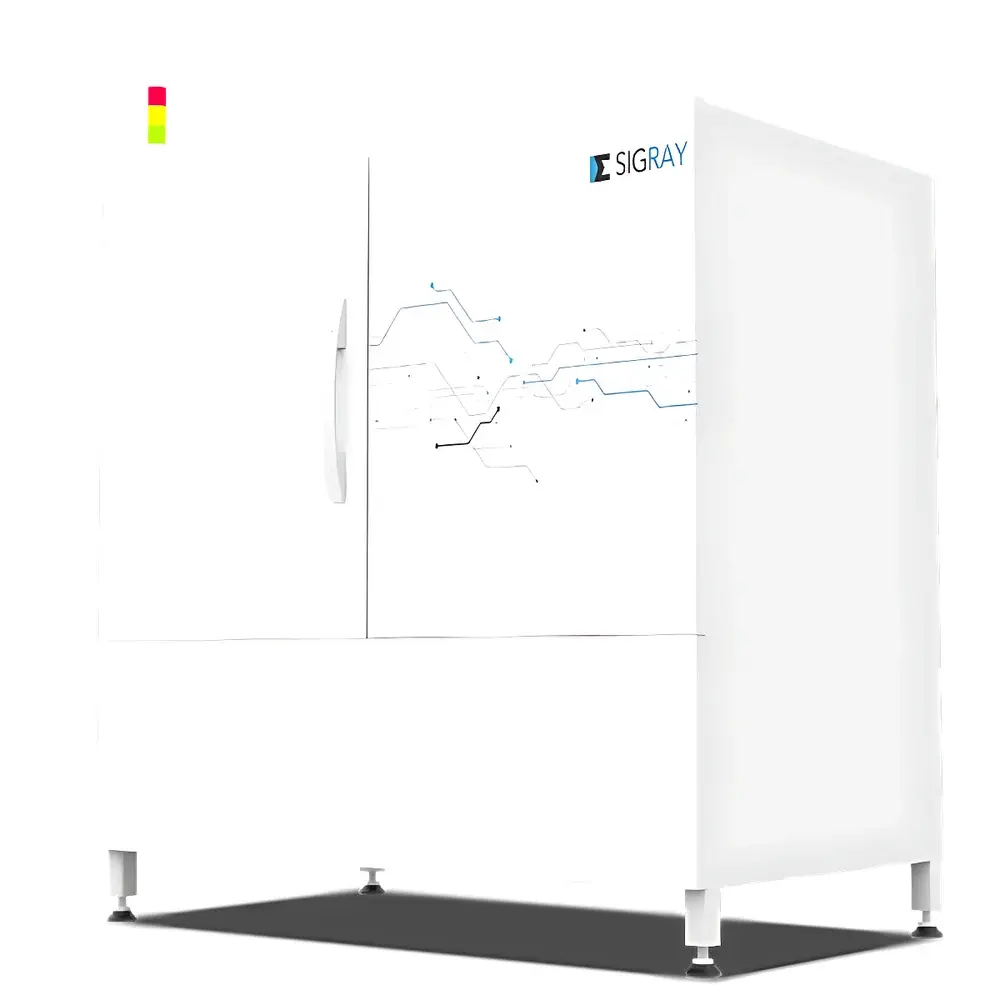
SIGRAY APEX Hybrid Industrial Micro-CT System
| Brand | SIGRAY |
|---|---|
| Origin | Shanghai, China |
| Manufacturer Type | Authorized Distributor |
| Product Category | Domestic |
| Model | APEX Hybrid |
| Pricing | Upon Request |
Overview
The SIGRAY APEX Hybrid Industrial Micro-CT System is a dual-mode X-ray microscopy platform engineered for high-fidelity, non-destructive 3D inspection of semiconductor packages, advanced interposers, and heterogeneous integrated assemblies. It integrates two physically distinct imaging geometries—laminography (CL) and computed tomography (CT)—within a single robust mechanical and optical architecture. Unlike conventional micro-CT systems constrained by cone-beam geometry and sample size limitations, the APEX Hybrid employs a precision angular laminography (PAL) configuration optimized for large-area planar devices such as 300 mm wafers, PCBs, and fan-out panels, while retaining full CT capability for localized high-resolution volumetric analysis. Its core measurement principle relies on high-brightness, nanofocused transmission X-ray generation combined with geometrically calibrated projection acquisition and iterative reconstruction physics. This enables sub-400 nm spatial resolution across both modalities—verified using NIST-traceable resolution test objects—and supports quantitative metrology compliant with ISO/IEC 17025-accredited laboratory practices.
Key Features
- Dual-mode imaging architecture: Seamless switching between laminography (CL) and cone-beam CT without hardware reconfiguration
- Sub-350 nm effective spatial resolution in both CL and CT modes, validated per ASTM E2863–22 guidelines for X-ray micro-computed tomography system performance
- Precision Angular Laminography (PAL): Proprietary optical geometry minimizing stripe artifacts and maximizing contrast-to-noise ratio (CNR) in layered structures such as RDLs, TSVs, and hybrid Cu–Cu bonds
- Nanofocused open-tube X-ray source: Diamond-substrate patterned tungsten target with intrinsic self-calibration; 160 kV maximum acceleration voltage; cathode lifetime >3,000 hours
- HyperCapture detector family: Standard 7 MP flat-panel detector (50 µm pixel pitch); optional 13 MP or 16 MP variants for extended field-of-view or enhanced sampling density
- Air-bearing rotational stage with <50 nm radial runout; XYZ translation stage (100 × 20 × 100 mm travel) for precise ROI targeting
- Integrated SHP robotic sample handler supporting unattended batch scanning of up to 10 samples (100 × 100 mm each)
Sample Compatibility & Compliance
The APEX Hybrid accommodates diverse semiconductor packaging formats—from intact 300 mm wafers and multi-die 2.5D/3D IC stacks to HBM-enabled CPU modules and mobile SoCs (e.g., iPhone 14 Pro logic die). Its laminography mode eliminates the need for destructive dicing or thinning prior to inspection, enabling true “as-built” failure analysis. The system complies with IEC 61000-6-3 (EMC emissions), ISO 13849-1 (functional safety for automated motion control), and supports audit-ready data integrity under FDA 21 CFR Part 11 when deployed with GigaRecon’s reconstruction audit log and XRM Companion’s acquisition metadata tagging. All raw projections are stored in open HDF5 format; reconstructed volumes export to standard DICOM-CT and NIfTI containers for integration into GLP/GMP-aligned QA workflows.
Software & Data Management
Two tightly coupled software suites form the operational backbone: XRM Companion (acquisition) and GigaRecon (reconstruction). XRM Companion provides Python API access, scan recipe automation, real-time dose monitoring, and seamless integration with third-party robotics via RS-232/Ethernet protocols. GigaRecon implements a GPU-accelerated SART+TV iterative reconstruction engine capable of reconstructing 2048 × 2048 × 2200 voxel datasets in under 45 seconds—five times faster than conventional FDK methods while preserving edge fidelity and low-contrast detectability. Optional modules include MegaView for gigapixel mosaic stitching, Comet Dragonfly for AI-assisted defect segmentation, and Avizo for quantitative pore network analysis and dimensional metrology traceable to NIST SRM 2088.
Applications
- Non-destructive FA of microbumps, C4 solder joints, and hybrid Cu–Cu bonded interfaces in advanced packaging
- High-aspect-ratio TSV bridging and void detection in silicon interposers at ≤5 µm pitch
- 3D metrology of HBM3 stack alignment, microbump coplanarity, and underfill delamination
- Progressive-resolution imaging of full-system assemblies: from 8 µm voxel surveys of smartphone logic boards to 1 µm targeted CT of critical IP blocks
- Reverse engineering of heterogeneous chiplets and fan-out wafer-level packaging (FOWLP) without decapsulation
FAQ
What distinguishes laminography from conventional CT in semiconductor inspection?
Laminography enables artifact-free imaging of large, flat samples by rotating the source-detector pair around a fixed tilt axis, avoiding the geometric truncation and ring artifacts inherent in cone-beam CT of oversized planar objects.
Is the 350 nm resolution achievable across all sample sizes and densities?
Resolution is specified under optimal conditions (e.g., NTT resolution phantom, 80 kV, 100 µA, 1× magnification); actual resolution depends on material attenuation, source spot size, detector MTF, and reconstruction parameters.
Does the system support automated defect classification?
Yes—when paired with optional Dragonfly or Avizo, users can deploy supervised ML models trained on labeled defect libraries for repeatable pass/fail decisions aligned with IPC-A-610 or JEDEC JESD22-A108 standards.
Can the APEX Hybrid be integrated into an existing FA lab workflow?
It exports standard DICOM-CT and HDF5 files, supports OPC UA for MES connectivity, and includes RESTful APIs for triggering scans from external test equipment or LIMS platforms.
What regulatory documentation is provided for validation?
Factory acceptance test (FAT) reports, IQ/OQ protocols, and uncertainty budgets per ISO/IEC 17025 are supplied; installation qualification includes beam stability, geometric calibration, and resolution verification using certified phantoms.



