
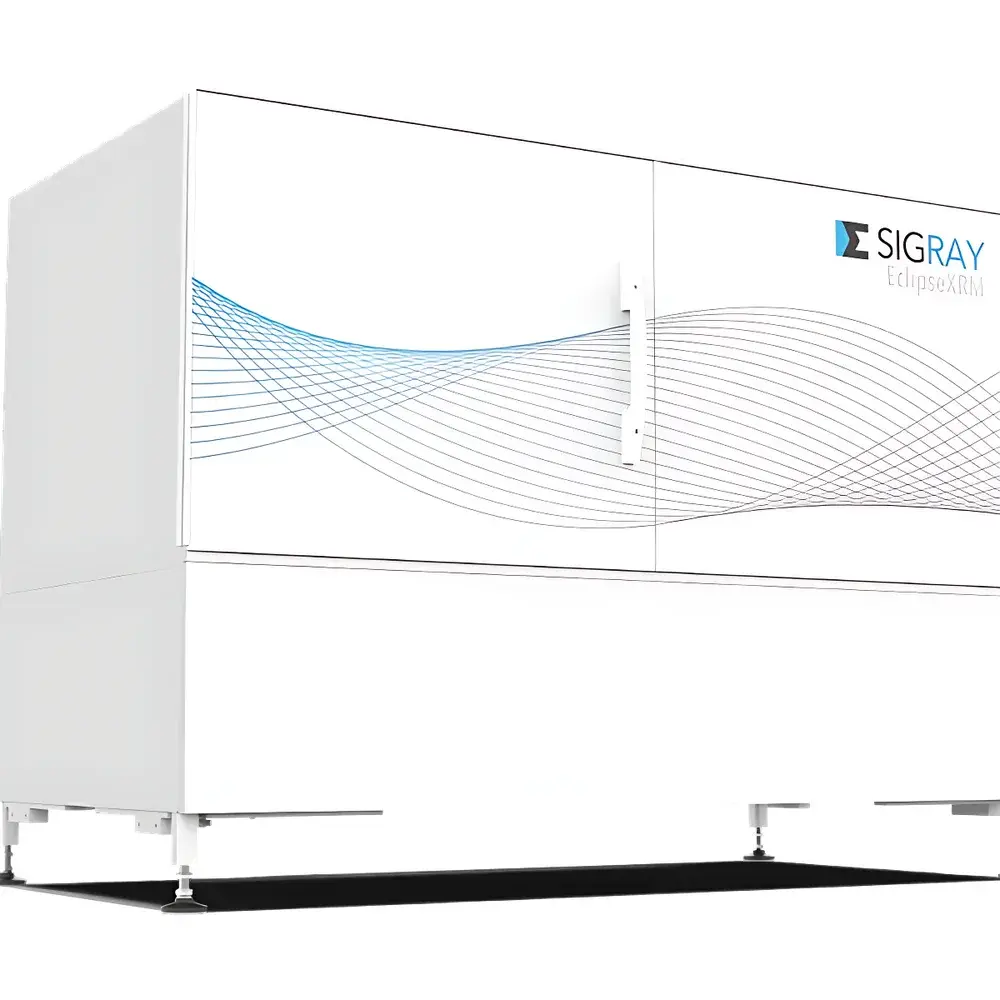
Sigray EclipseXRM-910 Industrial Micro-CT System
| Brand | Sigray |
|---|---|
| Origin | Shanghai, China |
| Model | EclipseXRM-910 |
| Spatial Resolution | 0.3 µm |
| Voxel Size | <30 nm |
| Working Distance Capability | Sub-micron resolution at ≥100 mm sample diameter |
| X-ray Source | Dual-source configuration — 160 kVp nanofocus tungsten source (diamond substrate) + optional Multi-Spectral Source (MSS) with up to 7 selectable anode materials (Cr, Cu, Rh, Mo, Ag, Ti, Au, W) |
| Detector Configuration | Dual-detector system — 6.7 MP HyperCapture-Pro CMOS (upgradable to 13 MP or 27 MP) + 16 MP UltraVision-HDX CMOS |
| Reconstructive Software | GigaRecon (FDK & iterative reconstruction |
| Acquisition Software | Sigray3D with AI-assisted AutoPilot and robotic sample handling (up to 20 samples) |
| Phase Contrast Imaging | Enabled natively via propagation-based phase retrieval |
| Compliance Framework | Designed for GLP/GMP-aligned workflows |
| Operating Environment | Dual-workstation architecture — Windows GUI + real-time Linux control kernel (EPICS-compatible) |
Overview
The Sigray EclipseXRM-910 is a high-performance industrial micro-computed tomography (micro-CT) system engineered for non-destructive 3D internal characterization of materials across semiconductor, energy storage, life sciences, and geoscience domains. Unlike conventional laboratory X-ray microscopes constrained by the trade-off between field-of-view (FOV), working distance, and spatial resolution, the EclipseXRM-910 employs a patented dual-source, multi-spectral architecture combined with optimized optical path design to deliver true sub-300 nm voxel resolution—achievable even at extended working distances (>100 mm). This capability is grounded in propagation-based X-ray imaging physics, where phase contrast mechanisms are leveraged alongside absorption contrast to enhance sensitivity for low-Z materials (e.g., polymers, biological tissues, Li-ion electrode binders) without requiring synchrotron radiation.
Key Features
- Sub-0.3 µm Spatial Resolution: Achieved through a 160 kVp nanofocus X-ray source with diamond substrate thermal management and sub-50 nm rotational stability on a maintenance-free air-bearing rotation stage.
- Multi-Spectral Source (MSS) Option: Patented tunable X-ray source offering quasi-monochromatic beams across seven selectable anode materials (Cr, Cu, Rh, Mo, Ag, Ti, Au, W), enabling energy-selective contrast optimization for challenging heterogeneous samples.
- Dual-Detector Architecture: Standard configuration includes a 6.7 MP HyperCapture-Pro CMOS detector (expandable to 27 MP) for large-FOV survey scans and a 16 MP UltraVision-HDX detector optimized for high-resolution, high-dynamic-range acquisition.
- Native Phase Contrast Imaging: Propagation-based phase retrieval implemented directly within the acquisition pipeline—no additional hardware or extended scan time required—enabling quantitative analysis of soft-tissue structures and polymer interfaces.
- AI-Enhanced Workflow Automation: Sigray3D software integrates AutoPilot—a machine learning–guided acquisition engine that recommends optimal source voltage, current, exposure, and magnification settings per sample type—and supports robotic sample handling for unattended batch processing (up to 20 samples).
- GigaRecon Reconstruction Engine: Commercially fastest cone-beam CT reconstruction platform, delivering full-volume FDK reconstructions in under 45 seconds for datasets up to 2048 × 2048 × 2200 voxels; iterative algorithms reduce required projections by up to 5× while preserving structural fidelity.
Sample Compatibility & Compliance
The EclipseXRM-910 accommodates samples ranging from sub-millimeter biological specimens to 100 mm-diameter industrial components—including intact coin cells, packaged ICs, rock cores, and in situ mechanical test rigs. Its long-working-distance design eliminates the need for high-magnification optical coupling, thereby preserving detection efficiency and minimizing geometric unsharpness. The system meets foundational requirements for regulated environments: raw data files embed timestamped, immutable metadata; software logs all user actions with role-based permissions; optional configurations support 21 CFR Part 11 compliance (electronic signatures, audit trails, and system validation documentation). While not pre-certified as medical or diagnostic equipment, its metrological traceability aligns with ISO/IEC 17025 principles for testing laboratories and ASTM E1441 (Standard Guide for Computed Tomography Imaging) best practices.
Software & Data Management
Sigray3D provides a unified interface for alignment, scanning, and real-time preview—featuring one-click sample centering, automated beam hardening correction, and dynamic dose modulation. All acquisitions are stored in vendor-agnostic HDF5 format with embedded DICOM headers, ensuring interoperability with third-party analysis platforms (e.g., Dragonfly, Avizo, MATLAB). GigaRecon supports parallelized GPU-accelerated reconstruction across multiple NVIDIA A100-class nodes and exports volumetric data in standard NIfTI, TIFF stack, or STL formats. For advanced segmentation, Sigray offers deep learning–based routines trained on domain-specific ground-truth datasets—validated to improve segmentation accuracy by >35% and reduce manual curation time by 4× compared to threshold-based methods.
Applications
- Semiconductor Failure Analysis: Resolves sub-200 nm intermetallic voids, wire bond delamination, and microbump cracks in fully packaged devices—without decapsulation—supporting root-cause analysis in accordance with JEDEC JESD22-A108 and IPC-A-610 standards.
- Battery Research & In Situ Testing: Enables hierarchical imaging—from full-cell FOV down to 0.21 µm voxel resolution on cathode particles—under thermal, electrochemical, or mechanical stress conditions. Validated in peer-reviewed studies of Zn-ion dendrite evolution (Adv. Energy Mater. 2022, 12, 2200255).
- Life Sciences & Biomaterials: Visualizes myelinated axons, collagen fibril orientation, and vascular networks in unstained murine neural tissue at 0.25 µm isotropic resolution—complementing histology and SEM without destructive sectioning.
- Geoscience & Additive Manufacturing: Quantifies pore-throat connectivity in shale matrix, detects lack-of-fusion defects in Ti-6Al-4V laser powder bed fusion parts, and tracks crack initiation during in situ tensile loading.
FAQ
What distinguishes EclipseXRM-910 from conventional micro-CT systems?
It uniquely resolves the FOV–resolution–working distance trilemma via patented source-optics-detector co-design—not reliant on geometric magnification alone—delivering 0.3 µm resolution at >100 mm working distance.
Is phase contrast imaging available without additional hardware?
Yes. Propagation-based phase contrast is natively enabled through optimized source coherence and detector pixel pitch; no grating or crystal optics are required.
Can the system be integrated into automated lab infrastructure?
Absolutely. EPICS-compatible control layer, RESTful API endpoints, and Linux-based real-time controller enable seamless integration with LIMS, MES, and robotic sample logistics platforms.
Does the system support regulatory-compliant data archiving?
With optional validation package, it provides electronic signature support, immutable audit logs, and IQ/OQ documentation templates aligned with FDA and EU Annex 11 expectations.
What level of technical support is provided post-installation?
Sigray delivers on-site installation, application-specific training, annual performance verification (per ASTM E1441), and remote diagnostics with SLA-backed response times for critical issues.



