
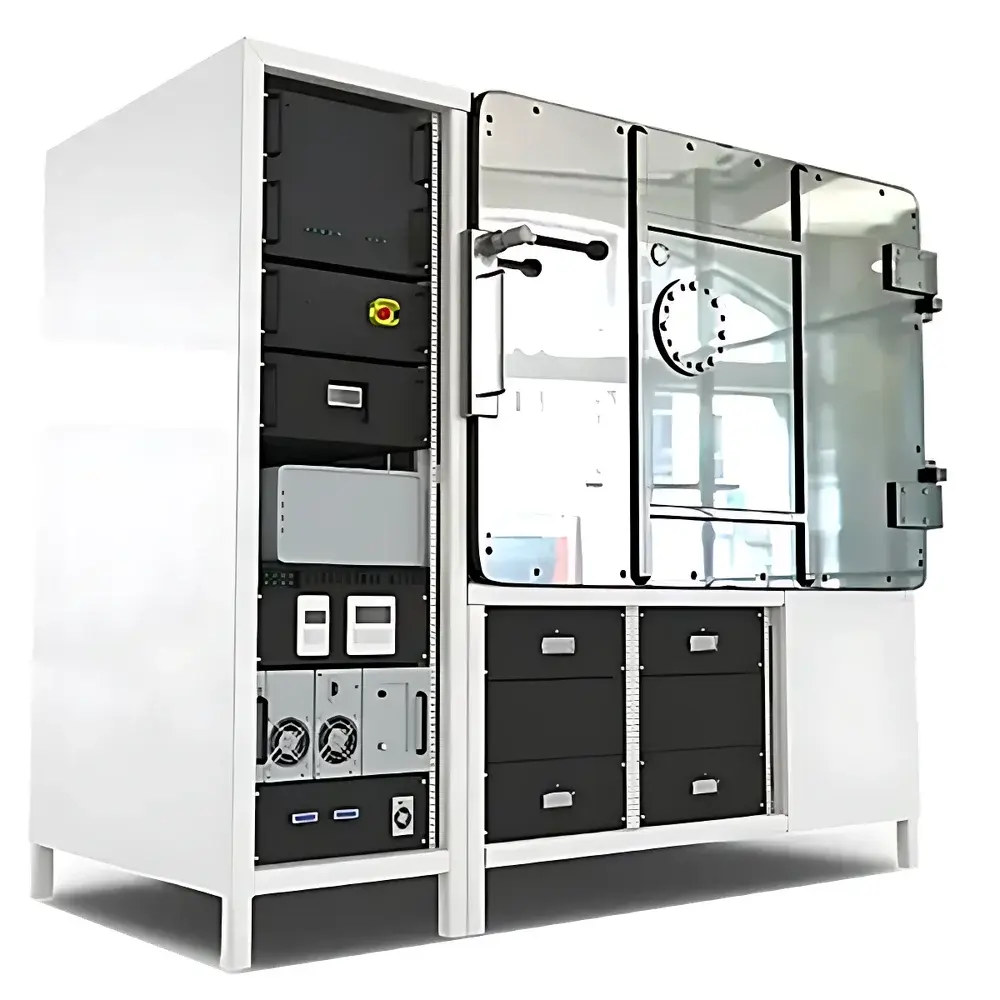
Sigray QuantumLeap-V210 Laboratory-Scale X-ray Absorption Fine Structure (XAFS) Spectrometer
| Brand | Sigray |
|---|---|
| Origin | USA |
| Model | QuantumLeap-V210 |
| Energy Range | 1.7–10 keV |
| XAS Modes | Transmission |
| XANES Resolution | ≤0.7 eV |
| EXAFS Resolution | <10 eV |
| Beam Spot Size | 100 µm (diameter) |
| Vacuum Level | <10⁻⁵ Torr |
| X-ray Source | Patented Multi-Target Microfocus Source (W & Mo anodes, 300 W, 20–50 kV) |
| Focusing Optics | Dual-Parabolic Capillary Lens (Pt-coated, ~80% transmission, 1:1 magnification) |
| Analyzer Crystals | HAPG/HOPG, Ge(111), Ge(220), Ge(400) |
| Detector | Spatially Resolved Photon-Counting Detector |
| Sample Capacity | Up to 16 × 3 mm diameter samples |
| Dimensions | 107 cm W × 241 cm H × 191 cm D |
Overview
The Sigray QuantumLeap-V210 is a laboratory-scale, vacuum-enclosed X-ray Absorption Spectroscopy (XAS) system engineered to deliver synchrotron-comparable performance for both X-ray Absorption Near Edge Structure (XANES) and Extended X-ray Absorption Fine Structure (EXAFS) measurements. Unlike conventional lab-based XAS instruments, the QuantumLeap-V210 employs a patented multi-target microfocus X-ray source coupled with high-efficiency capillary focusing optics and energy-dispersive crystal analyzers—enabling full-spectrum acquisition in seconds to minutes without monochromator scanning. Its operational energy range of 1.7–10 keV supports quantitative analysis of low-Z elements including phosphorus (Z = 15) and sulfur (Z = 16), made possible by a robust vacuum architecture maintaining pressures below 10⁻⁵ Torr. The system operates exclusively in transmission geometry, optimized for solid, thin-film, and pelletized samples, and delivers spatially resolved micro-XAS with a 100 µm beam spot—facilitating chemical mapping across heterogeneous materials without destructive sectioning.
Key Features
- Patented multi-target X-ray source with motorized tungsten (W) and molybdenum (Mo) anodes—enabling automatic selection to avoid characteristic line interference and ensure smooth, artifact-free spectra across 4.5–25 keV.
- Dual-parabolic capillary X-ray lens with Pt-coated inner surface, delivering ~80% optical throughput and 1:1 imaging fidelity at 100 µm focal spot size—critical for micro-XANES/EXAFS on spatially heterogeneous samples.
- Hermetically sealed ultra-high vacuum chamber (<10⁻⁵ Torr) with load-lock transition chamber—eliminating air absorption losses and enabling reliable low-energy XAS down to 1.7 keV.
- Energy-dispersive detection architecture using spatially resolved photon-counting detectors coupled with HAPG/HOPG or Ge-family analyzer crystals (Ge(111), Ge(220), Ge(400))—providing simultaneous acquisition of full XAS spectra without mechanical scanning.
- Motorized XYZ sample stage supporting up to 16 × 3 mm diameter samples, programmable for automated point-by-point or grid-based micro-XAS mapping.
- Real-time spectral preview during acquisition and integrated calibration routines traceable to NIST-standard reference foils (e.g., V, Fe, Cu).
Sample Compatibility & Compliance
The QuantumLeap-V210 accommodates standard XAS sample formats—including pressed pellets, self-supporting films, and electrodeposited layers—with minimal thickness constraints due to its high-brightness source and efficient optics. Its vacuum-compatible design supports air-sensitive and hygroscopic specimens without cryo-transfer or glovebox integration. For regulatory environments, the system supports audit-ready data capture: all acquisition parameters (energy step, dwell time, detector gain, vacuum pressure, sample position) are embedded in metadata and timestamped per spectrum. While not certified as GMP/ISO 17025-compliant out-of-the-box, the instrument’s deterministic acquisition workflow, hardware interlocks, and CSV-exported raw data (compatible with Athena, Artemis, Demeter, and LARCH) align with GLP and FDA 21 CFR Part 11 principles when deployed within validated laboratory information management systems (LIMS).
Software & Data Management
QuantumLeap Control Software provides a guided, workflow-driven interface for experiment setup—from element selection and automatic parameter loading (e.g., recommended energy range, exposure time, crystal choice) to multi-sample batch execution. Spectra are acquired as calibrated intensity-vs-energy datasets with live visualization. All raw and processed data export in ASCII-compatible CSV format, preserving column headers (Energy_eV, I0_counts, It_counts, Mu_norm) for direct ingestion into standard XAS analysis toolchains. No proprietary binary formats or vendor-locked processing engines are used. Optional Python API enables integration with custom automation scripts, Jupyter-based analysis pipelines, or institutional data repositories compliant with FAIR (Findable, Accessible, Interoperable, Reusable) principles.
Applications
- Catalysis research: In situ/operando tracking of oxidation state changes and local coordination geometry in supported metal catalysts (e.g., Co, Ni, Fe oxides) under controlled gas atmospheres.
- Energy materials: Quantitative speciation of sulfur redox couples in lithium–sulfur battery cathodes and phosphorus coordination environments in solid-state electrolytes.
- Environmental geochemistry: Speciation of As, Se, and Cr in soil extracts and mineral phases at environmentally relevant concentrations (ppm-level detection via micro-XAS).
- Biogeochemistry and metallomics: Mapping metal-binding motifs in metalloproteins and synthetic analogues without cryogenic freezing or crystallization.
- Materials degradation science: Time-resolved micro-XANES of corrosion interfaces in alloy coatings or passivation layers under electrochemical control.
FAQ
Does the QuantumLeap-V210 require external water cooling or compressed air?
No—the system uses closed-loop thermoelectric and forced-air cooling; no external utilities beyond standard 208–240 VAC, 30 A power are required.
Can the instrument perform fluorescence-mode XAS?
No—it is optimized exclusively for transmission-mode XAS. Fluorescence detection is not supported due to geometric and signal-to-noise constraints inherent to the energy-dispersive architecture.
Is remote operation supported?
Yes—software includes secure SSH-accessible command-line controls and VNC-enabled GUI remote desktop functionality, compatible with institutional firewall policies.
What maintenance is required for the X-ray optics and vacuum system?
Capillary lenses require no periodic realignment; vacuum pumps are oil-free turbomolecular units with >20,000-hour MTBF. Annual preventive maintenance includes pressure leak verification, detector gain recalibration, and source filament resistance check.
How does the system handle radiation safety compliance?
The fully interlocked vacuum enclosure meets ANSI N43.3 and IEC 61010-1 requirements for Class I X-ray equipment. Interlock logs and dose-rate maps (measured per NCRP Report No. 148) are provided with installation documentation.





