
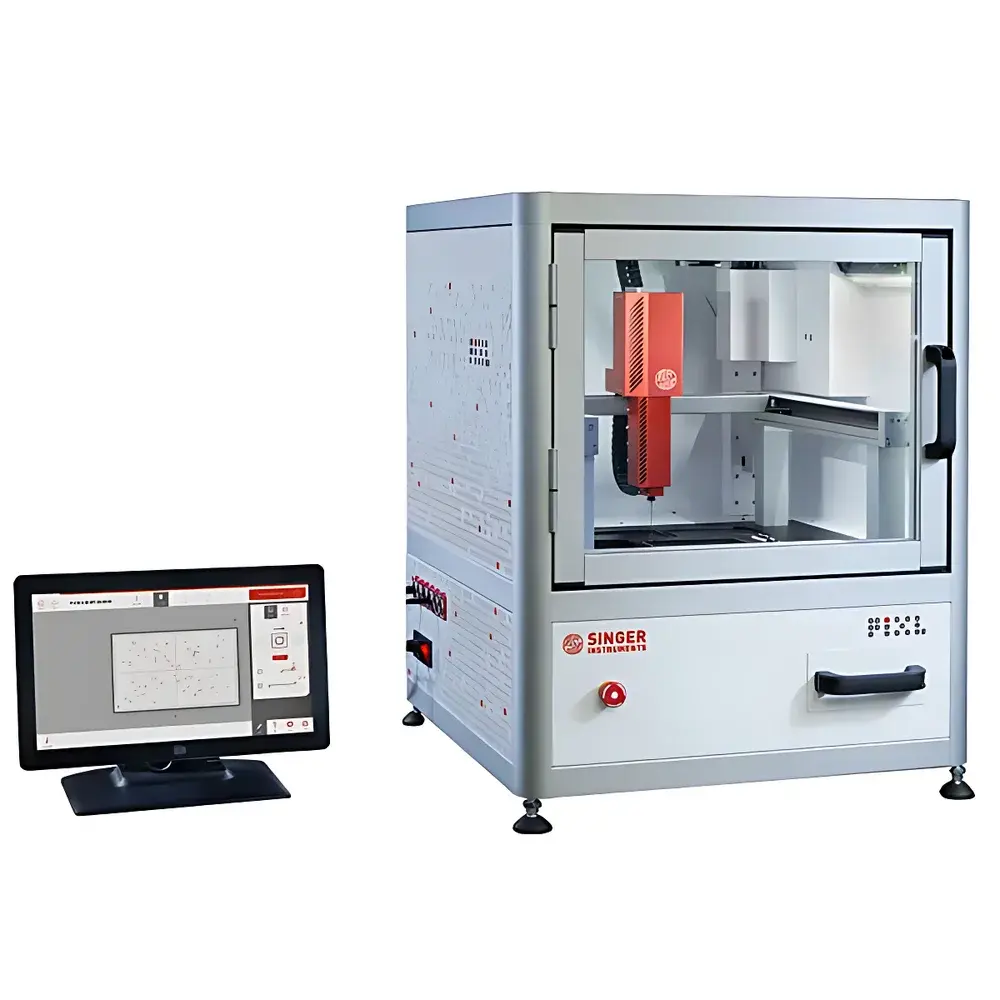
SINGER PIXL High-Precision Colony Picking Workstation
| Brand | SINGER |
|---|---|
| Origin | United Kingdom |
| Model | PIXL |
| Dimensions (L×W×H) | 718 × 630 × 810 mm |
| Weight | 70 kg |
| Power Supply | 240 V, 10 A (2400 W) |
| Throughput | Up to 130 microplates per hour |
| Supported Plate Formats | 96-well, 384-well, 1536-well SBS-compliant plates, Petri dishes, shallow/deep well plates, agar plates |
| Picking Modes | Liquid-to-liquid, liquid-to-agar, agar-to-liquid |
| Sterilization | Integrated UV lamp + anti-contamination front shield |
| Imaging | High-resolution static/dynamic colony morphology analysis |
| Fluorescence Capability | Multi-channel fluorescence module for GFP/RFP/mCherry and other standard fluorophores |
| Software Interface | Graphical user interface (GUI) with drag-and-drop workflow configuration |
| External Integration | API-enabled for LIMS, robotic arms, and third-party liquid handlers |
Overview
The SINGER PIXL High-Precision Colony Picking Workstation is an engineered solution for automated, aseptic isolation and re-arraying of microbial colonies—optimized for yeast, bacteria, and microalgae. Built upon a precision motion control platform with sub-millimeter positional accuracy, the PIXL employs sterile disposable picking pins (not needles or loops) that eliminate the need for in-line sterilization cycles between picks. Its core functionality is grounded in computer vision–guided colony recognition, combined with deterministic robotic arm kinematics calibrated to SBS-standard plate geometries. Unlike legacy colony pickers reliant on vacuum-based aspiration or mechanical scraping, the PIXL uses contact-based pin transfer—ensuring high viability retention (>95% colony recovery post-pick) and minimal cross-contamination risk. Designed for integration into NGS library preparation pipelines, functional genomics screens, and strain engineering workflows, the system operates under ambient lab conditions without requiring laminar flow enclosures—its integrated UV irradiation chamber and anti-contamination front shield maintain ISO Class 5-equivalent sterility during operation.
Key Features
- Throughput-optimized architecture enabling up to 130 standard microplates per hour—validated using 96-well and 384-well formats.
- Compact footprint (718 × 630 × 810 mm) designed for benchtop deployment in space-constrained BSL-2 labs.
- Multi-mode colony handling: supports liquid-to-liquid transfers, liquid-to-agar spotting, and agar-to-liquid picking across 96-, 384-, and 1536-density arrays.
- Integrated high-resolution imaging system with adjustable white-light and multi-channel fluorescence excitation/emission filters (470/525 nm, 540/590 nm, 580/630 nm) for phenotypic screening and reporter-based selection.
- Graphical workflow editor enabling point-and-click protocol definition—no coding required for colony selection logic, re-array mapping, or conditional branching based on morphology or fluorescence intensity thresholds.
- UV-C (254 nm) sterilization cycle (5–10 min) with automatic interlock safety shutoff; front shield constructed from UV-transparent acrylic with antimicrobial coating.
Sample Compatibility & Compliance
The PIXL accommodates all standard SBS-compliant vessels—including round Petri dishes (up to 150 mm), shallow/deep well plates, and custom agar-filled trays—without mechanical adaptation. It maintains compatibility with common microbiological media (LB, YPD, M9, R2A) and supports both opaque and translucent agar formulations. From a regulatory standpoint, the system’s audit-trail-capable software logs all user actions, instrument events, and image metadata in timestamped, immutable records—supporting GLP and GMP-aligned documentation requirements. While not FDA-cleared as a medical device, its operational design aligns with ISO 13485 principles for instrumentation used in quality-controlled life science research environments. All firmware and GUI updates are version-controlled and traceable via SINGER’s secure customer portal.
Software & Data Management
The PIXL Control Suite runs on a dedicated Windows 10 IoT Enterprise host with real-time process monitoring, image archiving, and CSV/JSON export of picking coordinates, colony metrics (area, circularity, intensity), and user-defined annotations. Image data is stored losslessly in TIFF format with embedded EXIF metadata including exposure time, gain, and calibration reference tags. The software supports 21 CFR Part 11–compliant electronic signatures when configured with domain-authenticated login and role-based access control (RBAC). An open RESTful API enables bidirectional communication with LIMS platforms (e.g., LabVantage, STARLIMS), scheduling systems, and automated incubator interfaces—facilitating end-to-end unattended library construction from colony isolation to PCR setup.
Applications
- NGS library preparation: High-fidelity picking of transformants post-electroporation or conjugation for barcoded amplicon sequencing.
- Functional genomics: Systematic arraying of yeast knockout collections (e.g., BY4741 background) for chemical-genetic interaction profiling.
- Strain optimization: Isolation and re-arraying of high-producing clones from mutagenesis or adaptive evolution experiments.
- Phenotypic screening: Quantitative morphological analysis (colony size, edge roughness, pigment diffusion) coupled with fluorescent reporter readouts.
- Plasmid rescue & validation: Targeted picking of antibiotic-resistant colonies followed by direct lysis and qPCR verification on-chip.
FAQ
Does the PIXL require daily maintenance or recalibration?
No routine recalibration is needed; the system performs self-alignment at startup using fiducial markers on the stage. Weekly cleaning of the pin holder and UV chamber is recommended.
Can the PIXL integrate with existing liquid handlers or incubators?
Yes—via Ethernet-connected API or physical I/O triggers (TTL/RS-232); documented integration protocols are provided for Hamilton STAR, Tecan Fluent, and HiMedia incubators.
Is training included with purchase?
SINGER provides remote and on-site operator certification (2-day course), covering protocol development, troubleshooting, and audit-log review procedures.
What is the expected lifetime of the disposable picking pins?
Each sterile pin set supports ≥5,000 colony picks under standard LB-YPD conditions; wear is monitored automatically via force-sensing feedback during contact.
Does the system support custom plate definitions beyond SBS standards?
Yes—the GUI allows manual coordinate mapping for non-standard trays, including custom agar molds or multi-layered microfluidic devices.





