
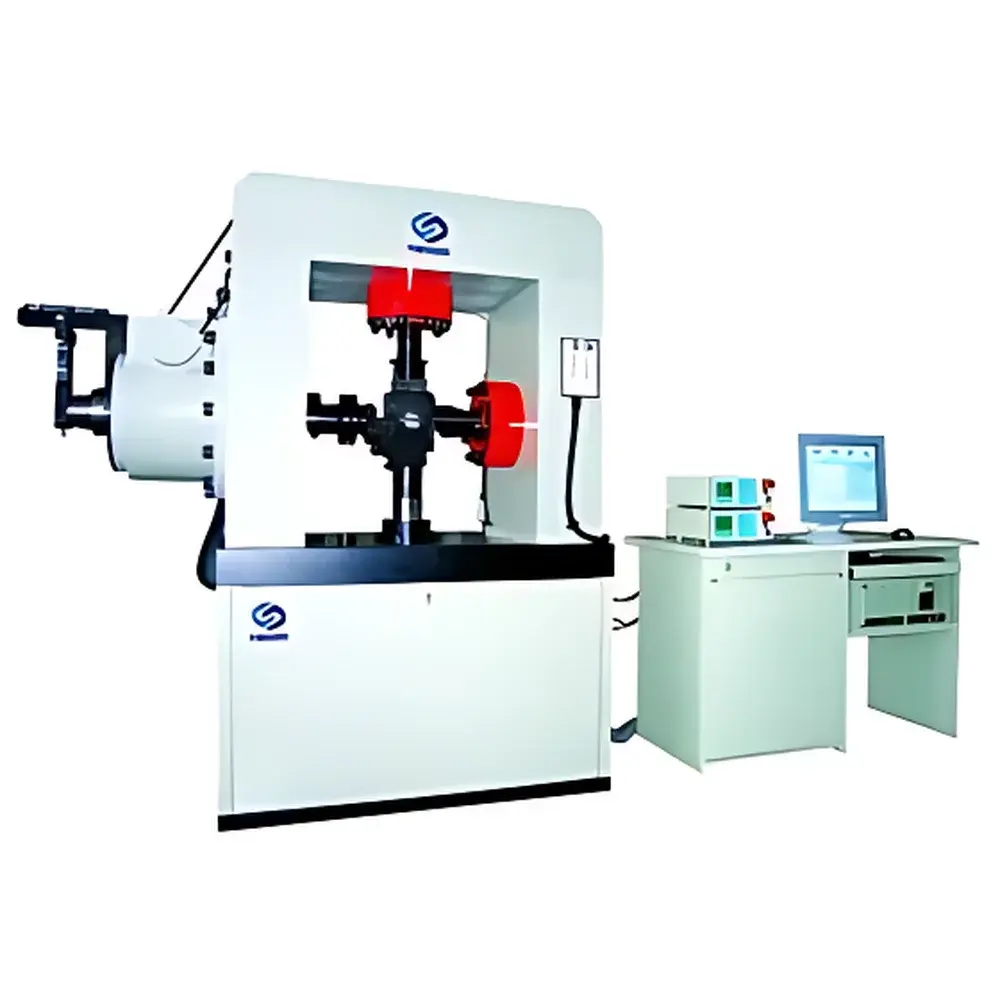
SINOTEST ZYJ-L400 Rock Shear Rheometer
| Brand | SINOTEST |
|---|---|
| Origin | Jilin, China |
| Manufacturer Type | Direct Manufacturer |
| Model | ZYJ-L400 |
| Axial Max Load | 400 kN |
| Shear Max Load | 400 kN |
| Force Resolution | <10 N |
| Force Measurement Accuracy | ±0.5% of reading |
| Shear Deformation Range | 0–20 mm |
| Deformation Measurement Accuracy | ±0.5% F.S. |
| Loading Speed (Axial/Shear) | 0.001–10 mm/min or 2–100 kN/min |
| Specimen Dimensions | 150×150×150 mm / 100×100×100 mm |
| Long-Term Stability Duration | ≥120 days |
| Power Consumption (Rheological Mode) | <0.5 kW |
Overview
The SINOTEST ZYJ-L400 Rock Shear Rheometer is a high-stability, dual-axis electro-mechanical servo testing system engineered for long-term rheological characterization of geological materials under controlled shear and axial loading conditions. It operates on the principle of coupled stress–strain rate analysis in quasi-static regimes, enabling precise quantification of time-dependent deformation behavior—including primary, secondary (steady-state), and tertiary creep stages—as well as stress relaxation responses in rock and concrete specimens. Designed specifically for geomechanical laboratories, mining research institutes, and civil engineering R&D centers, this instrument supports standardized shear rheology protocols for intact rock, jointed rock masses, weak-plane-embedded specimens (e.g., bedding planes, faults, or clay seams), and cementitious composites. Its architecture meets structural requirements for ASTM D7012 (Standard Test Methods for Compressive Strength and Elastic Moduli of Intact Rock Core Specimens), ISO 1920-6 (Testing of Concrete — Part 6: Determination of Compressive Strength of Concrete), and supplementary guidelines from the International Society for Rock Mechanics (ISRM) for shear creep testing.
Key Features
- Dual independent servo-controlled actuators for simultaneous and decoupled application of axial compressive load (up to 400 kN) and tangential shear force (up to 400 kN), ensuring true biaxial stress path control.
- High-resolution force measurement using calibrated precision load cells (<10 N resolution; ±0.5% reading accuracy) with minimal thermal drift—critical for multi-week creep experiments requiring micro-newton-level stability.
- EDC60 full-digital controller (DOLL GmbH, Germany) integrated with industrial PC-based acquisition software, supporting closed-loop displacement and load control modes with programmable ramp-hold-step sequences.
- Real-time data logging at configurable sampling intervals (down to 100 ms), synchronized acquisition of axial displacement, shear displacement, axial force, and shear force, with built-in self-diagnostic routines executed before and during test execution.
- Uninterruptible power supply (UPS) integration ensures continuity of test execution and data integrity during grid outages—essential for experiments exceeding 100 days in duration.
- Low-power operational profile (<0.5 kW in sustained rheological mode), optimized for energy-efficient long-duration testing without thermal interference to specimen or sensor systems.
Sample Compatibility & Compliance
The ZYJ-L400 accommodates standard cubic rock specimens per ISRM suggested methods: 100 × 100 × 100 mm and 150 × 150 × 150 mm. Custom fixtures support inclined weak-plane configurations (e.g., 30°, 45°, 60° shear interfaces) and bonded interface testing. The system complies with mechanical safety standards IEC 61000-6-2 (EMC immunity) and ISO 12100 (risk assessment for machinery). Data traceability aligns with GLP (Good Laboratory Practice) requirements, including electronic audit trails, user access levels, and timestamped raw data export in CSV and binary formats compatible with MATLAB, Python (NumPy/Pandas), and commercial FE post-processors.
Software & Data Management
The embedded control and analysis suite provides real-time visualization of force–displacement–time trajectories across both axes. Advanced graphical functions include dynamic curve zooming, overlay of multiple test runs, differential strain-rate plotting, logarithmic time scaling, annotation insertion, and automated report generation compliant with internal QA templates. All datasets are stored with metadata tags (operator ID, environmental temperature/humidity logs, calibration certificate IDs, and versioned firmware build numbers). Export options include ASCII, HDF5, and XML schemas supporting interoperability with LIMS platforms and regulatory submissions under FDA 21 CFR Part 11 when configured with digital signature modules.
Applications
- Time-dependent shear strength degradation in fault-zone gouge under reservoir-scale effective stresses.
- Creeep rupture prediction in underground excavation support design (e.g., tunnel lining interaction with surrounding rock).
- Constitutive modeling of viscoelastic–viscoplastic behavior in shale, sandstone, and granite using Burgers, Findley, or fractional derivative models.
- Long-term performance evaluation of grouted rock bolts and interface bonding between concrete and bedrock.
- Validation of numerical simulations (e.g., FLAC2D/FLAC3D, Phase2, RS2) against experimentally derived rheological parameters (creep compliance J(t), relaxation modulus G(t)).
- Accelerated aging studies of concrete-rock interfaces under variable humidity and temperature cycling (when used with optional environmental chamber integration).
FAQ
What types of rock specimens are compatible with the ZYJ-L400?
Standard cubic specimens measuring 100 × 100 × 100 mm or 150 × 150 × 150 mm are supported. Anisotropic samples with pre-defined discontinuities (e.g., saw-cut joints, natural bedding planes) can be tested using adjustable shear fixtures.
Does the system support both creep and stress relaxation testing protocols?
Yes—programmable control logic enables automatic switching between constant-load (creep) and constant-displacement (relaxation) modes, with seamless transition handling and derivative-based termination criteria.
How is data integrity maintained during extended tests lasting over 100 days?
The EDC60 controller performs periodic internal diagnostics, while the UPS-backed architecture guarantees uninterrupted power delivery. All acquired data are written redundantly to SSD and network-attached storage with SHA-256 checksum validation.
Is third-party software integration possible?
Yes—open API access (TCP/IP socket interface) allows direct communication with custom Python or LabVIEW environments for real-time parameter modulation and external model coupling.
What calibration documentation is provided?
Each unit ships with NIST-traceable calibration certificates for all load cells and displacement transducers, valid for 12 months, along with uncertainty budgets per ISO/IEC 17025 Annex A.



