
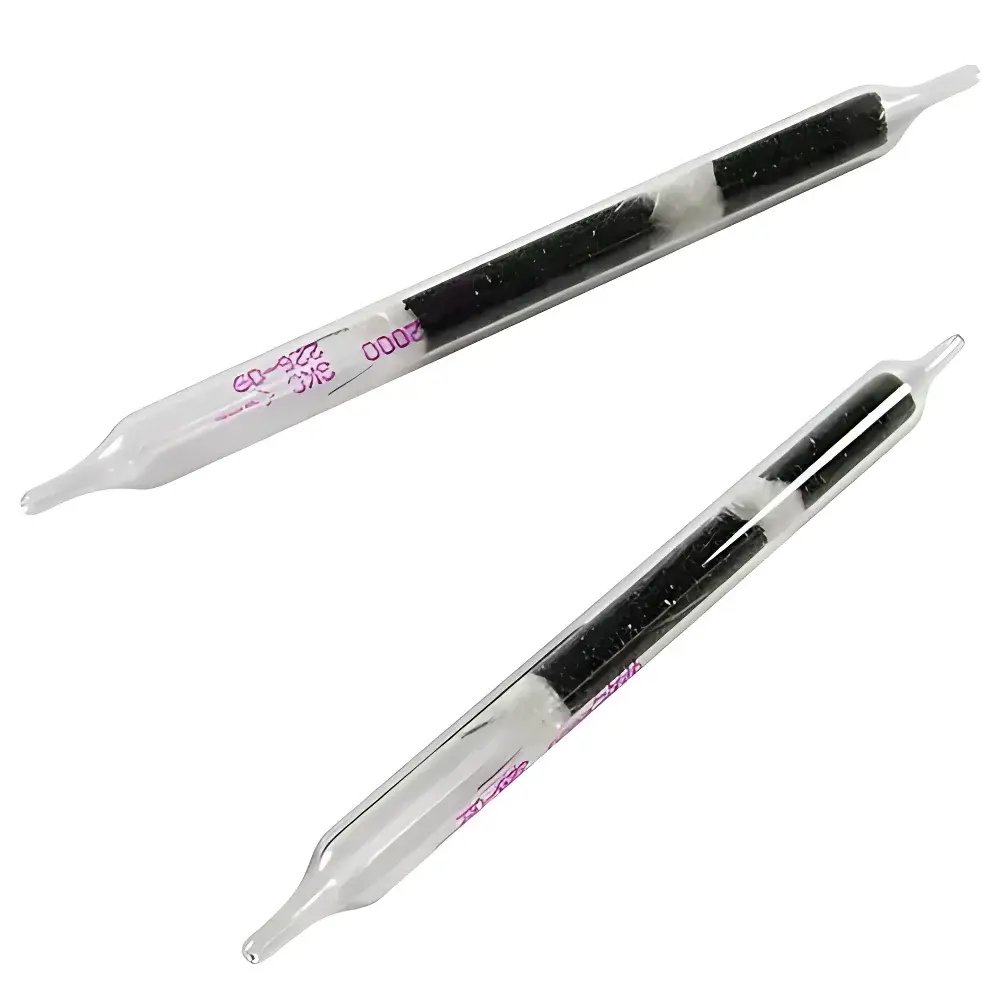
SKC Anasorb Sorbent Tubes
| Brand | SKC |
|---|---|
| Origin | USA |
| Model | Anasorb Sorbent Tubes |
| Type | Pre-packed, Certified Air Sampling Sorbent Tubes for Occupational & Environmental Monitoring |
Overview
The SKC Anasorb Sorbent Tubes are a family of rigorously validated, pre-packed sampling media engineered for quantitative collection and subsequent thermal or solvent desorption analysis of airborne organic vapors and gases. Introduced commercially in 1973 and adopted by the U.S. National Institute for Occupational Safety and Health (NIOSH) as a reference method component, Anasorb tubes represent over five decades of iterative development in sorbent science and air sampling metrology. Each tube is manufactured under controlled conditions to ensure batch-to-batch consistency, certified mass loading, and documented breakthrough capacity—critical attributes for compliance with OSHA, NIOSH, ISO 16000-6, and ASTM D5466 methodologies. The Anasorb platform leverages distinct carbonaceous and polymeric sorbents—including activated carbon, graphitized carbon black (GCB), and porous polymer resins—each selected for defined polarity, surface area, pore structure, and thermal stability to match analyte volatility, polarity, and reactivity.
Key Features
- Pre-packed and individually sealed in inert aluminum foil pouches with desiccant and humidity indicator, ensuring shelf life stability and preventing pre-sampling contamination.
- Traceable lot certification including sorbent mass, tube dimensions, end-caps (glass wool or stainless steel frits), and documented performance data (breakthrough volume, desorption efficiency, storage stability).
- Multiple sorbent configurations optimized for specific analyte classes: Anasorb 747 (low-ash synthetic carbon) for broad-spectrum nonpolar and moderately polar organics; Anasorb 727 (cross-linked styrene-divinylbenzene polymer) for reactive and highly polar compounds (e.g., aldehydes, ketones, amines); Anasorb GCB1/GCB2 for aliphatic/aromatic hydrocarbons and semi-volatile organic compounds (SVOCs); and Anasorb CSC (coconut shell charcoal) for high-capacity nonpolar vapor sampling.
- Available in standard configurations (e.g., 6 mm × 70 mm, 8 mm × 110 mm, 10 mm × 110 mm) with dual-bed options (e.g., Anasorb 747/Tenax TA, GCB1/Carbosieve S-III) to extend dynamic range and prevent front-end breakthrough in complex mixtures.
- Compatible with all major thermal desorption (TD) autosamplers (e.g., Markes UNITY, Gerstel MultiPurpose Sampler) and solvent extraction workflows using validated eluents such as CS₂, DMF, or methanol.
Sample Compatibility & Compliance
Anasorb tubes support sampling across occupational hygiene, indoor air quality (IAQ), and ambient environmental monitoring applications. They are referenced in over 40 NIOSH and OSHA methods (e.g., NIOSH 1501, 1600, 1601, 1603, 1613, 1624, 1625) and align with ISO 16000-6:2011 for VOC determination in indoor air. Performance validation includes documented breakthrough volumes (1–15 L for Anasorb 727 at 0.2 L/min), desorption efficiencies ≥95% for target analytes (e.g., benzene, toluene, xylene, formaldehyde, acetone), and stability studies confirming recoveries >90% after 30 days storage at ambient temperature and 50% relative humidity. All tubes meet GLP-compliant documentation requirements, including full traceability to raw material lots, QC test reports, and expiration dating.
Software & Data Management
While Anasorb tubes themselves are passive sampling media, their use integrates seamlessly into regulated analytical workflows governed by chromatographic data systems (CDS) compliant with FDA 21 CFR Part 11 and EU Annex 11. When paired with thermal desorption–gas chromatography–mass spectrometry (TD-GC-MS) platforms, Anasorb-derived data supports audit-ready electronic records, including sample ID tracking, calibration history, instrument method parameters, and audit trails for peak integration and quantitation. SKC provides downloadable method transfer documents and compatibility matrices for major TD system vendors to facilitate method validation and regulatory submission.
Applications
- Occupational exposure assessment for solvents (e.g., chlorinated hydrocarbons, ketones, esters) in manufacturing, painting, printing, and pharmaceutical cleanrooms.
- Indoor air quality surveys targeting formaldehyde, acetaldehyde, and other carbonyl compounds using Anasorb 727-based tubes.
- Environmental site assessment for petroleum hydrocarbons (BTEX, naphthalene) and chlorinated solvents using Anasorb GCB1 or CSC configurations.
- Method development for emerging contaminants—including perfluoroalkyl substances (PFAS) precursors and oxygenated volatile organic compounds (OVOCs)—leveraging Anasorb’s customizable dual-bed architectures.
- Validation of real-time sensor data through integrated grab-sampling and laboratory confirmation.
FAQ
What distinguishes Anasorb 747 from standard coconut shell charcoal?
Anasorb 747 is a low-ash synthetic carbon with tailored surface chemistry, offering improved recovery for polar ketones and aldehydes where traditional coconut charcoal exhibits poor retention or catalytic degradation.
Can Anasorb tubes be used for formaldehyde sampling?
Yes—Anasorb 727 is specifically validated for formaldehyde and other reactive carbonyls, demonstrating high breakthrough volumes and minimal artifact formation during storage.
Are Anasorb tubes suitable for thermal desorption without derivatization?
All Anasorb sorbents—including 727, 747, GCB1, and CSC—are thermally stable up to 320°C and compatible with direct thermal desorption GC-MS, eliminating the need for chemical derivatization in most cases.
How are Anasorb tubes certified for regulatory compliance?
Each production lot undergoes independent verification of sorbent mass, dimension tolerance, and performance against NIOSH criteria, with full QC documentation provided on request for audit readiness.
Do humidity levels affect Anasorb tube performance?
Controlled studies show no statistically significant impact of relative humidity (30–70%) on breakthrough volume or desorption efficiency for both polar and nonpolar compounds across Anasorb 727, 747, and CSC formulations.
Related Products







