
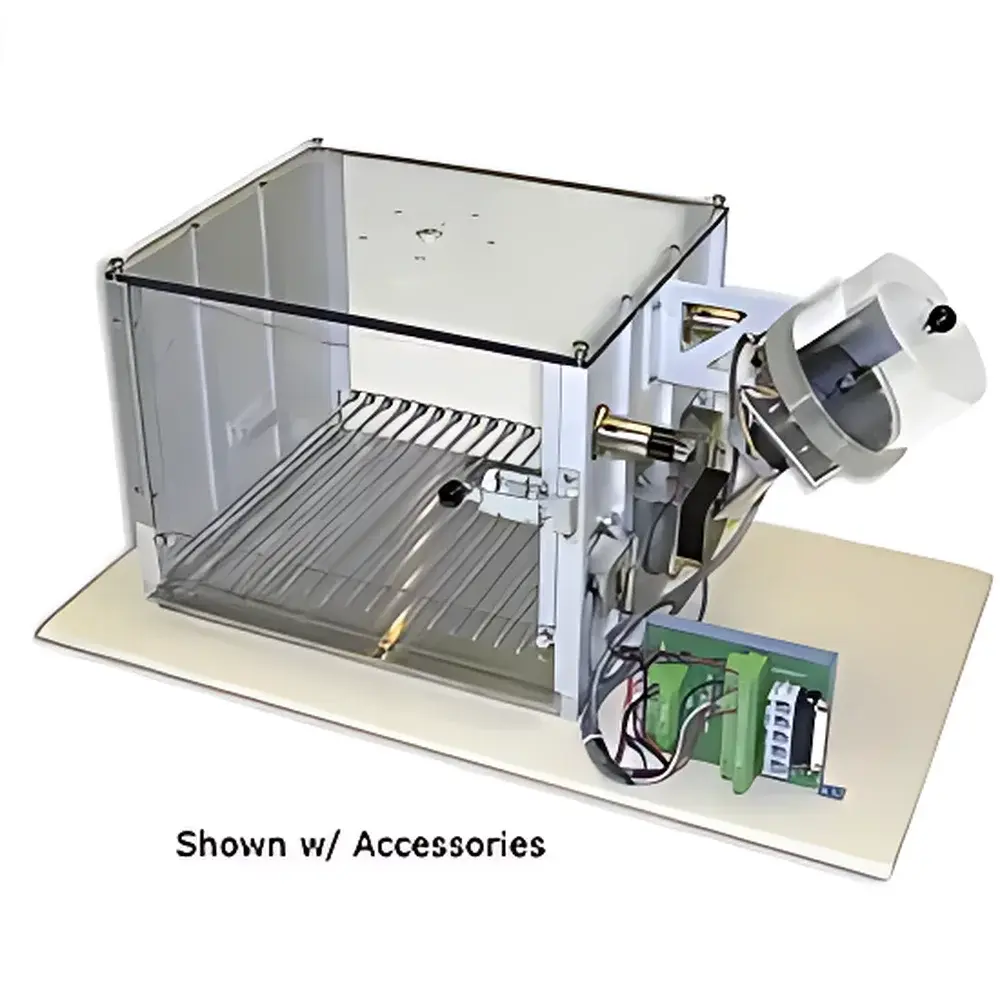
Skinner Box Operant Conditioning System – Lafayette Model for Rodent Behavioral Research
| Brand | RWD |
|---|---|
| Origin | Shenzhen, China |
| Manufacturer | RWD Life Science |
| Country of Origin | China |
| Model | Lafayette (USA) |
| Pricing | Available Upon Request |
Overview
The Skinner Box Operant Conditioning System is a rigorously engineered behavioral testing platform designed for precise quantification of operant learning and decision-making in rodents. Based on B.F. Skinner’s foundational principles of operant conditioning—where behavior is shaped by its consequences—the system implements controlled stimulus–response paradigms grounded in experimental psychology and translational neuroscience. This apparatus operates on a closed-loop paradigm: discrete environmental stimuli (e.g., light cues, auditory tones, or tactile prompts) are presented according to programmable schedules (FI, FR, VI, VR, DRL, etc.), and subject responses—lever presses, nose pokes, or touchscreen interactions—are detected with millisecond-level temporal resolution. The system supports both positive reinforcement (liquid or pellet delivery) and aversive contingencies (foot shock, optional), enabling rigorous investigation of reward valuation, behavioral inhibition, compulsivity, and neuropharmacological modulation. It is widely deployed in preclinical studies aligned with NIH BRAIN Initiative priorities, FDA-recommended behavioral pharmacology protocols, and GLP-compliant toxicology assessments.
Key Features
- Fully modular, standardized 3-inch panel architecture—compatible with legacy and third-party accessories from major vendors including Med Associates and Campden Instruments.
- Configurable base chassis accommodating rat- or mouse-specific dimensions, with adjustable floor grid spacing and removable waste trays for hygienic longitudinal studies.
- Optional integrated touchscreen interface (10.1″ capacitive display) validated for cognitive–operant dual-task paradigms, supporting visual discrimination, reversal learning, and attentional set-shifting protocols.
- Precision stimulus delivery: calibrated LED arrays (470 nm, 525 nm, 625 nm), broadband white noise generator (20–20,000 Hz, ±1 dB flatness), and digitally synthesized pure-tone output (1–20 kHz, 0.1 Hz resolution).
- Behavioral actuator options include stainless-steel levers (standard or reinforced), infrared nose-poke detectors (12 mm aperture, <10 ms latency), and programmable retractable levers for response inhibition assays.
- Integrated reward delivery subsystems: peristaltic pump (0.1–5 mL/min flow control, compatible with sucrose, ethanol, or drug solutions) and pellet dispenser (45 mg precision, jam-resistant hopper).
- Optional foot shock module (0.01–2.0 mA, square-wave, adjustable duration and inter-stimulus interval) compliant with NIH Animal Welfare Office guidelines for aversive learning paradigms.
Sample Compatibility & Compliance
The system is validated for use with Sprague-Dawley and Wistar rats (200–500 g), C57BL/6 and BALB/c mice (18–35 g), and transgenic lines expressing optogenetic or chemogenetic constructs. All hardware components meet IEC 61000-6-3 EMC emission standards and UL 61010-1 safety requirements for laboratory equipment. Data acquisition firmware supports audit trail logging and user access controls required under 21 CFR Part 11 for regulated behavioral pharmacology studies. Experimental protocols align with recommendations in the “Guide for the Care and Use of Laboratory Animals” (NRC, 2011) and ASTM E2559–22 for behavioral assay validation.
Software & Data Management
Control and data acquisition are managed via Lafayette’s proprietary OperantWorks™ software (v5.2+), a Windows-based application supporting real-time event logging, schedule scripting in a Python-embedded environment, and automated session archiving in HDF5 format. Raw timestamps (microsecond resolution), stimulus onset/offset markers, and response latencies are exported as CSV or MATLAB-compatible structures. Built-in statistical modules compute rate metrics (responses/sec), breakpoint analysis (PR schedules), and omission ratios (DRL tasks). Integration with MATLAB, Python (via PySerial and Pandas), and LabVIEW is supported through documented APIs. All session metadata—including animal ID, protocol version, operator ID, and calibration logs—is stored in SQLite databases with SHA-256 integrity hashing.
Applications
- Drug discovery: assessment of psychostimulant, opioid, or anxiolytic effects on reinforcement sensitivity and behavioral flexibility.
- Neuropsychiatric modeling: evaluation of compulsive responding in SAPAP3-KO mice or impulsivity in DAT-KD rats.
- Neurodegenerative research: longitudinal tracking of operant deficits in α-synuclein transgenic models.
- Cognitive neuroscience: touchscreen-based paired-associate learning and spatial working memory in aged rodents.
- Translational psychiatry: cross-species validation of computational models (e.g., Q-learning, hierarchical Bayesian inference) using trial-by-trial choice data.
- Toxicology: OECD Test Guideline 426-compliant assessment of developmental neurotoxicity endpoints.
FAQ
What species and strain configurations are supported out-of-the-box?
Standard configurations cover adult male/female C57BL/6J mice and Sprague-Dawley rats; custom adaptations for gerbils, hamsters, or juvenile cohorts are available upon engineering review.
Is the system compatible with optogenetic or fiber photometry integration?
Yes—dedicated TTL synchronization ports (5 V CMOS) support precise alignment of laser stimulation or fluorescence acquisition with operant events.
Can multiple boxes be synchronized for cohort-level behavioral phenotyping?
Up to 16 units can be daisy-chained via Ethernet with sub-millisecond inter-box timing alignment using IEEE 1588 PTP.
Does the software support automated protocol randomization and counterbalancing?
Yes—OperantWorks includes built-in randomization engines for stimulus order, side bias correction, and within-subject Latin-square design generation.
Are calibration certificates and IQ/OQ documentation available for GxP environments?
Full validation packages—including Installation Qualification (IQ), Operational Qualification (OQ), and traceable sensor calibration reports—are provided for regulated laboratories upon request.





