
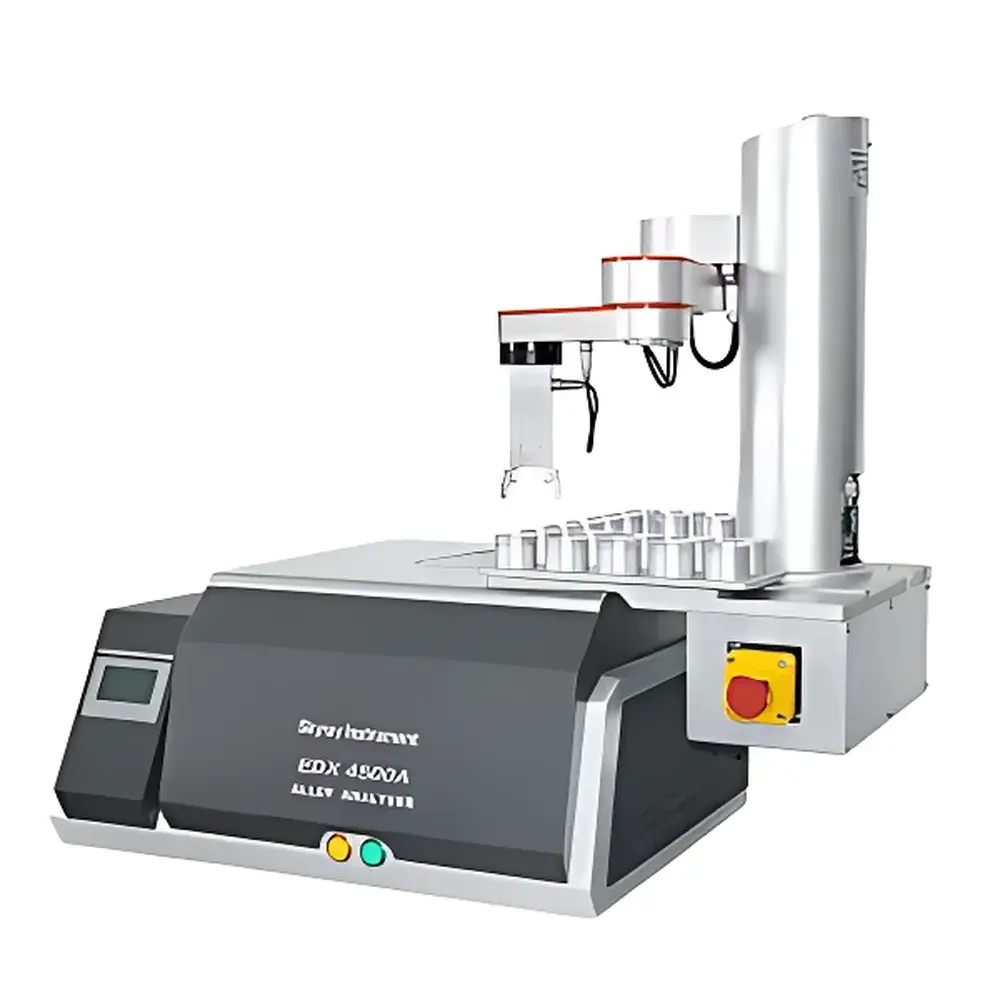
Skyray Instrument EDX 4500A Energy Dispersive X-Ray Fluorescence Spectrometer
| Brand | Skyray Instrument |
|---|---|
| Origin | Jiangsu, China |
| Manufacturer Type | Original Equipment Manufacturer (OEM) |
| Country of Origin | China |
| Model | EDX 4500A |
| Configuration | Benchtop/Floor-standing |
| Application Scope | General-purpose Inorganic Elemental Analysis |
| Automation | 23-position Automatic Sample Changer Integrated |
| Light Element Capability | Optimized for Na–Cl (Z = 11–17) via Intelligent Vacuum System |
| Regulatory Context | Compliant with ISO 8258 (control charting), ASTM E1621 (XRF for metals), and GB/T 176–2017 (cement analysis) |
Overview
The Skyray Instrument EDX 4500A is a benchtop/floor-standing energy dispersive X-ray fluorescence (EDXRF) spectrometer engineered for high-precision, non-destructive elemental quantification across the range of sodium (Na, Z = 11) to barium (Ba, Z = 56) and beyond. Its core measurement principle relies on primary X-ray excitation of sample atoms, followed by detection of characteristic secondary (fluorescent) X-rays using a high-resolution silicon drift detector (SDD). The instrument integrates an intelligent vacuum system—capable of dynamic pressure regulation between 1–10 Pa—to enhance photon transmission efficiency for low-energy X-rays emitted by light elements (Na, Mg, Al, Si, P, S, Cl), thereby achieving detection limits below 10 ppm for these analytes in optimized matrix conditions. Unlike wavelength-dispersive systems, the EDX 4500A delivers rapid multi-element acquisition (< 60 s per sample) without mechanical scanning, making it suitable for routine QC/QA workflows in industrial laboratories where throughput, reproducibility, and operational simplicity are prioritized over ultra-trace detection.
Key Features
- Intelligent vacuum control system with real-time pressure feedback, enabling stable excitation and detection of light elements (Na–Cl) without helium purge or cryogenic cooling.
- High-throughput automation via integrated 23-position robotic autosampler: supports unattended sequential analysis with programmable dwell times, repeat measurements, and auto-calibration triggers.
- Optimized excitation geometry with dual-target X-ray tube (Rh/Ag anodes selectable via software) and variable kV/mA control (5–50 kV, 1–1000 µA) for matrix-adaptive excitation.
- Large-area silicon drift detector (≥25 mm² active area) with Peltier cooling and <125 eV Mn Kα resolution at 0°C, ensuring robust peak deconvolution in complex spectra.
- Rugged, vibration-insensitive optical path design with fixed collimation and pre-aligned detector positioning—no field recalibration required under normal operating conditions.
- Modular hardware architecture supporting future upgrades including thin-film analysis modules, micro-spot mapping accessories, and compliance-ready software packages.
Sample Compatibility & Compliance
The EDX 4500A accepts solid blocks, pressed pellets, fused beads, powders (in sample cups), and flat-surface coatings up to 100 mm diameter × 40 mm height. It complies with IEC 61000-4 electromagnetic compatibility standards and meets Class 1 laser product safety requirements per IEC 60825-1. Analytical protocols align with ASTM E1621 (standard test method for elemental analysis of metal alloys by EDXRF), ISO 21047 (iron ores), and GB/T 176–2017 (cement chemical analysis). Optional software modules support 21 CFR Part 11-compliant electronic signatures, full audit trail logging, and user-role-based access control—enabling deployment in GLP- and GMP-regulated environments such as metallurgical QA labs and raw material certification centers.
Software & Data Management
Quantitative analysis is performed using SkyAnalysis™ v4.x, a Windows-based application featuring fundamental parameter (FP) and empirical calibration modes. The software includes spectral deconvolution algorithms based on iterative least-squares fitting, matrix correction routines for interelement effects (e.g., absorption, enhancement), and automated background subtraction using Snip algorithm variants. All measurement parameters—including tube voltage/current, detector live time, vacuum status, and sample ID—are embedded in raw data files (.skd format) and exported to CSV or XML for LIMS integration. Data integrity safeguards include timestamped operation logs, version-controlled method files, and checksum-verified export archives.
Applications
The EDX 4500A serves as a primary elemental analyzer in mineral processing (grade control of iron ore, bauxite, phosphate rock), ferrous and non-ferrous metallurgy (slag composition, alloy verification, inclusion analysis), cement and refractory manufacturing (raw mix homogeneity, clinker phase monitoring), petrochemical catalyst testing (Ni/V ratio in FCC catalysts), and environmental solid waste screening (heavy metal leachability assessment per TCLP protocols). Its ability to quantify major (Ca, Fe, SiO₂), minor (Ti, Mn, Cr), and trace (As, Pb, Cd) constituents in a single run reduces reliance on complementary techniques such as ICP-OES for routine batch release testing.
FAQ
Does the EDX 4500A require liquid nitrogen or Peltier-only cooling?
The standard configuration uses thermoelectric (Peltier) cooling only; no LN₂ is required. Detector stabilization time is ≤5 minutes from ambient startup.
Can the instrument analyze liquids or irregularly shaped samples?
Liquids must be contained in sealed XRF sample cups with Mylar or Polyimide film windows; irregular solids require flattening or pelletization to ensure consistent geometry and excitation volume.
Is method transfer possible between different EDXRF instruments?
Yes—SkyAnalysis™ supports export of FP models and calibration coefficients, though empirical calibrations require revalidation on each unit due to detector response variability.
What maintenance intervals are recommended?
Vacuum pump oil replacement every 6 months; detector window inspection annually; X-ray tube lifetime rated at ≥20,000 hours under typical operating conditions (30 kV/500 µA).




