
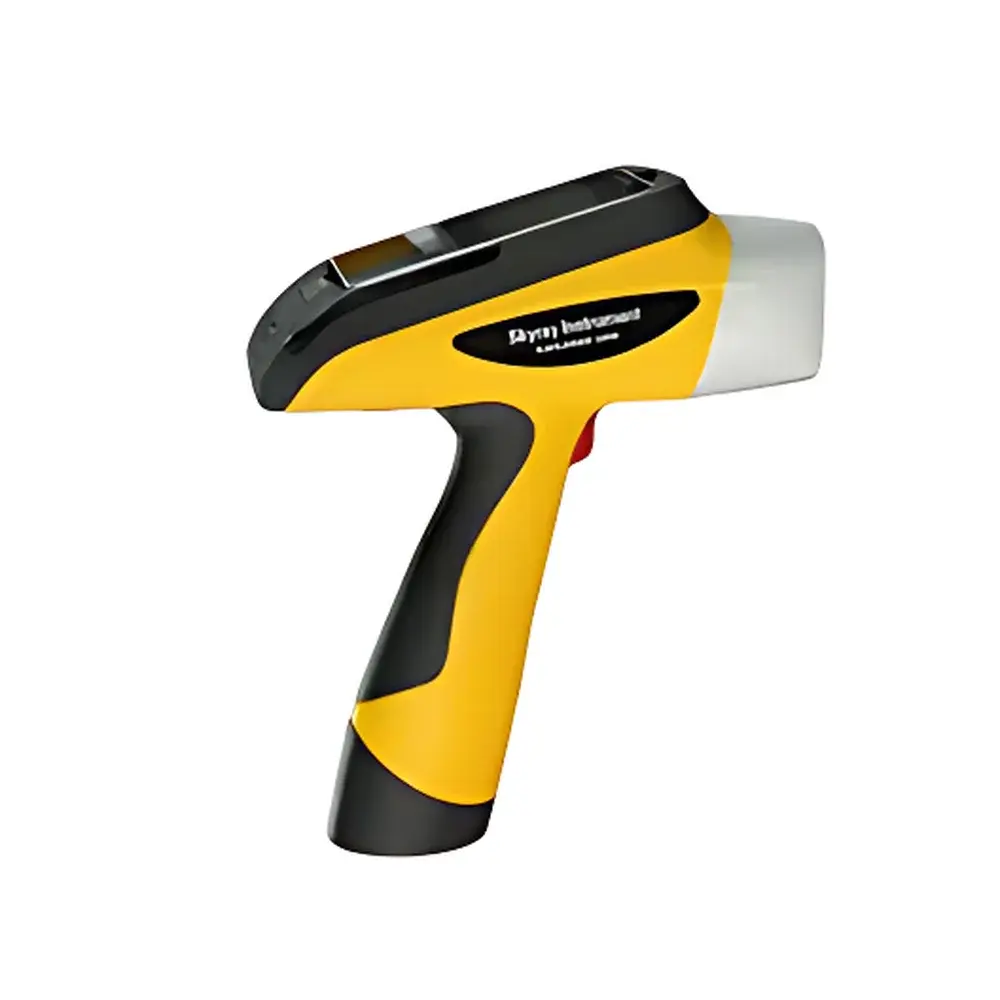
Skyray Instrument EXPLORER Series Portable Energy Dispersive X-Ray Fluorescence Spectrometer
| Brand | Skyray Instrument |
|---|---|
| Origin | Jiangsu, China |
| Manufacturer Type | Manufacturer |
| Regional Category | Domestic (China) |
| Model | EXPLORER |
| Price Range | USD 14,000–42,500 |
| Application Form Factor | Handheld / Portable |
| Industry Use | General-Purpose |
| Elemental Range | Mg (Z=12) to U (Z=92) |
| Concentration Range | 1 ppm – 99.99% |
| Energy Resolution | As low as 128 eV (FWHM at Mn Kα) |
| Repeatability | ≤0.05% RSD (for elements >96% wt in homogeneous samples) |
Overview
The Skyray Instrument EXPLORER Series is a family of handheld energy dispersive X-ray fluorescence (EDXRF) spectrometers engineered for field-deployable, non-destructive elemental analysis across diverse industrial and regulatory domains. Based on fundamental EDXRF physics—where primary X-rays from a micro-focus X-ray tube excite characteristic secondary (fluorescent) X-rays from sample atoms—the EXPLORER platform delivers laboratory-grade quantitative and qualitative data without sample preparation. Its core architecture integrates a high-brightness Ag-target end-window microfocus X-ray tube (50 kV / 200 µA), a silicon drift detector (SDD) with Fast-SDD option, and a real-time digital pulse processor enabling up to 500 kcps effective count rate. The system operates under ambient air conditions—enabled by ultra-short source-to-detector geometry and optimized beam path design—allowing reliable detection of light elements starting from magnesium (Mg, Z=12), eliminating the need for helium purging or vacuum chambers.
Key Features
- Compact ergonomic design: 1.7 kg total mass; dimensions 244 × 90 × 330 mm; integrated pistol-grip handle with military-grade shock-absorbing case.
- 5-inch full-HD (1080 × 720) capacitive touchscreen with 360° rotational mount—optimized for sunlight readability and glove-compatible multi-touch operation.
- IP54-rated sealed enclosure: dust- and splash-resistant housing validated for continuous operation in -20°C to +50°C ambient temperatures and ≤90% RH.
- Triple-layer radiation safety architecture: (1) hardware interlock disabling X-ray emission when no sample is detected; (2) reinforced alloy test chamber wall; (3) optional lead-lined shielding hood for low-Z matrix suppression.
- Intelligent tri-color status indicator: green (standby), pulsing red (active measurement), amber (fault alert)—visible from all angles.
- Dual-power configuration: standard 9,000 mAh Li-ion battery (12 h runtime); optional 27,000 mAh extended battery (up to 72 h field operation) with hot-swap capability and built-in backup memory.
- Integrated positioning systems: GPS geotagging (latitude/longitude/elevation), Wi-Fi 802.11 b/g/n, Bluetooth 4.2 for peripheral connectivity (e.g., portable printers, external storage).
Sample Compatibility & Compliance
The EXPLORER series supports direct analysis of solid metals, alloys, ores, soils, sediments, polymers, ceramics, electronic components, packaging materials, and powdered samples—no digestion, pressing, or coating required. It complies with international radiation safety standards including IEC 62495 (handheld XRF safety), ANSI N43.3, and EU Directive 2013/59/Euratom. For regulated workflows, firmware supports audit-trail logging per FDA 21 CFR Part 11 requirements when used in GLP/GMP environments. Applications span ASTM E1621 (RoHS screening), ASTM D6440 (soil metals), ISO 12847 (alloy identification), and USP / (elemental impurities in pharmaceuticals). Each unit undergoes factory calibration against NIST-traceable reference materials and includes certificate of conformance.
Software & Data Management
Preloaded with domain-specific application software suites—EXPLORER Alloy (v5.0), EXPLORER RoHS (v4.2), EXPLORER Geo (v3.8), and EXPLORER Enviro (v4.1)—the instrument features dual-mode interface: User Mode for one-touch material identification (e.g., alloy grade matching against >500 ASTM/EN/JIS牌号), and Expert Mode for custom curve development, multi-layer correction, and matrix-matched calibration. Software incorporates geometric and density compensation algorithms to correct for surface roughness, curvature, and heterogeneous microstructures. All spectral data are stored in vendor-neutral .spc format with embedded metadata (GPS coordinates, operator ID, time stamp, instrument settings). Local storage supports up to 32 GB microSD (4 GB preinstalled); data export via USB 2.0 (SPI protocol), Wi-Fi FTP, or Bluetooth RFCOMM. Cloud synchronization and fleet management dashboard integration are available via optional Skyray CloudLink subscription.
Applications
- Metallurgy & Manufacturing: Positive material identification (PMI) in piping, pressure vessels, aerospace components; scrap metal sorting; incoming raw material verification; heat-treat process validation.
- Environmental Monitoring: In-situ soil screening for As, Cd, Cr, Cu, Hg, Ni, Pb, Sb, V, Zn per EPA Method 6200; landfill leachate sludge profiling; mine tailings assessment.
- Electronics & RoHS Compliance: Screening printed circuit boards, connectors, solder, and plastic housings for restricted substances (Pb, Cd, Hg, Cr⁶⁺, Br); supplier qualification audits.
- Geology & Mining: Real-time ore grade estimation (Fe, Cu, Zn, Ni, Co, Au, REEs); exploration grid mapping; boundary delineation using georeferenced assay data.
- Consumer Goods Safety: Testing toys, jewelry, cosmetics packaging, and children’s products for heavy metal migration per EN71-3 and ASTM F963.
- Recycling & Circular Economy: Rapid classification of shredded e-waste, automotive catalysts, stainless steel grades, and aluminum alloys at material recovery facilities.
FAQ
Does the EXPLORER require helium or vacuum for light-element analysis?
No. Its optimized short-path geometry and high-efficiency SDD enable robust Mg–P detection in air.
Can it quantify elements in heterogeneous or irregularly shaped samples?
Yes. Built-in intensity-based matrix correction and optional micro-camera-assisted targeting improve accuracy on curved, porous, or layered surfaces.
Is the instrument suitable for ISO/IEC 17025-accredited laboratories?
Yes—when operated with documented procedures, traceable calibration standards, and enabled audit-trail mode, it meets technical requirements for accredited field testing.
What is the typical detection limit for lead in soil?
Under standard 60-second measurement, LOD is 5–10 ppm for Pb in homogenous soil matrices (based on NIST SRM 2710a validation).
How is data integrity ensured during field use?
All measurements include cryptographic hash signatures, timestamped operator login, and immutable spectral archives—fully compliant with ALCOA+ principles for regulated data handling.





