
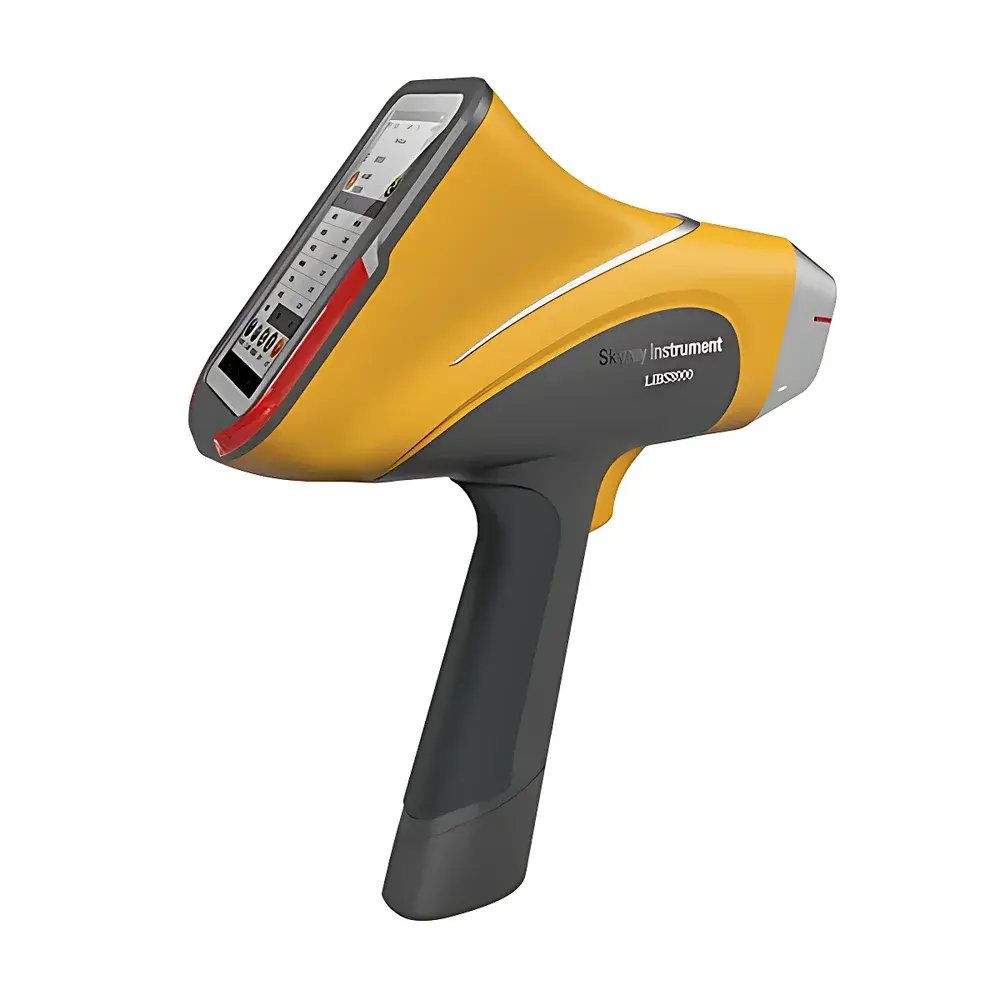
SkyRay LIBS8000 Handheld Laser-Induced Breakdown Spectrometer
| Brand | SkyRay Instrument |
|---|---|
| Origin | Jiangsu, China |
| Manufacturer Type | Direct Manufacturer |
| Country of Origin | China |
| Model | LIBS8000 |
| Instrument Type | Handheld |
| Weight | 1.9 kg |
| Display | 5.0-inch Touchscreen |
| IP Rating | IP54 |
| Laser Wavelength | 1064 nm |
| Plasma Temperature | >10,000 K |
| Spatial Resolution | <1 µm |
| Spectral Range | Typically 190–900 nm (standard configuration) |
| Language Support | 8 languages (English, Chinese, French, Italian, Spanish, German, Indonesian, Polish) |
| Data Integration | MES/LIMS/ERP-compatible via Ethernet/USB/Wi-Fi |
Overview
The SkyRay LIBS8000 is a handheld laser-induced breakdown spectroscopy (LIBS) instrument engineered for rapid, in-situ elemental analysis of solid metallic and alloyed materials. It operates on the fundamental principle of LIBS: a high-energy, nanosecond-duration pulsed laser (1064 nm) is focused onto the sample surface with energy density exceeding 10⁹ W/cm², inducing localized ablation and generating a transient micro-plasma (>10,000 K). As the plasma cools (within 1–10 µs), excited atoms and ions decay to lower energy states, emitting element-specific photons across the UV–VIS–NIR spectrum (typically 190–900 nm). These characteristic emission lines—each serving as a unique optical fingerprint—enable both qualitative identification and semi-quantitative determination of elemental composition without chemical dissolution or mechanical preparation.
Key Features
- True field-deployable design: Weighing only 1.9 kg and integrating a ruggedized magnesium-alloy chassis, the LIBS8000 supports extended handheld operation in industrial environments including foundries, scrap yards, and pipeline inspection sites.
- Real-time spectral acquisition: Equipped with a high-throughput Czerny–Turner spectrometer and back-illuminated CCD detector, it delivers full-spectrum capture within single-laser-shot latency—enabling analysis completion in under one second per measurement.
- Intuitive human interface: A 5.0-inch capacitive touchscreen provides direct access to calibration menus, spectral visualization tools, and report generation—supporting eight UI languages to accommodate multinational technical teams.
- Continuous operational integrity: Hot-swappable battery system ensures uninterrupted data collection during shift transitions or prolonged site surveys; no power-down or reboot required upon battery exchange.
- Environmental resilience: Certified to IP54 standards, the instrument resists dust ingress and water splashing from any direction—validated for use in humid refineries, outdoor metal recycling facilities, and unconditioned hangar bays.
- Embedded safety architecture: Dual redundant hardware interlocks—including beam shutter activation and proximity sensor feedback—physically disable laser emission when the measurement head is disengaged or obstructed, complying with IEC 60825-1 Class 4 laser safety requirements.
Sample Compatibility & Compliance
The LIBS8000 is optimized for direct analysis of conductive and semi-conductive solids, particularly aluminum alloys (e.g., 6061, 7075), stainless steels (304, 316), copper-based alloys (brass, bronze), and titanium grades. Surface oxidation, light oil films, or mill scale do not preclude reliable detection of major and minor constituents (Al, Mg, Si, Fe, Cr, Ni, Cu, Zn, Mn, Ti, etc.) at percent-to-hundred-ppm levels. While quantitative accuracy depends on matrix-matched calibration, the system supports user-defined calibration curves traceable to NIST SRM reference materials. Its measurement protocol aligns with ASTM E2926–22 (“Standard Test Method for Determination of Elements in Solid Metal Alloys by Laser-Induced Breakdown Spectroscopy”) and supports GLP-compliant audit trails when integrated with validated LIMS environments.
Software & Data Management
Built-in firmware includes SkyRay’s proprietary LIBS Analysis Suite v3.2, enabling real-time spectral preprocessing (dark current subtraction, cosmic ray removal, peak deconvolution), multivariate regression modeling (PLS, PCA), and customizable reporting templates (PDF/CSV export). Raw spectra and metadata (laser energy, gate delay, ambient temperature/humidity) are stored with timestamp and GPS coordinates (optional module). The instrument supports secure bidirectional communication via Ethernet, USB-C, or Wi-Fi 5 (802.11ac), enabling seamless integration into enterprise systems—including MES for material release verification, LIMS for QA/QC record linkage, and ERP for inventory reconciliation—using RESTful APIs compliant with ISO/IEC 11179 metadata standards.
Applications
- Aluminum production & recycling: Rapid grade sorting of extrusion billets, ingots, and post-consumer scrap to enforce alloy specification compliance (e.g., EN 573, ASTM B221).
- Aerospace manufacturing: On-wing verification of turbine disk alloys and fastener materials against AS9100-referenced composition limits prior to installation.
- Automotive supply chain: Incoming inspection of cast engine blocks and suspension components to detect out-of-specification trace elements affecting fatigue life.
- Petrochemical infrastructure: In-service verification of pipe weld chemistry to confirm resistance to sulfide stress cracking (SSC) per NACE MR0175/ISO 15156.
- Scrap metal trading: Real-time differentiation between stainless steel grades (304 vs. 316) and brass types (C260 vs. C360) at weighbridge checkpoints.
FAQ
Does the LIBS8000 require sample grinding or acid digestion before analysis?
No. The technique is inherently non-destructive at the macro scale and requires no sample preparation—only surface cleaning to remove thick contaminants is recommended.
Can it quantify light elements such as Li, Be, or B?
Yes, under controlled atmospheric conditions (e.g., argon purge), detection of elements down to atomic number 3 (Li) is achievable; standard air-based operation reliably covers Na and heavier elements.
How is calibration maintained across different operators and sites?
Calibration stability is ensured through daily drift correction using internal reference spectra and optional external CRMs; all calibration events are logged with operator ID and digital signature per 21 CFR Part 11 requirements.
Is spectral data export compatible with third-party chemometric software?
Yes. Full-resolution .SPC and .CSV files—including wavelength-calibrated intensity arrays and acquisition parameters—are natively supported for import into MATLAB, Unscrambler, or Python-based scikit-learn workflows.
What maintenance is required for long-term field reliability?
Annual optical alignment verification and spectrometer wavelength calibration are recommended; no consumables (e.g., lamps, gases, electrodes) are used in routine operation.
Related Products





