
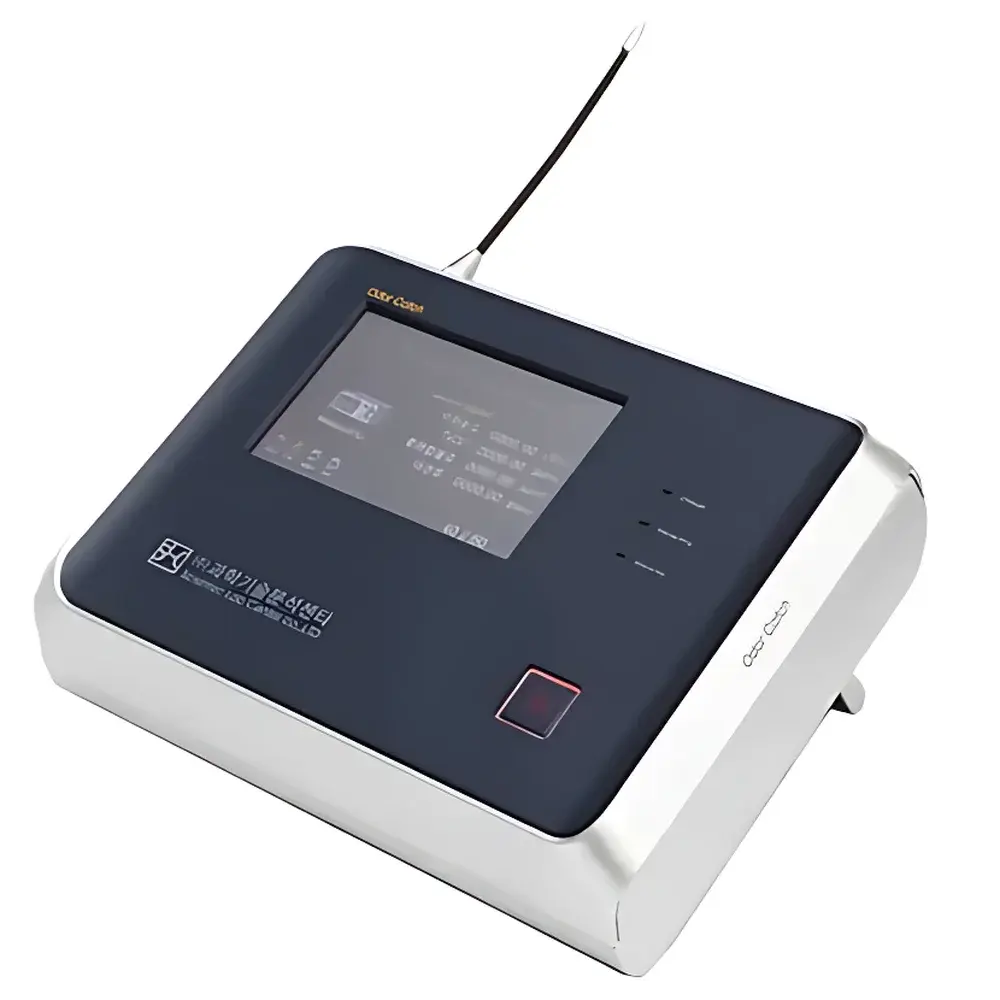
SLC-OP Portable Odor Measurement Instrument
| Origin | South Korea |
|---|---|
| Manufacturer Type | Authorized Distributor |
| Origin Category | Imported |
| Model | SLC-OP |
| Instrument Type | Portable |
| Sensor Configuration | 5-channel (Electrochemical NH₃/H₂S, PID for TVOC, MOS for amine/odor, dual-range odor sensor) |
| Measurement Outputs | Odor Unit (OU), ppm |
| Accuracy | ≤3% RSD |
| Detection Cycle | 1–5 min (user-configurable) |
| Display | 114 × 64 mm resistive touchscreen LCD |
| Power | Rechargeable Li-ion battery (2 h continuous operation) or 220 VAC adapter |
| Dimensions | 170 × 280 × 230 mm (H×W×D) |
| Weight | 10 kg |
| Enclosure | Anodized aluminum alloy |
| Data Storage | 1 GB SD card + RS-232 interface |
Overview
The SLC-OP Portable Odor Measurement Instrument is an engineered field-deployable solution designed for quantitative assessment of complex odor emissions in compliance with standardized sensory-based regulatory frameworks. Unlike passive sniffing tools or single-gas analyzers, the SLC-OP integrates multi-sensor fusion architecture—combining electrochemical (NH₃, H₂S), photoionization (TVOC), metal-oxide semiconductor (amine/complex odor), and a dedicated dual-range odor sensor—to deliver real-time, instrumentally derived Odor Units (OU) aligned with the principles of the Korean Standard KS IEC 62209-2 and the internationally recognized Three-Point Potency Method (ISO 13733, EN 13725). Its operational principle relies on simultaneous detection of key odorant surrogates, followed by algorithmic correlation to human olfactory response curves, enabling direct conversion of sensor signals into legally defensible dilution-to-threshold values (OU/m³). This approach bridges the gap between subjective olfactometry and objective instrumentation—critical for enforcement, baseline characterization, and trend analysis at emission sources.
Key Features
- Multi-parameter sensing platform supporting concurrent measurement of NH₃ (5–80 ppm), H₂S (high range: 1–80 ppm; low range: 0.05–2 ppm), TVOC (0.5–80 ppm), amine-class compounds, and composite odor intensity (1–10,000 OU for neutral odor; 1–70,000 OU for sulfur-dominant odor)
- Integrated micro-pump with particulate-filtered sampling path ensures representative air intake under variable ambient conditions and minimizes sensor fouling
- Resistive touchscreen LCD (114 × 64 mm) running Windows CE OS enables intuitive navigation, real-time waveform visualization, and on-device parameter configuration
- Onboard data logging to 1 GB SD card with timestamped records (OU, ppm, battery status, date/time); export via RS-232 serial interface for traceable post-processing
- Calibration traceability supported through field validation against certified reference standards and cross-comparison with dynamic olfactometer results per ISO 13733 Annex C
- Rugged anodized aluminum housing (IP54-rated ingress protection) provides mechanical durability and thermal stability during extended outdoor deployment
- Rechargeable lithium-ion battery delivers ≥120 minutes of continuous operation at standard flow rate (0.5 L/min), with AC adapter compatibility for lab-based verification
Sample Compatibility & Compliance
The SLC-OP is validated for gaseous-phase sampling across heterogeneous environments—including landfill boundary zones, wastewater treatment headspaces, indoor office spaces, vehicle cabins, and medical breath analysis settings. It meets functional equivalency requirements outlined in Korean Ministry of Environment Notice No. 2021-127 for odor monitoring equipment and supports audit-ready documentation per GLP-aligned workflows. While not a replacement for accredited olfactometry laboratories (e.g., ISO 13733-certified facilities), its output is intended for screening-level compliance verification, source identification, and temporal profiling where rapid turnaround and spatial mobility are essential. All sensor modules undergo factory calibration against NIST-traceable gas standards, and drift compensation algorithms maintain measurement consistency over extended duty cycles.
Software & Data Management
Data acquisition and reporting are managed via embedded firmware compliant with basic FDA 21 CFR Part 11 principles: user login authentication, immutable audit trail generation (including operator ID, calibration events, and data export timestamps), and electronic signature support for field reports. Raw sensor outputs and calculated OU values are stored in CSV format with metadata headers, facilitating integration into LIMS or environmental data management systems (EDMS). Optional PC software provides spectral overlay visualization, statistical summary (mean OU, max peak, 95th percentile), and automated report generation aligned with municipal odor complaint investigation templates.
Applications
- Regulatory field screening at industrial emission stacks and municipal waste handling facilities
- Odor impact assessment for environmental permitting and community complaint resolution
- Indoor air quality diagnostics in commercial buildings, hospitals, and public transport interiors
- Process optimization in food processing, rendering, and composting operations
- Clinical research applications involving volatile organic compound (VOC) profiling in exhaled breath for gastrointestinal disorder biomarker studies
- Baseline characterization prior to odor control system installation or retrofit
FAQ
How does the SLC-OP correlate sensor readings to Odor Units (OU)?
It applies empirically derived transfer functions based on multi-linear regression models trained against paired field olfactometry data sets, weighted by compound-specific odor activity values (OAVs) and receptor binding affinities.
Is periodic recalibration required?
Yes—recommended every 90 days or after 200 hours of cumulative operation; full sensor module recalibration must be performed using certified span gases traceable to KRISS or NIST.
Can the device operate in high-humidity environments?
Yes, with integrated humidity compensation; however, condensation-prone conditions (>90% RH) require optional hydrophobic inlet filtration to prevent sensor saturation.
Does it comply with ISO 13733 for official odor reporting?
No—it is not certified as a primary olfactometer but serves as a validated screening tool whose outputs may support ISO 13733-compliant investigations when used in tandem with accredited laboratory olfactometry.
What maintenance is required beyond calibration?
Routine cleaning of the inlet filter and pump diaphragm every 30 days; annual sensor module replacement recommended for optimal accuracy retention.
Related Products







