
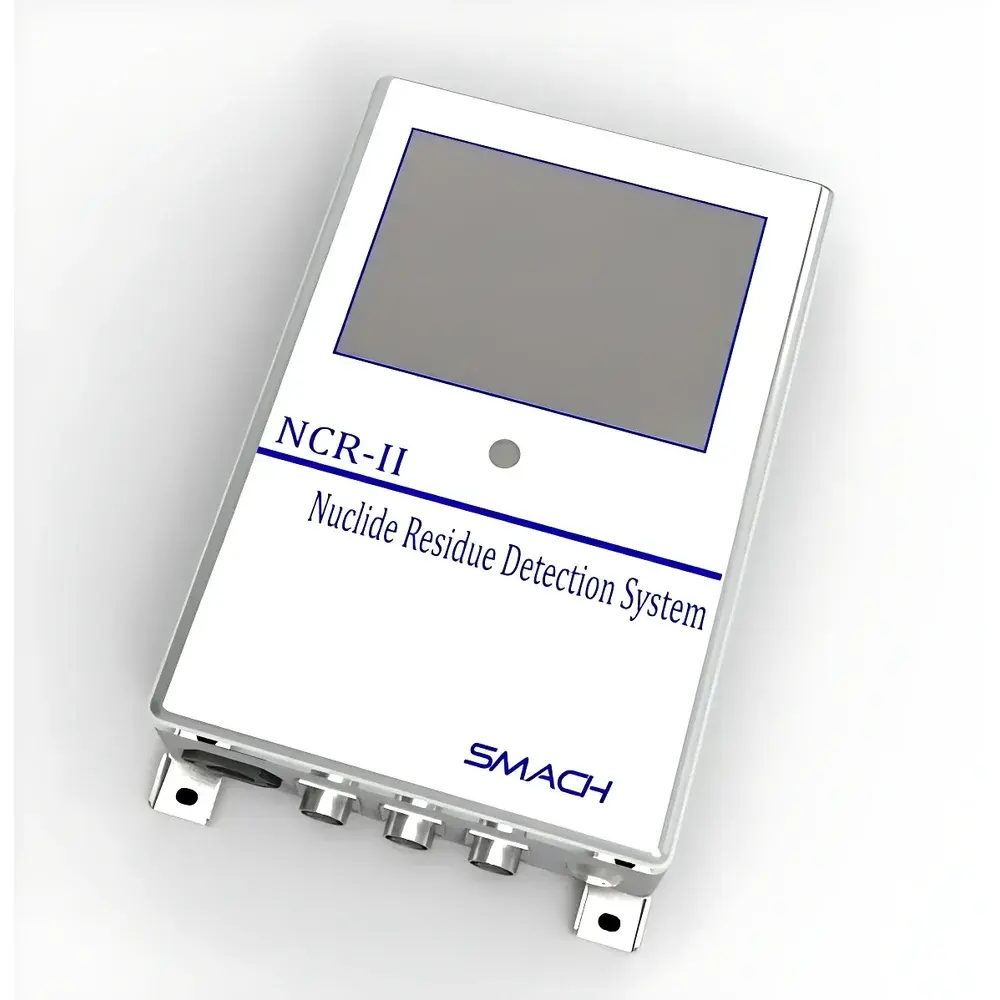
SMACH NCR2 In Vivo Radionuclide Residual Activity Monitor
| Brand | SMACH |
|---|---|
| Origin | Fujian, China |
| Manufacturer Type | Authorized Distributor |
| Country of Origin | China |
| Model | NCR2 |
| Instrument Category | Radiation Dose Rate Meter / Activity Monitor |
| Instrument Type | Online, Standalone In Vivo Monitoring System |
| Detection Medium | Human Body (Post-Therapeutic/Diagnostic Patients) |
| Detector Type | Scintillation Detector (NaI(Tl) or LaBr3-based) |
| Measurement Capability | Multi-nuclide Quantification (I-131, Tc-99m, F-18, etc.) |
| Activity Range | 0.1–500 mCi (3.7 MBq–18.5 GBq) |
| Sensitivity | High-Sensitivity Scintillation Detection Unit |
| Measurement Time | ~30 s per subject |
| Output Units | Bq, MBq, Ci, CPS |
| Compliance | Designed in accordance with GBZ 120–2020, IAEA Safety Standards Series No. GSR Part 3, ICRP Publication 103, and US NRC Regulatory Guide 8.39 |
Overview
The SMACH NCR2 In Vivo Radionuclide Residual Activity Monitor is an online, non-invasive, stand-alone measurement system engineered for quantitative assessment of residual radionuclide activity in patients following diagnostic or therapeutic nuclear medicine procedures. It operates on the principle of gamma-ray spectroscopy using a high-efficiency scintillation detector—typically NaI(Tl) or LaBr3(Ce)—coupled with digital pulse processing and spectral deconvolution algorithms. Unlike conventional survey meters or dose rate instruments, the NCR2 performs in vivo activity quantification by measuring emitted gamma photons through calibrated geometry and energy-specific peak analysis, enabling direct estimation of retained activity (in Bq or Ci) for clinically relevant nuclides including 131I, 99mTc, and 18F. The system is designed to support regulatory discharge decisions under GBZ 120–2020, which mandates objective, traceable verification that patient residual activity falls below prescribed release limits—particularly critical for protecting infants, pregnant individuals, and caregivers in domestic environments.
Key Features
- Regulatory-Aligned In Vivo Quantification: Implements nuclide-specific calibration factors and decay correction protocols aligned with IAEA SSG-46, ICRP dose coefficients, and national standards (GBZ 120–2020), ensuring metrological traceability for clinical discharge authorization.
- Integrated Collimation & Background Compensation: Equipped with a fixed lead/tungsten collimator to restrict field-of-view to the anterior torso, minimizing scatter and cross-talk from adjacent subjects; real-time ambient background subtraction via continuous low-dose monitoring channel.
- Touchless, Autonomous Operation: Combines infrared presence detection and passive facial recognition (ISO/IEC 19794-5 compliant) to auto-initiate measurement without physical contact or staff intervention—reducing workflow burden and radiation exposure to personnel.
- Multi-Modal Operator Guidance: Embedded HD camera captures synchronized still images and time-stamped video clips during acquisition; integrated voice prompt system provides step-by-step instructions and alerts for positioning errors or motion artifacts.
- Real-Time Spectral Analysis: Onboard MCA (Multi-Channel Analyzer) firmware performs energy windowing, peak centroiding, and interference correction for overlapping gamma emissions (e.g., 131I at 364 keV vs. 99mTc at 140 keV), supporting simultaneous multi-nuclide discrimination.
- Ruggedized Clinical Architecture: IP54-rated enclosure, medical-grade power supply (IEC 60601-1), and EMI-hardened signal chain ensure stable operation in PET/CT suites, radioiodine therapy wards, and outpatient imaging departments.
Sample Compatibility & Compliance
The NCR2 is validated for adult and pediatric patients (≥5 years, ≥15 kg) undergoing radiopharmaceutical administration. It accommodates variable body habitus through adjustable detector height and auto-scaling attenuation correction based on anthropometric input (height/weight). All measurement protocols comply with GLP-aligned data integrity requirements: audit trails, electronic signatures (per FDA 21 CFR Part 11 readiness), and immutable storage of raw spectra, processed results, and metadata (time stamp, operator ID, nuclide selection, calibration epoch). Device design conforms to electromagnetic compatibility (IEC 61326-1), electrical safety (IEC 61010-1), and radiation safety (IEC 62461) standards. Clinical validation reports—including uncertainty budgets per GUM (JCGM 100:2008) and repeatability studies (n ≥ 20 per nuclide)—are available upon request for QA/QC documentation.
Software & Data Management
The NCR2 integrates with the SMACH RadMonitor Suite—a DICOM-SR-compliant clinical workstation supporting HL7 v2.5.1 messaging for bidirectional EMR integration (Epic, Cerner, Meditech). Each measurement generates a structured report containing: corrected net count rates per ROI, decay-corrected activity values with expanded uncertainty (k=2), compliance status flag (PASS/FAIL vs. GBZ 120 thresholds), and embedded spectral snapshots. Data is stored in AES-256 encrypted SQLite databases with role-based access control (RBAC), automatic daily backups to network-attached storage (NAS), and optional cloud archiving (HIPAA-compliant AWS S3). Audit logs record all user actions—including report generation, parameter edits, and calibration updates—with timestamp, IP address, and session hash.
Applications
- Pre-discharge clearance screening for 131I thyroid ablation patients in dedicated radioiodine therapy units.
- Outpatient eligibility verification after 99mTc-MDP bone scans or 18F-FDG PET/CT studies.
- Dynamic retention monitoring during multi-dose therapeutic regimens (e.g., 177Lu-PSMA).
- Quality assurance audits in nuclear medicine departments seeking ISO/IEC 17025 accreditation.
- Research applications in internal dosimetry modeling and biokinetic parameter validation.
FAQ
Does the NCR2 require source-based energy calibration before each use?
No. The system performs automatic energy stabilization using built-in 137Cs and 57Co reference sources; full spectral recalibration is recommended quarterly or after detector replacement.
Can it distinguish between 131I and 123I in mixed administrations?
Yes—via dual-peak analysis (364 keV and 159 keV) with resolution-dependent separation capability (FWHM ≤ 8.5% at 662 keV); requires ≥200 kcps total count for statistically robust deconvolution.
Is the facial recognition module GDPR- and HIPAA-compliant?
Yes. Biometric templates are locally processed and never transmitted; raw images are encrypted at rest and purged after 90 days unless explicitly archived per institutional policy.
What is the minimum detectable activity (MDA) for 18F at 30 cm distance?
Typical MDA is 0.035 MBq (0.95 µCi) at 30 s acquisition, calculated per ANSI N42.22–2022 using Currie methodology and background variability measured over 24 h.
Does the system support third-party spectral analysis software export?
Yes—raw .CNF files (Canberra format) and ASCII-exported spectrum CSVs are accessible via USB or secure FTP; compatible with Genie 2000, GammaVision, and custom Python/Matlab toolchains.
Related Products







