
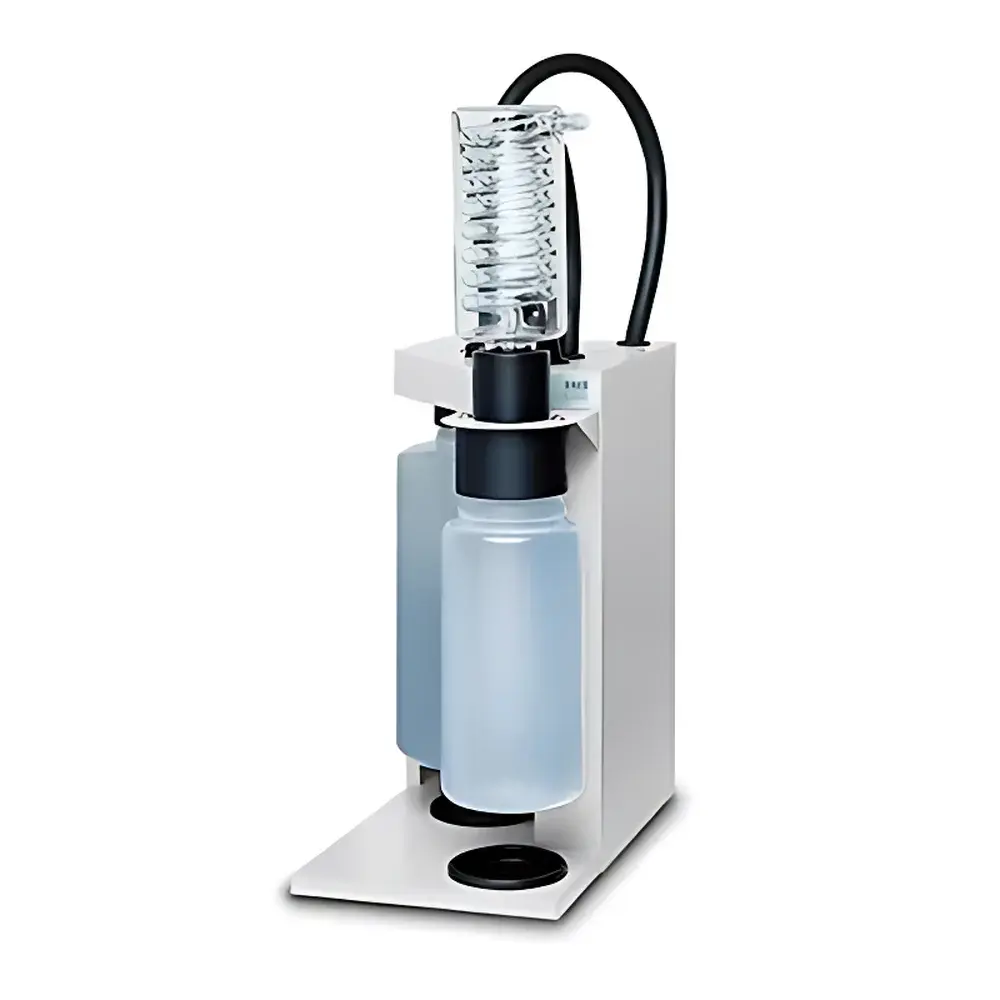
SMS Tail Gas Absorption Unit (VELP SMS Model)
| Brand | VELP |
|---|---|
| Origin | Italy |
| Model | SMS |
| Dimensions | 300 × 500 × 190 mm |
| Weight | 3.5 kg |
| Construction | Epoxy-coated stainless steel |
| Absorption Stages | Three-stage (condensation → alkaline neutralization → activated carbon adsorption) |
| Pump Type | Recirculating water-based absorption pump (JP series) |
| Vacuum Control | Adjustable |
| Optional Accessories | Replacement activated carbon packs (A00001164), activated carbon filter cartridge (A00001165), IQ/OQ validation documentation (A00000252) |
Overview
The VELP SMS Tail Gas Absorption Unit is an engineered safety solution designed for controlled chemical analysis laboratories where elemental analyzers—particularly combustion-based CHNS/O or halogen analyzers—generate acidic, corrosive, or toxic off-gases during sample pyrolysis and oxidation. Operating on a sequential three-stage purification principle—physical condensation, aqueous alkaline neutralization, and post-treatment adsorption—the SMS unit ensures quantitative removal of hydrogen halides (HCl, HBr), sulfur oxides (SO₂, SO₃), nitrogen oxides (NOₓ), and residual organic vapors prior to atmospheric venting. Its architecture integrates thermodynamic and mass-transfer optimization: the large interfacial area between ascending gas streams and downward-flowing NaOH solution enables rapid, stoichiometric acid–base reaction kinetics, while the downstream activated carbon stage captures non-polar volatiles and trace organics unreactive toward alkaline scrubbing. The unit is not a standalone analyzer but a critical ancillary device compliant with laboratory ventilation best practices and aligned with ISO 17025-accredited environmental health & safety (EHS) protocols.
Key Features
- Three-stage integrated gas treatment: condensation chamber, NaOH-solution scrubber (pH >13), and high-surface-area activated carbon adsorption bed
- Epoxy-coated stainless steel construction ensures long-term resistance to acid corrosion and mechanical wear under continuous operation
- Adjustable vacuum regulation via JP-series recirculating water pump supports stable flow rates across varying analyzer exhaust profiles (typical range: 0.5–2.5 L/min)
- Optimized gas–liquid contact geometry maximizes residence time and mass transfer efficiency without requiring external compressed air or auxiliary power
- Compact footprint (300 × 500 × 190 mm) and low mass (3.5 kg) enable flexible benchtop integration adjacent to elemental analyzers or fume hoods
- Modular consumables design: standardized activated carbon cartridges (A00001165) and pre-packed replacement kits (A00001164) simplify maintenance and support GLP-compliant logbook tracking
Sample Compatibility & Compliance
The SMS unit is compatible with all combustion-type elemental analyzers generating acidic effluent—including those used for total halogen (Cl, Br, I), sulfur, and nitrogen determination in polymers, pharmaceuticals, petrochemicals, and environmental matrices. It meets fundamental requirements of EN 14181 (quality assurance of automated measuring systems), OSHA 1910.1200 (Hazard Communication Standard), and EU Directive 2010/75/EU (Industrial Emissions Directive) for localized emission control. When deployed with validated elemental analyzers operating under USP , ASTM D7359, or ISO 14852 test methods, the SMS contributes to full system-level compliance by preventing cross-contamination and ensuring operator exposure remains below TLV-TWA thresholds for HCl (<5 ppm) and SO₂ (<2 ppm). IQ/OQ documentation (A00000252) supports audit readiness for GMP and GLP-regulated environments.
Software & Data Management
The SMS is a passive, hardware-only device with no embedded firmware or digital interface. Its operational integrity relies on mechanical and chemical parameters—not software control. However, when integrated into a validated analytical workflow (e.g., VELP U-5000 or EA Series analyzers), it forms part of a documented safety subsystem. Maintenance logs—including carbon replacement dates, NaOH replenishment cycles, and vacuum pressure calibration records—must be retained per 21 CFR Part 11 Annex 11 principles if used in regulated pharmaceutical or clinical testing labs. No electronic data output is generated; all performance verification is conducted via pH strip monitoring of scrubber solution and periodic breakthrough testing using FTIR or ion chromatography.
Applications
- Neutralization of HCl and HF from halogen analysis of PVC, flame retardants, and fluorinated pharmaceuticals
- Removal of SO₂ and SO₃ during sulfur determination in coal, heavy fuel oil, and lubricants
- Scavenging of NOₓ species generated during high-temperature nitrogen analysis of fertilizers and biological tissues
- Post-combustion cleanup in EPA Method 5050B and ISO 17294-2 compliant wastewater solids analysis
- Protection of analyzer IR cells and catalytic furnaces from acid-induced degradation in routine QC labs
FAQ
What types of acids does the SMS unit effectively neutralize?
It quantitatively removes hydrogen halides (HCl, HBr, HI), sulfuric and sulfurous acid vapors (H₂SO₄, H₂SO₃), and nitric/nitrous acid derivatives (HNO₃, HNO₂) through stoichiometric reaction with NaOH solution.
How often must the activated carbon be replaced?
Replacement frequency depends on sample load and halogen/sulfur content; typical service life ranges from 50–200 analyses. Visual inspection for discoloration and breakthrough testing are recommended prior to each validation cycle.
Is the SMS unit compatible with non-VELP elemental analyzers?
Yes—it interfaces with any analyzer equipped with standard 6–10 mm exhaust tubing and operates within vacuum ranges of 5–30 kPa, making it suitable for Thermo Scientific, Elementar, and PerkinElmer combustion systems.
Does the unit require electrical power?
Only the JP-series recirculating pump requires AC power (100–240 V, 50/60 Hz); the absorption chamber itself functions passively.
Can the NaOH concentration be adjusted?
Yes—users may prepare 0.5–2.0 M NaOH solutions depending on expected acid load; higher concentrations improve neutralization capacity but increase risk of crystallization at low temperatures.





