
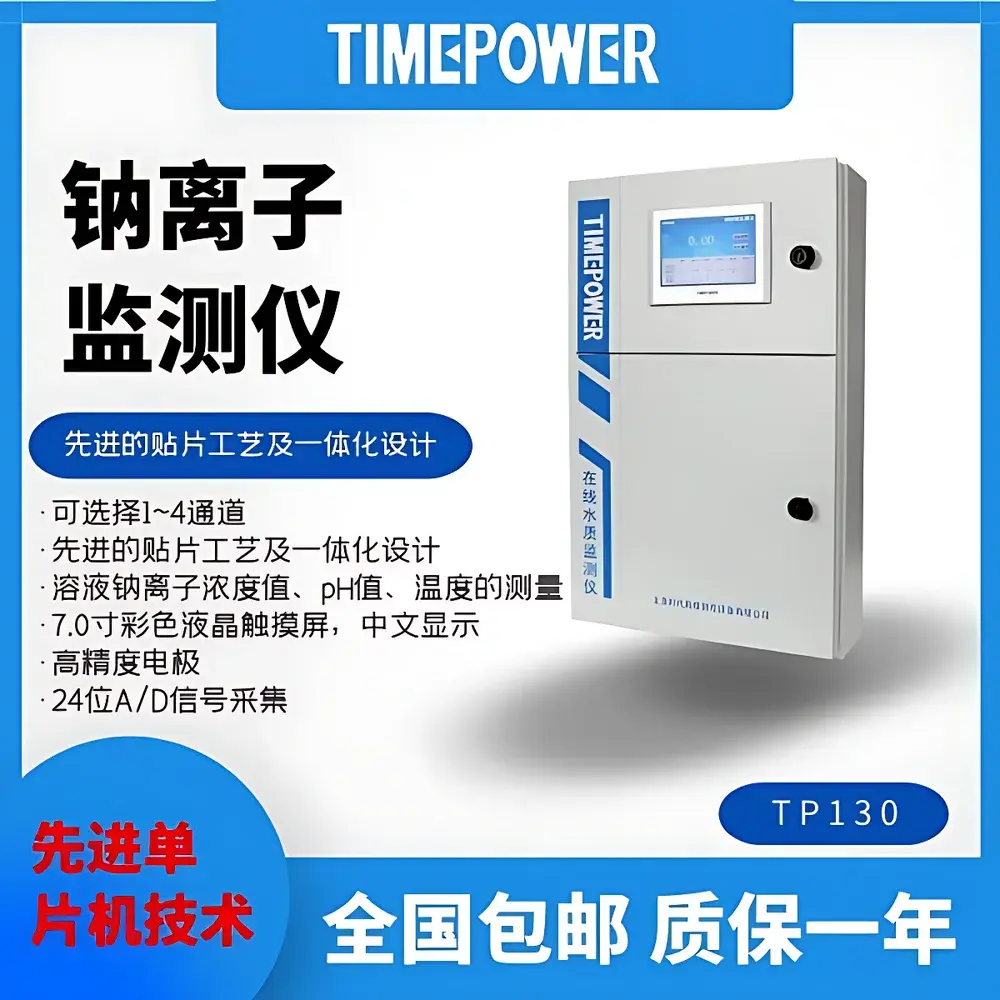
Sodium Ion Monitor – TP130 Benchtop & Online Sodium Analyzer
| Brand | TimePower |
|---|---|
| Origin | Beijing, China |
| Manufacturer Type | OEM Manufacturer |
| Country of Origin | China |
| Model | TP130 |
| Pricing | Upon Request |
Overview
The TimePower TP130 Sodium Ion Monitor is a high-stability benchtop and online sodium analyzer engineered for continuous, low-concentration sodium ion (Na⁺) measurement in ultra-pure water and process streams. It operates on the principle of potentiometric ion-selective electrode (ISE) detection, utilizing a solid-state sodium-specific composite electrode paired with integrated pH and temperature sensing elements. This tri-sensor architecture enables real-time compensation for alkalinity (via pH monitoring during sample conditioning with reagent-grade NaOH or diisopropylamine) and automatic temperature correction—critical for achieving sub-ppb (µg/L) accuracy in high-resistivity water systems. Designed specifically for applications demanding stringent cation purity control—such as boiler feedwater in fossil-fueled power plants, condensate polishing loops, semiconductor ultrapure water (UPW) distribution networks, and pharmaceutical water-for-injection (WFI) systems—the TP130 complies with core performance expectations outlined in ASTM D4582–22 (Standard Practice for Measuring Sodium in High-Purity Water) and supports alignment with USP and EP 2.2.38 water quality specifications.
Key Features
- Potentiometric sodium ISE measurement with integrated pH and temperature electrodes for simultaneous multi-parameter acquisition
- Auto-compensated alkalinity monitoring via dedicated pH channel to ensure optimal pNa response in low-conductivity matrices
- High-resolution backlit LCD display with full Chinese-language interface—designed for operator familiarity in domestic industrial environments
- Multi-parameter real-time screen: simultaneous display of pNa value (converted to µg/L), pH, temperature (°C), system time, and operational status
- Configurable measurement cycle per channel—enabling flexible deployment across single-point monitoring or multi-stream sequential analysis
- Embedded data logger storing up to 6,000 timestamped records including sodium concentration values, calibration events, and system diagnostics
- Programmable analog output: software-selectable 0–10 mA, 0–20 mA, or 4–20 mA current loop without hardware modification
- Digital communication interface compliant with RS-485 Modbus RTU protocol for integration into SCADA, DCS, or PLC-based control architectures
Sample Compatibility & Compliance
The TP130 is optimized for aqueous samples with conductivity below 1 µS/cm and total dissolved solids (TDS) < 0.1 ppm. It accommodates standard 1/4" NPT or 3/8" compression fittings for inline installation and accepts flow-through cells compatible with ANSI/ISA-71.04 G1 corrosion classification environments. While not certified to IEC 61508 SIL or ATEX/IECEx for hazardous areas, its enclosure meets IP65 ingress protection when mounted in controlled indoor process rooms. The instrument supports GLP-compliant operation through traceable calibration logging and user-accessible audit trails. Data integrity aligns with FDA 21 CFR Part 11 requirements when deployed with validated third-party data acquisition software supporting electronic signatures and change controls.
Software & Data Management
The embedded firmware provides password-protected access levels (Operator, Technician, Administrator) for parameter configuration, calibration execution, and data export. Calibration routines follow two-point or three-point protocols using NIST-traceable sodium standards (e.g., 0.1 µg/L and 10 µg/L Na⁺ in deionized water matrix). All calibration coefficients, timestamps, and electrode slope diagnostics are retained in non-volatile memory. Raw measurement data can be retrieved via RS-485 using standard Modbus register mapping or exported manually via USB-to-serial adapter (optional accessory). No proprietary PC software is required; interoperability is ensured with common industrial HMI platforms and cloud-based IIoT dashboards supporting Modbus TCP gateways.
Applications
- Continuous sodium monitoring in turbine condensate and boiler feedwater circuits (ASTM D1066, ISO 13578)
- Leak detection in steam generators and heat exchangers via sudden pNa excursions
- Quality assurance in pharmaceutical purified water (PW) and water-for-injection (WFI) systems per USP
- Process control in semiconductor UPW distribution loops where Na⁺ > 0.5 µg/L triggers alert thresholds
- Environmental compliance monitoring of effluent streams in chemical and fertilizer manufacturing
- Research-grade sodium quantification in biochemical buffer preparation and enzyme activity assays
FAQ
What is the typical detection range for the TP130 sodium analyzer?
The instrument measures sodium ion concentrations from 0.01 µg/L to 10,000 µg/L (pNa 9.0 to pNa 2.0), with optimal accuracy maintained between 0.1–100 µg/L under properly alkalized conditions.
Does the TP130 require daily maintenance?
No routine daily intervention is needed beyond periodic verification of alkalizing reagent levels and quarterly electrode cleaning/calibration—consistent with ASTM D4582 recommended practice.
Can the TP130 be integrated into an existing DCS system?
Yes, via RS-485 Modbus RTU interface with configurable baud rate (up to 115.2 kbps) and standard register addressing for pNa, pH, temperature, and status flags.
Is temperature compensation automatic?
Yes—integrated Pt1000 or thermistor-based temperature sensing enables real-time Nernstian correction across 5–45°C operating range.
How is calibration traceability documented?
Each calibration event logs date/time, standard concentrations used, measured mV response, calculated slope (%/decade), and operator ID—retained for ≥6,000 entries in internal flash memory.




