Sofraser MIVI-9100 Online Vibrational Viscometer for Resin Process Monitoring
| Brand | Sofraser |
|---|---|
| Origin | France |
| Model | MIVI-9100 |
| Measurement Principle | Vibrational Rod (Resonant Frequency Damping) |
| Viscosity Range | 0–1,000,000 mPa·s |
| Temperature Range | –20 to 300 °C (standard up to 200 °C, extended option available) |
| Pressure Rating | 60 bar (extended to 500 bar) |
| Repeatability | ±0.2% |
| Reproducibility | ±0.5% |
| Construction Material | 316L stainless steel (optional Hastelloy®, PTFE, or enamel coating) |
| Temperature Sensor | Integrated PT100 (Class A) |
| Output Signals | 4–20 mA (±0.1%, 12-bit resolution, 750 Ω load), Relay (1 A / 250 VAC or 30 VDC), RS485/RS422 (Modbus RTU, 300–19,200 baud) |
| Hazardous Area Certification | ATEX EEx ia IIC T3–T6, FM, JIS, 3A compliant |
| Power Supply | 80–265 VAC / 100–380 VDC |
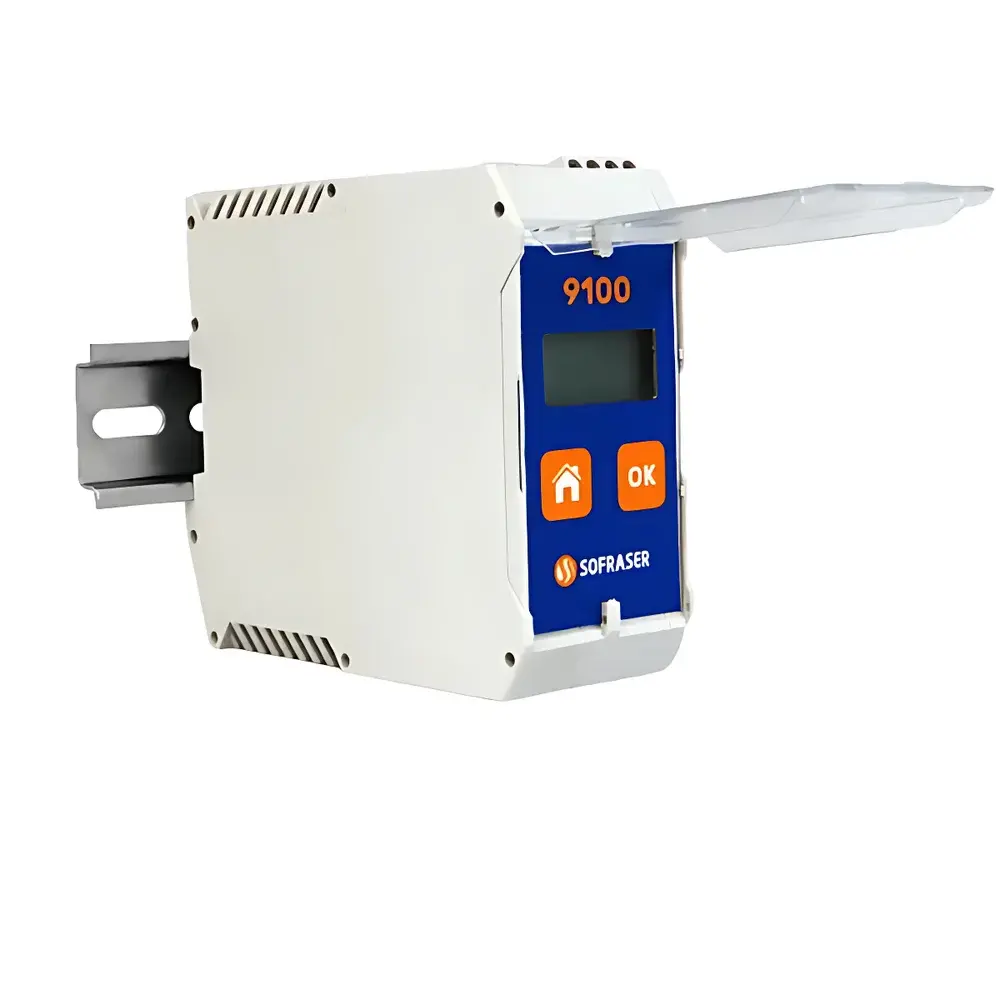
| Display | Dual LED — 4-digit red (viscosity & temperature), 6-digit green (units) |
| Optional Software | WISC80 Configuration & Data Acquisition Suite |
Overview
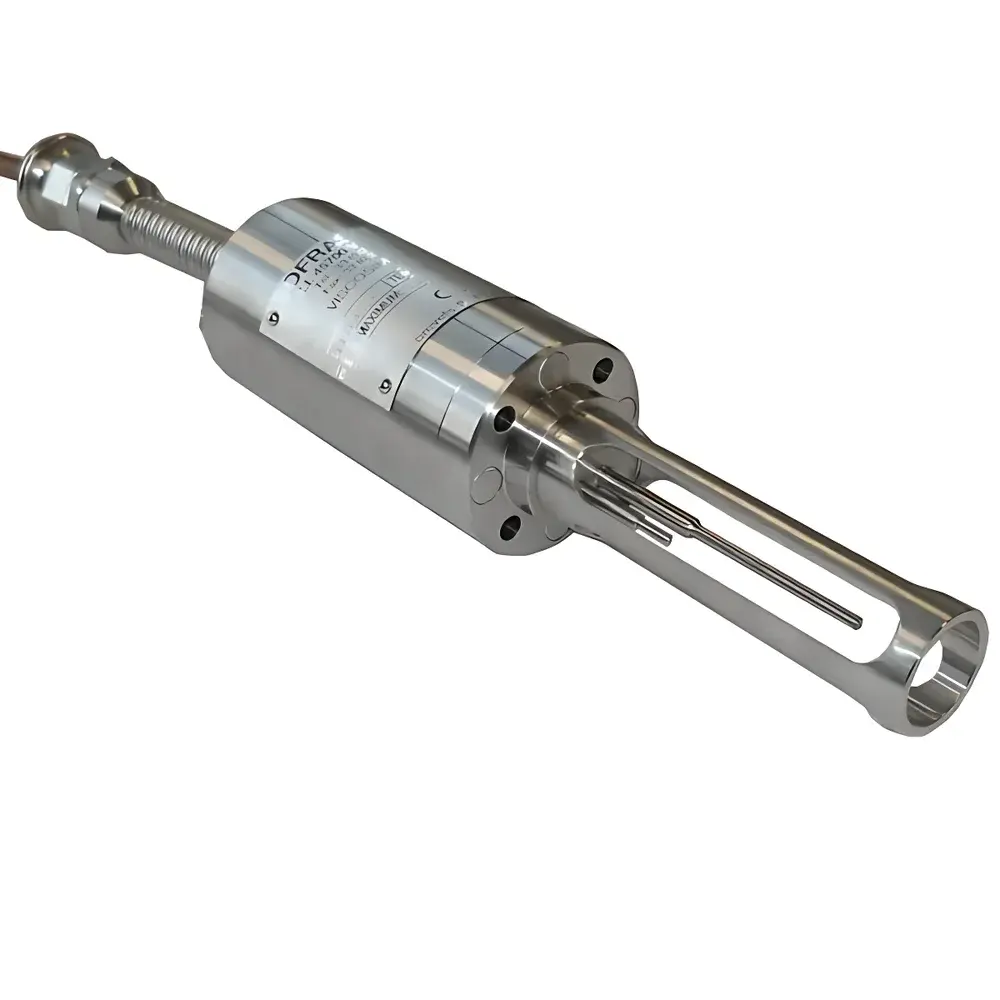
The Sofraser MIVI-9100 is a robust, intrinsically safe online vibrational viscometer engineered for continuous, real-time viscosity monitoring of reactive and thermally sensitive resin systems in demanding industrial process environments. Unlike rotational or capillary-based instruments, the MIVI-9100 employs a resonant vibrating rod principle: a precisely tuned stainless-steel probe oscillates at its natural frequency when energized by low-power AC excitation. As the probe immerses in flowing process fluid, viscous drag damps the amplitude and shifts the resonant frequency—both parameters are linearly correlated to dynamic viscosity across six decades (0–1×10⁶ mPa·s). This solid-state, wear-free transduction mechanism eliminates moving parts, bearings, or seals subject to fouling or degradation—making it uniquely suited for polymerization reactors, epoxy curing lines, polyurethane dispersion tanks, and solvent-borne adhesive blending systems where long-term stability and zero maintenance intervals are critical operational requirements.
Key Features
- True online measurement with no sample extraction, bypass loops, or flow conditioning required—installed directly into pipe spools or reactor walls via standard flanged connections (DIN/ANSI/JIS)
- Intrinsically safe design certified for Zone 0/1 hazardous areas (ATEX EEx ia IIC T3–T6, FM Class I Div 1, JIS, and 3A sanitary compliance)
- Integrated dual-parameter sensing: simultaneous real-time viscosity and temperature acquisition via embedded PT100 (IEC 60751 Class A) with automatic temperature compensation
- Full pressure compensation algorithm embedded in firmware—valid up to 500 bar with optional high-pressure probe variants
- Dual LED display interface: 4-digit red display for primary process values (viscosity in mPa·s or cP; temperature in °C/°F), 6-digit green unit field, and five dedicated status LEDs for system health and alarm states
- Configurable analog output (4–20 mA, 12-bit resolution, ±0.1% accuracy) with user-defined scaling, plus discrete relay outputs for interlock or batch termination signals
- Industrial-grade digital communication via RS485/RS422 supporting Modbus RTU protocol (300–19,200 baud), enabling seamless integration into DCS, SCADA, and MES platforms
Sample Compatibility & Compliance
The MIVI-9100 is validated for use with highly viscous, non-Newtonian, and shear-thinning resin matrices—including unsaturated polyesters, vinyl esters, epoxies, phenolics, acrylics, and reactive hot-melt adhesives. Its inert 316L stainless-steel wetted surface (optionally upgraded to Hastelloy C-276, PTFE-lined, or vitreous enamel-coated probes) resists chemical attack from aggressive solvents, amines, anhydrides, and acidic monomers. The instrument meets ISO 2555, ASTM D2196, and ISO/IEC 17025 traceability requirements when used with factory-calibrated reference oils. For regulated industries, its deterministic measurement architecture supports ALCOA+ data integrity principles; optional WISC80 software enables 21 CFR Part 11-compliant audit trails, electronic signatures, and secure user role management—facilitating GMP/GLP-aligned process validation in pharmaceutical excipient or medical device resin manufacturing.
Software & Data Management
The optional WISC80 configuration and acquisition software provides full remote commissioning, sensor diagnostics, calibration verification, and historical trend analysis. It supports time-synchronized logging of viscosity, temperature, pressure (when interfaced with external transmitters), and alarm events at user-defined intervals (100 ms to 1 h). Data export formats include CSV, Excel, and OPC UA-compatible XML—enabling direct ingestion into statistical process control (SPC) engines or digital twin models. Firmware updates are performed via USB or Modbus, with rollback capability and checksum-verified installation. All configuration changes are timestamped and logged with operator ID, satisfying FDA-required change control documentation for regulated resin synthesis processes.
Applications
- Real-time endpoint detection in epoxy resin curing and polycondensation reactions
- Consistency control during solvent-free acrylic emulsion polymerization
- Batch-to-batch viscosity verification in UV-curable oligomer synthesis
- Monitoring gel point onset in phenolic resin production under nitrogen blanket
- Feed-forward control of diluent addition in high-solids alkyd resin manufacturing
- Quality gate enforcement for incoming raw material resins prior to compounding
- Process deviation detection during continuous twin-screw extrusion of thermoset composites
FAQ
Does the MIVI-9100 require periodic recalibration in situ?
No—its resonant vibration principle is inherently drift-free. Calibration is performed once at factory using NIST-traceable silicone oil standards; field verification is conducted annually using a certified reference fluid per ISO 17025 procedures.
Can the probe be installed in vertical or horizontal pipelines without affecting accuracy?
Yes—the measurement is independent of flow orientation or velocity profile; however, minimum flow velocity (>0.3 m/s) is recommended to ensure representative sampling and prevent sedimentation in filled systems.
Is temperature compensation applied automatically during high-shear mixing operations?
Yes—real-time PT100 readings feed a dynamic compensation algorithm that corrects for thermal expansion and viscosity-temperature dependence per ASTM D341 standard equations.
How does the MIVI-9100 handle air bubbles or particulate contamination in resin streams?
The vibrating rod design is insensitive to transient entrained gas; particles 10 vol%, optional ultrasonic degassing integration is supported via auxiliary I/O.
What cybersecurity protocols are implemented for Modbus RTU communication?
While Modbus RTU itself is unencrypted, the MIVI-9100 supports network-level isolation via VLAN segmentation, configurable slave ID access control, and hardware write-protection for critical registers—aligning with ISA/IEC 62443-3-3 Level 1 recommendations.
Related Products