
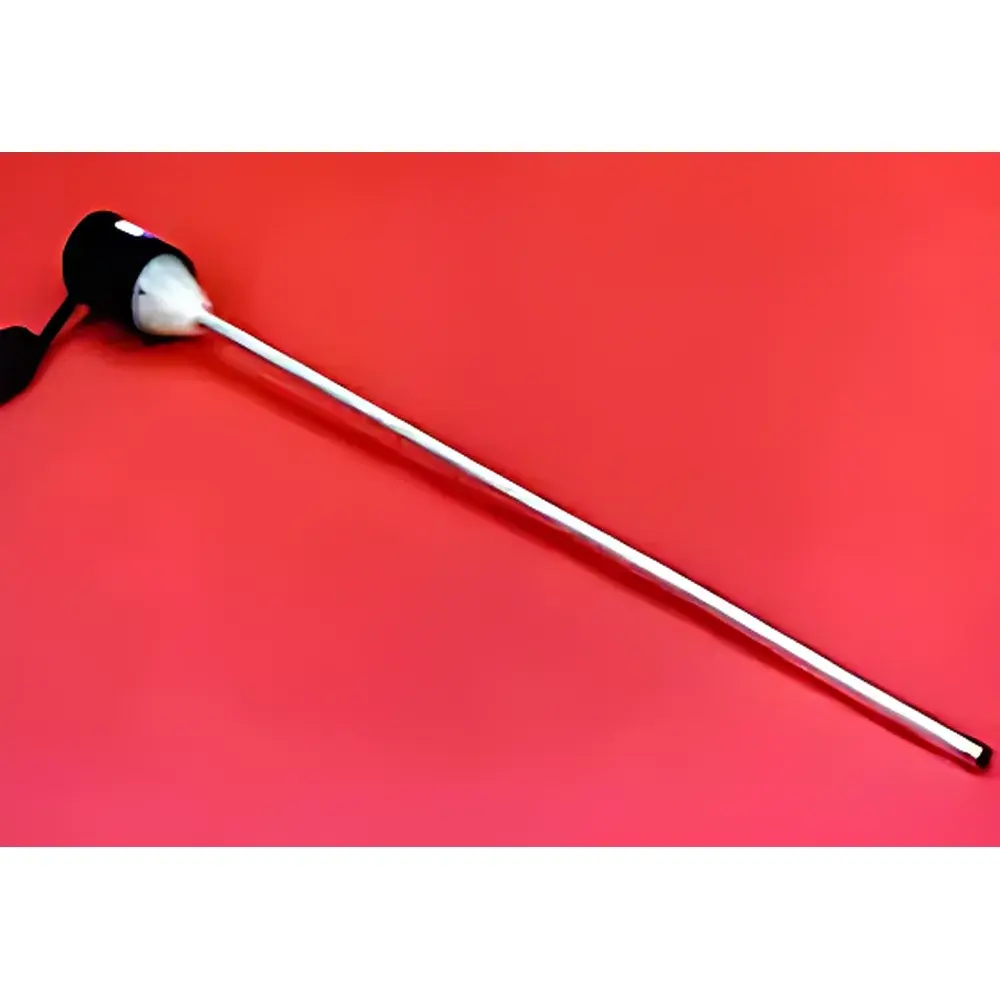
Solar Light PMA2112 High-Intensity UVA Radiometer for UV Curing Applications
| Brand | Solar Light |
|---|---|
| Origin | USA |
| Model | PMA2112 |
| Spectral Range | 320–390 nm |
| Peak Sensitivity | ~365 nm |
| Operating Tip Temperature | 0–400 °C |
| Sensor Operating Temperature | 0–50 °C |
| Dynamic Range | 0.1 mW/cm² to 20 W/cm² |
| Display Resolution | 0.1 mW/cm² |
| Temperature Coefficient | <0.05 %/°C |
| Probe Diameter | 9.5 mm (0.375 in) |
| Probe Length | 18 in (457 mm) |
| Overall Dimensions | 40.6 mm × 500 mm |
| Weight | 425 g (15 oz) |
| Cable | Retractable, 0.3–1.5 m |
| Radiometric Units | kW/m², W/cm², or mW/cm² (user-selectable) |
| Dose Integration | Yes, with START/STOP control and 1024-point memory buffer |
| Compliance | NIST-traceable calibration |
Overview
The Solar Light PMA2112 is a high-intensity, thermally robust UVA radiometer engineered specifically for industrial ultraviolet curing environments. It operates on the principle of broadband photodiode-based radiometry, optimized for spectral responsivity across 320–390 nm — the critical UVA band used in mercury-vapor, LED, and arc-lamp UV curing systems. Its peak sensitivity near 365 nm aligns precisely with the dominant emission line of low-pressure mercury lamps, ensuring accurate quantification of irradiance relevant to photopolymerization kinetics. Unlike conventional silicon photodiodes, the PMA2112 integrates a quartz light guide and remote sensor architecture: incident radiation is collected via a cosine-corrected diffuser at the probe tip, transmitted through a thermally insulated quartz fiber, and measured by a temperature-stabilized photodetector housed remotely within the meter body. This design decouples the sensing element from extreme thermal exposure — enabling reliable operation at probe tip temperatures up to 400 °C — while maintaining traceable radiometric accuracy.
Key Features
- High-temperature probe capable of continuous operation at tip temperatures up to 400 °C, suitable for proximity measurements near UV lamps, ovens, and conveyor-based curing zones
- Cosine-corrected optical input with integrated diffuser ensures accurate angular response per ISO/CIE standards for irradiance measurement
- NIST-traceable calibration certificate provided with each unit, supporting audit-ready compliance under GLP, GMP, and FDA 21 CFR Part 11 frameworks when paired with PMA2100 controller
- Wide dynamic range: 0.1 mW/cm² to 20 W/cm² (equivalent to 1 W/m² to 200 kW/m²), covering both low-intensity monitoring and high-power industrial UV sources
- Three selectable irradiance units (mW/cm², W/cm², kW/m²) with automatic scaling and user-defined conversion factors (e.g., 1 W/m² = 0.1 mW/cm²)
- Real-time dose integration with START/STOP functionality; LCD displays accumulated radiant exposure (J/cm²) and elapsed time, with hourglass icon indicator
- Onboard data logging: 1024-point buffer supports unattended monitoring at user-defined intervals (e.g., hourly), enabling 42 days of continuous 24-hour recording
- Electrical isolation between probe and meter eliminates ground-loop interference and enhances safety in high-voltage UV generator environments
Sample Compatibility & Compliance
The PMA2112 is compatible with all common UVA-emitting sources used in industrial UV curing, including medium-pressure mercury vapor lamps, doped amalgam lamps, and 365 nm LED arrays. Its spectral response excludes UVB and UVC contributions, minimizing cross-sensitivity in mixed-spectrum environments. The probe’s stainless-steel housing and fused silica window meet IP65-rated environmental protection requirements. Calibration adheres to ASTM E1318 (Standard Specification for Radiometers Used in UV Curing) and supports conformance with ISO 11664-3 (Colorimetry – Part 3: Spectral matching) for spectral responsivity validation. When used with the PMA2100 controller, full audit trails, electronic signatures, and timestamped dose records satisfy 21 CFR Part 11 data integrity requirements for regulated manufacturing processes.
Software & Data Management
While the PMA2112 operates as a standalone analog probe, it is designed exclusively for use with the Solar Light PMA2100 Universal Radiometer Controller. The PMA2100 provides real-time waveform capture, statistical analysis (min/max/avg tracking), and automated stability assessment over time. Logged data exports in CSV format are compatible with LIMS, MES, and SPC platforms. Firmware updates and configuration management occur via USB interface, with version-controlled calibration tables stored onboard. All measurement sessions include embedded metadata: date/time stamp, unit selection, integration mode, and serial-number-referenced calibration expiration.
Applications
- Quantitative monitoring of UV lamp output degradation during production runs to support predictive maintenance and lamp replacement scheduling
- In-line irradiance mapping across conveyor belts in flexographic, offset, and digital inkjet curing systems
- Validation of UV dose uniformity in conformal coating, adhesive bonding, and 3D-printing resin curing processes
- Process qualification and requalification per ISO 9001 and IATF 16949 requirements for automotive and medical device manufacturing
- Environmental exposure testing where UVA irradiance must be controlled and documented under ASTM G154 or ISO 4892-3 protocols
- Hazardous area measurements — probe-only deployment minimizes operator exposure to heat, ozone, and UV radiation
FAQ
What is the maximum allowable tip temperature for continuous operation?
The probe tip is rated for continuous exposure up to 400 °C; however, the internal sensor must remain within 0–50 °C — ensured by the quartz light guide’s thermal decoupling design.
Can the PMA2112 measure pulsed UV sources?
Yes — its analog bandwidth and sampling rate (when used with PMA2100) support stable measurement of modulated and flash-lamp UV sources, provided pulse repetition rates exceed 1 Hz.
Is recalibration required after exposure to high temperature?
No — the NIST-traceable calibration remains valid post-thermal cycling, as verified by Solar Light’s accelerated life testing per MIL-STD-810G procedures.
How is cosine correction validated?
Each unit undergoes angular responsivity testing at ±75° incidence angles in accordance with CIE Publication 18.2, with deviation ≤±3% from ideal cosine law.
Does the system support automated pass/fail reporting based on dose thresholds?
Yes — the PMA2100 firmware allows programmable upper/lower limits with audible and visual alerts, plus exportable compliance reports for quality documentation.





