
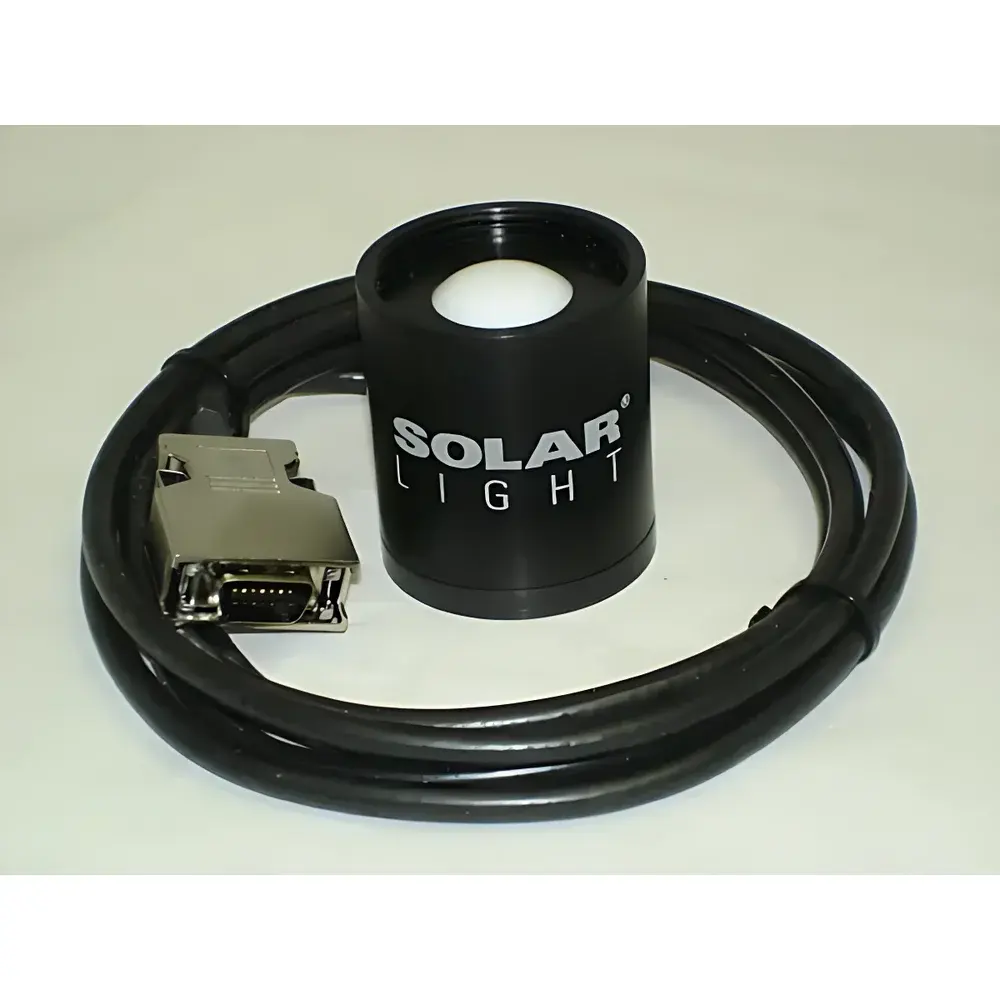
Solar Light PMA2120 UV Radiation Safety Monitor for ACGIH TLV Compliance
| Brand | Solar Light |
|---|---|
| Origin | USA |
| Model | PMA2120 |
| Spectral Response | Aligned with ACGIH UV Hazard Action Spectrum (Fig. 1) |
| Angular Response | ≤5% deviation up to 60° from normal incidence |
| Measurement Range | 0–1 mW/cm² |
| Display Resolution | 0.01 μW/cm² |
| Dose Calculation | Real-time integration to mJ/cm² |
| TLV Mode | Displays time-to-reach ACGIH TLV (3 mJ/cm² per 8-hr shift) |
| Operating Temperature | 0–50 °C (32–120 °F), non-condensing |
| Cable | Retractable 0.3–1.5 m |
| Dimensions | Ø40.6 mm × H45.8 mm |
| Weight | 200 g |
Overview
The Solar Light PMA2120 UV Radiation Safety Monitor is an industrial-grade, NIST-traceably calibrated photodetector engineered specifically for occupational health and safety compliance with the American Conference of Governmental Industrial Hygienists (ACGIH) Threshold Limit Values (TLVs®) for ultraviolet radiation exposure. It operates on the principle of spectrally weighted radiometric measurement, where incident UV irradiance (μW/cm²) is dynamically integrated over time to compute cumulative radiant exposure (mJ/cm²), referenced directly to the ACGIH-defined hazard action spectrum—emphasizing biologically effective wavelengths across UVA (315–400 nm) and UVB (280–315 nm) bands. Unlike broadband UV meters, the PMA2120 incorporates optical filtering and detector responsivity matched to the ACGIH spectral weighting function (ACGIH TLV® Documentation, 2023 Edition, Figure 1), ensuring physiologically relevant quantification of photochemical risk to ocular and dermal tissues. Its primary operational purpose is to determine permissible worker exposure duration in real time—displaying “time-to-TLV” based on measured irradiance and the ACGIH-specified 3 mJ/cm² threshold for an 8-hour workday—thereby supporting engineering controls, administrative procedures, and personal protective equipment (PPE) validation under OSHA 1910.97 and ANSI/ISEA Z358.1-2022 guidance.
Key Features
- NIST-traceable calibration with documented uncertainty budget, delivered with individual calibration certificate valid for 12 months
- Cosine-corrected diffuser enabling angular response deviation ≤5% up to ±60°, meeting ISO/CIE 19476:2015 requirements for irradiance measurement geometry
- Real-time dual-mode display: instantaneous irradiance (μW/cm²) and cumulative dose (mJ/cm²), both referenced to ACGIH spectral weighting
- Dynamic TLV timer: calculates and updates remaining safe exposure time continuously as irradiance fluctuates during operation
- Configurable audible alarm triggers when preset dose threshold (e.g., 3 mJ/cm²) is reached or exceeded
- Robust aluminum housing rated IP54 for resistance to dust ingress and incidental water splashing in industrial environments
- Retractable 1.5-m coaxial cable with BNC termination for stable signal transmission and minimized electromagnetic interference
Sample Compatibility & Compliance
The PMA2120 is validated for use across diverse UV-emitting sources including low- and medium-pressure mercury vapor lamps, UV-LED arrays, arc welding systems, germicidal UVC lamps (254 nm), and UV-curing systems (320–395 nm). It does not require sample preparation or consumables; measurements are performed in situ using direct beam or reflected irradiance geometry. The instrument conforms to ACGIH TLV® criteria for occupational UV exposure assessment and supports compliance with OSHA General Duty Clause (Section 5(a)(1)), EU Directive 2006/25/EC (Artificial Optical Radiation), and IEC 62471:2006 (Photobiological Safety of Lamps). While not a medical device, its dose reporting aligns with clinical thresholds established in ISO 15858:2016 (UV-C disinfection safety) and ANSI RP-27.1-2022 (Recommended Practice for UV Radiation Protection).
Software & Data Management
The PMA2120 operates as a standalone field instrument without proprietary software dependency. All data—including timestamped irradiance logs, integrated dose records, and TLV expiration timestamps—are stored locally in non-volatile memory (up to 10,000 data points) and retrievable via optional USB interface (PMA-USB adapter sold separately). Exported CSV files include columns for date/time, irradiance (μW/cm²), accumulated dose (mJ/cm²), remaining exposure time (min), and alarm status flags. For regulated environments, the unit supports audit-ready documentation: calibration certificates include NIST traceability statements, measurement uncertainty (k=2), and reference standard IDs. Though not 21 CFR Part 11 compliant out-of-the-box, its deterministic firmware architecture and immutable log structure enable validation for GLP/GMP applications when deployed with controlled change management and electronic signature protocols.
Applications
- Occupational hygiene surveys in welding shops, semiconductor photolithography cleanrooms, and UV-curing printing facilities
- Validation of UV germicidal irradiation (UVGI) system output in healthcare HVAC ducts and surface disinfection cabinets
- Verification of UV-blocking efficacy in safety eyewear, face shields, and architectural glazing per ANSI Z87.1-2020
- Commissioning and routine performance checks of UV LED curing lines in adhesive bonding and coating processes
- Field assessment of solar UV exposure in outdoor industrial settings using optional solar correction algorithms
- Academic and regulatory research supporting revision of occupational exposure limits and spectral weighting functions
FAQ
What biological endpoints does the ACGIH TLV for UV radiation protect against?
The ACGIH TLV protects against acute photokeratoconjunctivitis (welder’s flash), chronic actinic damage to the cornea and lens, and non-melanoma skin cancers. It is derived from primate and rabbit ocular lesion studies, with peak spectral sensitivity centered at 270 nm.
Does the PMA2120 measure UVC (200–280 nm) radiation?
Yes—the detector’s spectral response includes UVC, but its weighting function follows the ACGIH hazard curve, which assigns near-zero relative effectiveness below 270 nm. Thus, it reports biologically weighted irradiance, not raw UVC power.
Can the instrument be recalibrated in-house?
No. Recalibration must be performed by Solar Light or an ISO/IEC 17025-accredited laboratory using ACGIH-spectrum-matched reference sources traceable to NIST SRM 2215.
Is the PMA2120 suitable for measuring pulsed UV sources?
It is designed for continuous or quasi-steady-state UV emissions. For pulsed lasers or short-duration flashes (<10 ms), specialized integrating sphere-based systems with microsecond sampling are recommended.
How frequently should field verification be performed?
Daily zero-check with opaque cap and annual full recalibration are recommended. Field verification against a known reference source (e.g., Solar Light UV-Biometer) should occur before each survey campaign.




