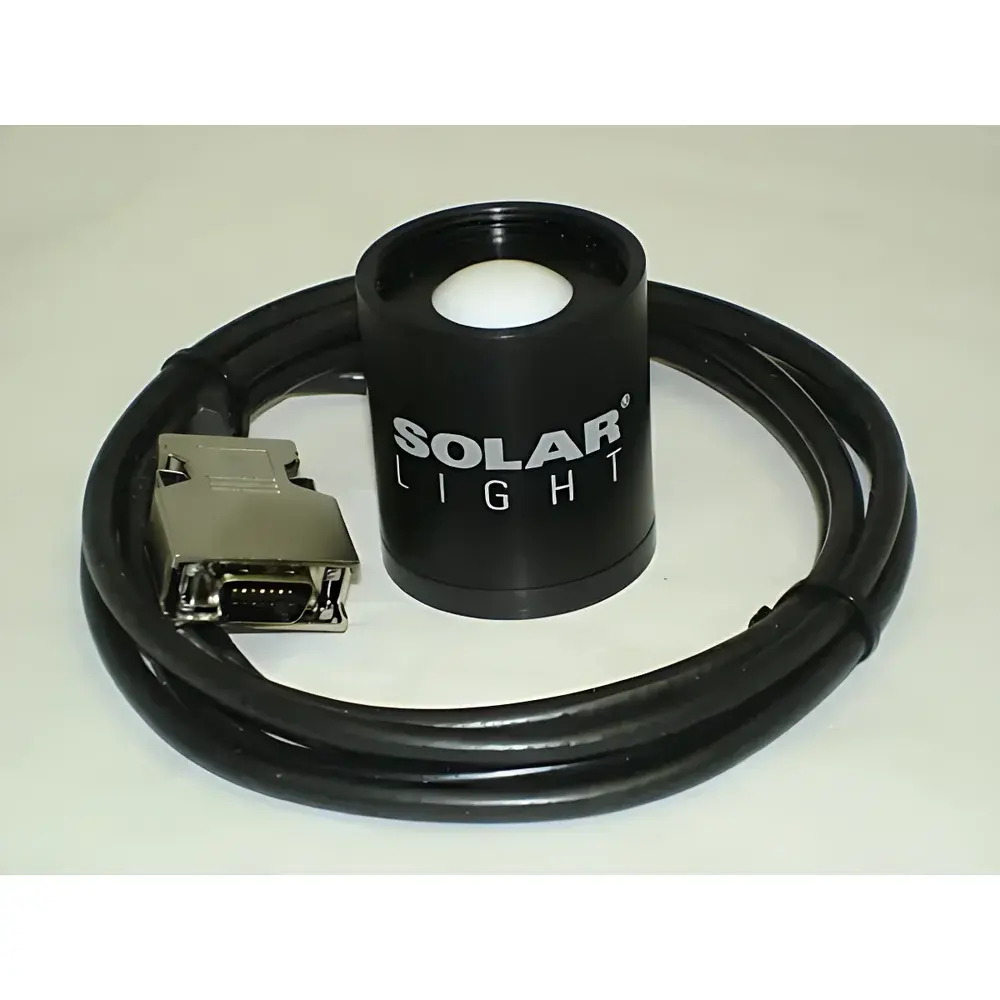
Solar Light PMA2131 Scotopic Illuminance Detector
| Brand | Solar Light |
|---|---|
| Origin | USA |
| Model | PMA2131 |
| Spectral Response | CIE scotopic luminosity function (V′(λ), 400–600 nm) |
| Angular Response | ≤5% deviation up to ±60° |
| Measurement Range | 200,000 scotopic mLux / 20,000 mft-cd / 120,000 µW/m² |
| Resolution | 1 mLux / 0.1 mft-cd / 1 µW/m² |
| Operating Temperature | 0–50 °C (32–120 °F), non-condensing |
| Detector Diameter | 40.6 mm |
| Height | 45.8 mm |
| Weight | 200 g |
| Calibration | NIST-traceable |
| Cable | Retractable, 0.3–1.5 m |
| Cosine Correction | Integrated |
Overview
The Solar Light PMA2131 Scotopic Illuminance Detector is a precision optical sensor engineered for quantitative measurement of low-level visible radiation in accordance with the CIE scotopic luminosity function V′(λ). Unlike photopic illuminance meters optimized for daylight-adapted vision (V(λ), peak at 555 nm), the PMA2131 replicates the spectral sensitivity of the human rod-dominated visual system under mesopic to scotopic conditions—specifically across the 400–600 nm band, with maximum responsivity at 507 nm. This spectral weighting enables physiologically relevant quantification of light environments where cone photoreceptors are inactive or minimally engaged, such as night-time navigation, astronomical observation sites, darkroom validation, and low-luminance display evaluation. The detector employs a silicon photodiode coupled with a custom interference filter stack and diffuser assembly to achieve high-fidelity conformity to the CIE V′(λ) curve (Publication No. 191:2010), verified via spectral irradiance calibration against NIST-traceable standards. Its compact, handheld form factor supports field-deployable measurements without compromising metrological integrity.
Key Features
- True CIE scotopic spectral response (V′(λ)) compliant across 400–600 nm, validated per CIE Technical Report 191:2010
- Integrated cosine-corrected diffuser ensuring angular response deviation ≤5% up to ±60° incidence angle
- Wide dynamic range: 0.0001–200,000 scotopic lux (scotopic mLux), supporting both ultra-low-light research and moderate ambient assessment
- NIST-traceable factory calibration with documented uncertainty budget and certificate of conformance
- Multi-unit display capability: scotopic lux (scotopic mLux), millifoot-candles (mft-cd), and spectral irradiance (µW/m² at 507 nm equivalent)
- Thermally stabilized analog front-end and low-noise signal conditioning for long-term stability (<0.5% drift/year)
- Compact ergonomic housing (Ø40.6 mm × 45.8 mm, 200 g) with retractable 0.3–1.5 m shielded data cable
Sample Compatibility & Compliance
The PMA2131 is designed for direct measurement of broadband or quasi-monochromatic visible sources operating within scotopic-relevant intensity regimes—including LED arrays, phosphor-based night-vision illuminators, OLED microdisplays, fluorescent signage, and bioluminescent samples. It does not require spectral deconvolution or post-processing correction when used with sources emitting primarily between 400 and 600 nm. The instrument conforms to ISO/CIE 19476:2014 (Photometry — Measurement of scotopic and mesopic luminance) and supports compliance workflows aligned with ASTM E308-22 (Standard Practice for Computing the Colors of Objects by Using the CIE System) for scotopic-weighted integrals. While not a medical device, its output metrics are routinely cited in GLP-compliant clinical protocols evaluating pupillary light reflex, circadian phase shifting, and low-luminance visual acuity—where traceable scotopic flux quantification is essential for inter-study reproducibility.
Software & Data Management
The PMA2131 interfaces via standard analog voltage output (0–2 V full scale, configurable per range) or optional digital RS-232/USB adapter (sold separately), enabling integration into automated test benches, environmental monitoring networks, or custom LabVIEW/Python acquisition systems. Raw output is linearly proportional to scotopic illuminance; no proprietary drivers are required. When paired with Solar Light’s PMASoft v4.x suite (Windows-compatible), users gain access to real-time logging, time-stamped CSV export, statistical summary (min/max/avg/std dev), and overlay plotting against reference V′(λ) curves. All measurement sessions support audit-trail generation compliant with FDA 21 CFR Part 11 requirements when deployed on validated computing platforms—ensuring data integrity for regulated applications in lighting R&D and human factors laboratories.
Applications
- Validation of night-vision device illumination systems and cockpit lighting ergonomics
- Characterization of scotopic efficacy in adaptive streetlighting and tunnel lighting controls
- Quantitative assessment of display black-level performance and OLED pixel leakage in dark-adapted viewing
- Photobiological safety evaluation of low-intensity blue-enriched sources targeting melanopsin activation
- Field measurement of skyglow and light pollution impact on nocturnal ecological habitats
- Supporting ISO 12837:2021 (Road vehicles — Lighting and light-signalling devices — Photometric and colorimetric requirements) for scotopic adaptation thresholds
- Clinical ophthalmology studies involving rod-saturation kinetics and dark adaptation timelines
FAQ
How does scotopic illuminance differ from photopic illuminance?
Scotopic illuminance uses the CIE V′(λ) function (peak at 507 nm), representing rod-mediated vision under low-light conditions (10 lux). The two scales are not numerically interchangeable.
Is the PMA2131 suitable for measuring LED sources with narrowband blue emission?
Yes—provided the LED’s dominant wavelength falls within 400–600 nm and its spectral bandwidth is ≤50 nm FWHM. For broader or UV/IR-emitting sources, additional filtering or spectral correction may be necessary.
Can this detector be used in outdoor environments?
It is rated for operation between 0–50 °C in non-condensing conditions. Rain, snow, or direct solar exposure during measurement is not recommended; use with a weather-shielded mounting bracket for extended field deployment.
What is the calibration interval recommendation?
Annual recalibration against NIST-traceable standards is advised for ISO/IEC 17025-compliant labs; biennial verification suffices for routine industrial QA where measurement uncertainty budgets permit.
Does the unit support data logging without a PC?
No internal memory is included. Continuous logging requires external hardware (e.g., data logger with analog input or USB interface module).