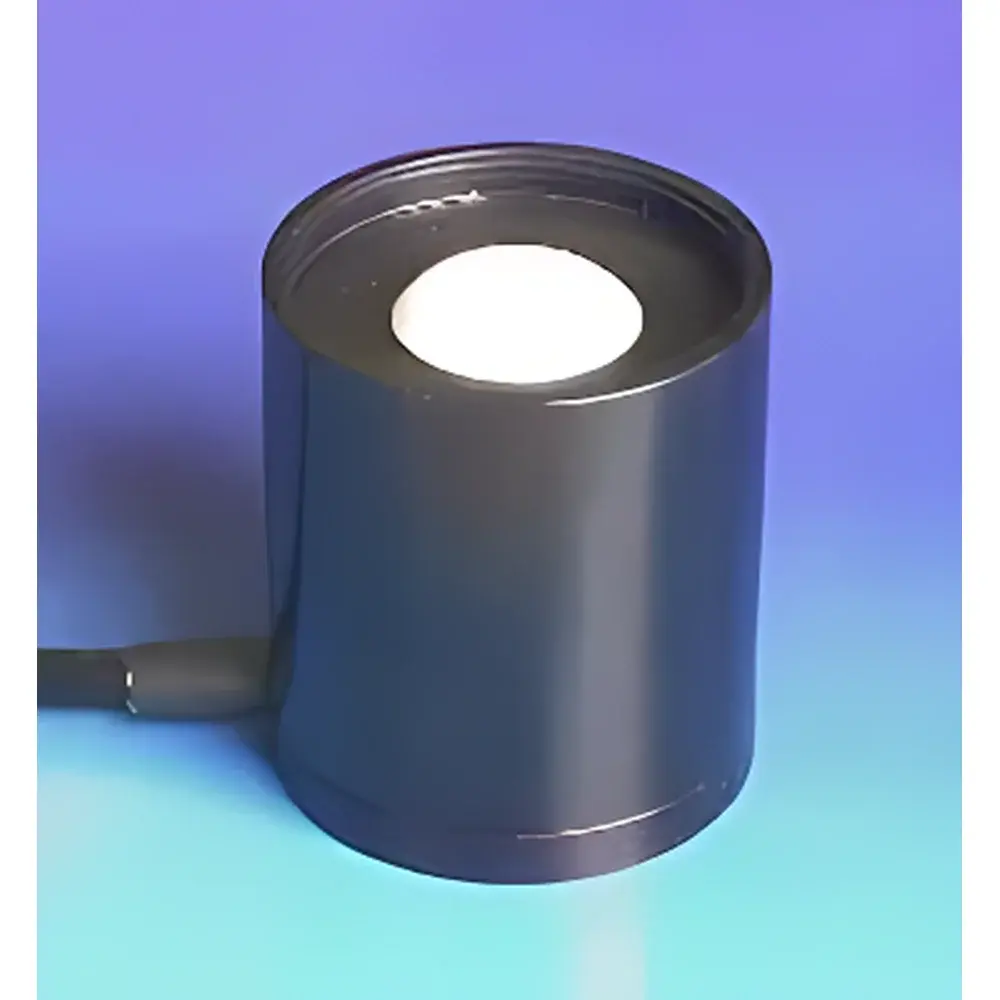
Solar Light PMA2135 Photopic Flash Radiometer
| Brand | Solar Light |
|---|---|
| Origin | USA |
| Model | PMA2135 |
| Spectral Response | CIE Photopic Luminous Efficiency Function (400–700 nm) |
| Angular Response | ≤5% deviation up to 60° from normal incidence |
| Detector Active Area | 0.474 in² (3.06 cm²) |
| Cosine Correction | PTFE-coated hemispherical diffuser |
| Calibration | NIST-traceable |
| Operating Temperature | −10 to +60 °C |
| Dimensions | Ø40.6 mm × 45.8 mm |
| Weight | 284 g |
| Cable Length | 0.9 m |
| Display Update Interval | Every 5 seconds on PMA2100 console |
| Units | Irradiance (mW/cm² or W/cm²), Dose (mJ/cm² or J/cm²) |
| Resolution | Full-scale range / 10⁴ for both irradiance and dose |
Overview
The Solar Light PMA2135 Photopic Flash Radiometer is a precision optical measurement instrument engineered for the accurate characterization of short-duration, high-intensity pulsed light sources—particularly xenon flash lamps used in UV curing, phototherapy validation, industrial photochemical processing, and lamp aging studies. Unlike continuous-source radiometers, the PMA2135 is specifically designed to resolve transient optical events with microsecond-to-millisecond duration, capturing both peak spectral irradiance and integrated radiant exposure (dose) per pulse. Its photopic spectral response conforms strictly to the CIE 1931 V(λ) luminous efficiency function (400–700 nm), ensuring metrological alignment with human photopic vision under daylight-adapted conditions. This makes it uniquely suitable for applications where biological or visual relevance—not just broadband radiometric power—is critical, such as in photobiological safety assessments (IEC 62471), UV-curing process control, and calibration of flash-based inspection systems.
Key Features
- Simultaneous acquisition of peak irradiance (in mW/cm² or W/cm²) and single-pulse radiant dose (in mJ/cm² or J/cm²)
- PTFE-coated hemispherical diffuser providing <5% angular deviation up to ±60°, enabling accurate measurements of both collimated and extended light sources
- NIST-traceable factory calibration with documented uncertainty budget, supporting ISO/IEC 17025-compliant laboratory workflows
- Stable silicon photodiode sensor with long-term drift <±0.5% per year, verified via quarterly internal reference checks
- Integrated signal conditioning optimized for pulse rise times ≥1 µs and pulse widths ≥10 µs
- Compact, ruggedized aluminum housing (Ø40.6 mm × 45.8 mm) rated for operation between −10 °C and +60 °C in non-condensing environments
- Direct interface with Solar Light PMA2100 universal meter console, enabling real-time display, data logging, and trigger-synchronized capture
Sample Compatibility & Compliance
The PMA2135 is compatible with all flash lamp types emitting within the 400–700 nm band—including xenon, mercury-xenon, and filtered pulsed LED sources—provided pulse energy falls within user-specified full-scale ranges. It is not intended for scotopic (low-light) or infrared measurements. The detector’s photopic weighting ensures compliance with ANSI/IES RP-27.3-22 for photobiological safety evaluation of pulsed lamps and aligns with relevant clauses of IEC 61000-4-5 (surge immunity) and IEC 61326-1 (EMC for laboratory equipment). While the unit itself does not carry CE or UKCA marking, its calibration documentation satisfies traceability requirements under FDA 21 CFR Part 11 when used in GMP-regulated UV-curing validation protocols. All delivered units include a calibration certificate referencing NIST SRM 2217a (photometric standard lamp) and SRM 2032 (spectral irradiance standard).
Software & Data Management
When paired with the PMA2100 console, the PMA2135 supports timestamped data export via RS-232 or USB-C to CSV or Excel-compatible formats. The PMA2100 firmware (v3.2+) includes audit trail functionality compliant with GLP and basic 21 CFR Part 11 requirements—capturing operator ID, calibration date, measurement mode, and instrument configuration at time of record. Raw pulse waveform capture is not supported; however, statistical parameters (peak, average, dose, pulse width at half-maximum) are computed onboard and stored with 16-bit resolution. No proprietary software installation is required for basic operation, though optional Solar Light DataLink™ (v4.1) enables automated report generation, trend analysis across batches, and integration with LIMS via ODBC.
Applications
- UV-A/UV-B flash lamp output verification in adhesive curing, ink drying, and conformal coating processes
- Photostability testing per ICH Q1B guidelines using pulsed exposure regimens
- Validation of surgical or dermatological flashlamp systems against ANSI Z136.3 laser safety thresholds
- Calibration transfer between primary standards labs and manufacturing QA labs
- Field verification of solar simulator flash uniformity and spectral match (when combined with spectral filters)
- Research into Purkinje shift dynamics via controlled photopic-to-scotopic transition experiments (requires auxiliary low-light instrumentation)
FAQ
Can the PMA2135 measure scotopic or mesopic light levels?
No. The detector is spectrally weighted exclusively to the CIE photopic V(λ) curve and lacks sensitivity below 0.001 Lux. For scotopic applications, a dedicated scotopic radiometer (e.g., PMA2140 with rod-weighted filter) is required.
Is the cosine correction validated per ISO 13406-2 or CIE S 023?
The PTFE hemispherical diffuser meets the angular acceptance criteria defined in CIE Publication 177:2007 for photometric detectors, with measured deviation ≤5% at 60° incidence—exceeding the ±10% tolerance specified for Class L photometers.
Does the PMA2135 support external triggering or synchronization?
No. It operates autonomously upon detection of a pulse exceeding its preset threshold. Synchronization with external equipment requires integration via the PMA2100’s TTL trigger output port.
What is the minimum measurable pulse width?
The system reliably resolves pulses ≥10 µs in duration, assuming peak irradiance exceeds 1% of full-scale range. Sub-microsecond pulses require oscilloscope-based photodiode characterization.
Can the full-scale range be reconfigured after purchase?
Yes—within hardware limits—by returning the unit to Solar Light for recalibration and firmware update. Range changes must be accompanied by new NIST-traceable certification.