
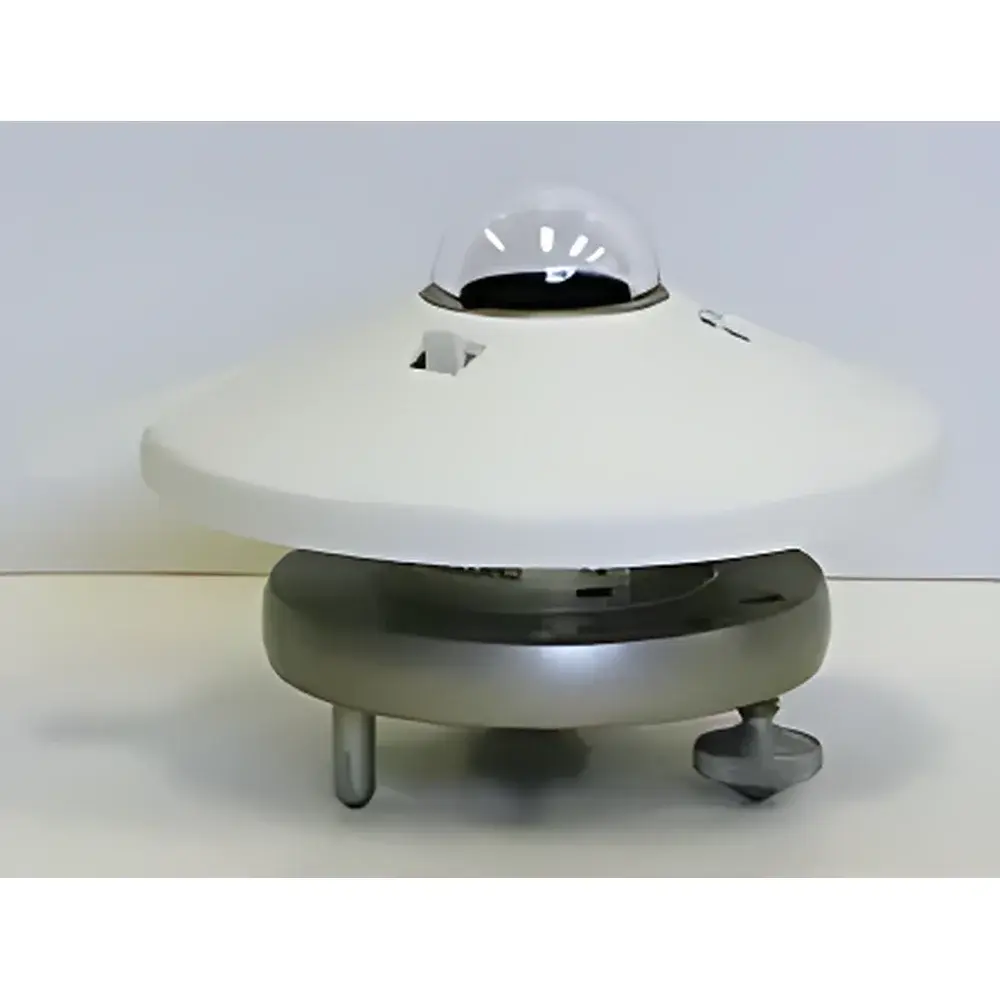
Solar Light PMA2144 Class II Pyranometer
| Brand | Solar Light |
|---|---|
| Origin | USA |
| Model | PMA2144 |
| Spectral Range | 310–2800 nm |
| Full-Scale Range | 2000 W/m² (200 mW/cm²) |
| Response Time | 18 s (95%) |
| Annual Drift | <1% |
| Nonlinearity | <2.5% (at 1000 W/m²) |
| Thermal Zero Offset | <15 W/m² (at 200 W/m²) |
| Cosine Response Error | ≤2% up to 70° zenith angle |
| Operating Temperature | −40 to +80 °C |
| Cable Length | 9 m |
| Sensor Diameter (with shade) | 60.3 mm |
| Weight | 0.31 kg |
Overview
The Solar Light PMA2144 Class II Pyranometer is a thermopile-based broadband solar irradiance sensor engineered for high-fidelity measurement of global horizontal irradiance (GHI) under natural and controlled lighting conditions. Designed in strict accordance with ISO 9060:2018 classification requirements for secondary standard pyranometers, the PMA2144 delivers metrologically traceable performance suitable for scientific-grade environmental monitoring, solar energy assessment, and laboratory radiometric validation. Its core sensing element consists of a precision blackened thermopile mounted beneath a hemispherical optical glass dome—engineered to transmit the full solar spectrum (310–2800 nm) while providing mechanical protection and environmental sealing. Incident solar radiation heats the thermopile junctions, generating a microvolt-level output proportional to irradiance. Each unit is individually calibrated against NIST-traceable reference standards, with calibration coefficients and proprietary signal processing algorithms permanently stored in an onboard memory chip. When interfaced with the Solar Light PMA2100 meter or compatible data acquisition systems, these parameters are automatically loaded, enabling immediate, error-corrected display of irradiance values in W/m² or mW/cm².
Key Features
- ISO 9060:2018 Class II classification—validated for routine meteorological and solar resource assessment
- Thermopile detector with blackened absorber surface ensures uniform spectral responsivity across 310–2800 nm
- Optical glass dome provides both spectral filtering and physical protection; minimizes thermal offset and long-term drift
- Integrated cosine correction optimized to ≤2% deviation up to 70° zenith angle
- NIST-traceable calibration certificate supplied with each unit; recalibration recommended every two years per IEC 61724-1
- Low thermal zero offset (<15 W/m² at 200 W/m² ambient irradiance) enhances accuracy under low-light conditions
- Rugged aluminum housing and IP67-rated construction enable continuous outdoor deployment across −40 to +80 °C
- Onboard EEPROM stores unit-specific calibration coefficients, temperature compensation parameters, and linearization algorithms
Sample Compatibility & Compliance
The PMA2144 is compatible with all Solar Light PMA-series meters (e.g., PMA2100) and third-party DAQ systems supporting low-level DC voltage input (typically 0–25 mV full scale). It meets the performance criteria defined in ISO 9060:2018 for secondary standard pyranometers and is routinely deployed in networks compliant with WMO Guide to Meteorological Instruments and Methods of Observation (CIMO Guide), ASTM E892, and IEC 61724-1 for photovoltaic system performance monitoring. While not certified to GLP or FDA 21 CFR Part 11, its traceable calibration chain, audit-ready documentation, and stable long-term output support data integrity requirements in regulated research environments—including agricultural phenotyping studies, daylighting simulation validation, and HVAC commissioning protocols governed by ASHRAE 90.1 and ISO 8995.
Software & Data Management
No proprietary software is required for basic operation—the PMA2144 functions as a passive analog transducer. However, when used with the Solar Light PMA2100 handheld meter, real-time irradiance values are displayed on a backlit LCD with selectable units (W/m² or mW/cm²) and automatic temperature compensation applied via embedded firmware. For automated logging, the sensor’s analog output can be integrated into SCADA platforms, Campbell Scientific CR-series loggers, or LabVIEW-based acquisition systems. All calibration certificates include serial-number-matched uncertainty budgets (k=2) and spectral responsivity curves. Raw voltage outputs may be converted to irradiance using the equation: E = (V × S) + CT, where S is the sensitivity (µV/(W/m²)), V is measured voltage, and CT is temperature-dependent zero-offset correction.
Applications
- Meteorological networks measuring global horizontal irradiance (GHI) for climate modeling and weather forecasting
- Agricultural research quantifying photosynthetically active radiation (PAR) proxies and evapotranspiration modeling
- Solar energy site assessments, PV system performance ratio (PR) analysis, and soiling loss evaluation
- Architectural daylighting studies and compliance verification with LEED v4.1 EQ Credit: Daylight
- Laboratory validation of artificial light sources (e.g., xenon arc, metal halide, LED arrays) per CIE S 023/E:2013
- Calibration transfer between reference cells and reference pyranometers in solar simulator qualification (IEC 60904-9)
- Thermal comfort studies integrating solar gain data into PMV/PPD models (ISO 7730)
FAQ
What is the difference between Class II and Class A pyranometers?
Class II devices per ISO 9060:2018 exhibit higher uncertainty tolerances than Class A (secondary standard) units—particularly in directional response, temperature dependence, and nonlinearity—but remain suitable for most operational solar monitoring applications where cost-effectiveness and field robustness are prioritized over ultra-high metrological rigor.
Can the PMA2144 measure diffuse irradiance?
Yes—when paired with a motorized shadow band or shading disk (e.g., Solar Light PMA2150), the instrument enables separation of diffuse horizontal irradiance (DHI) from global horizontal irradiance (GHI); direct normal irradiance (DNI) is then derived mathematically.
Is recalibration required, and how often?
Annual verification is recommended; formal recalibration against a reference standard is advised every 24 months to maintain traceability and account for aging-related thermopile drift and dome transmission degradation.
Does it require power?
No—the PMA2144 is a passive sensor with no internal electronics or power supply; it generates a self-powered thermoelectric signal proportional to incident irradiance.
Can it be used indoors under artificial lighting?
Yes, provided the source emits within its 310–2800 nm spectral range; however, spectral mismatch errors may arise with narrowband sources (e.g., monochromatic LEDs), necessitating correction factors derived from measured responsivity curves.




