
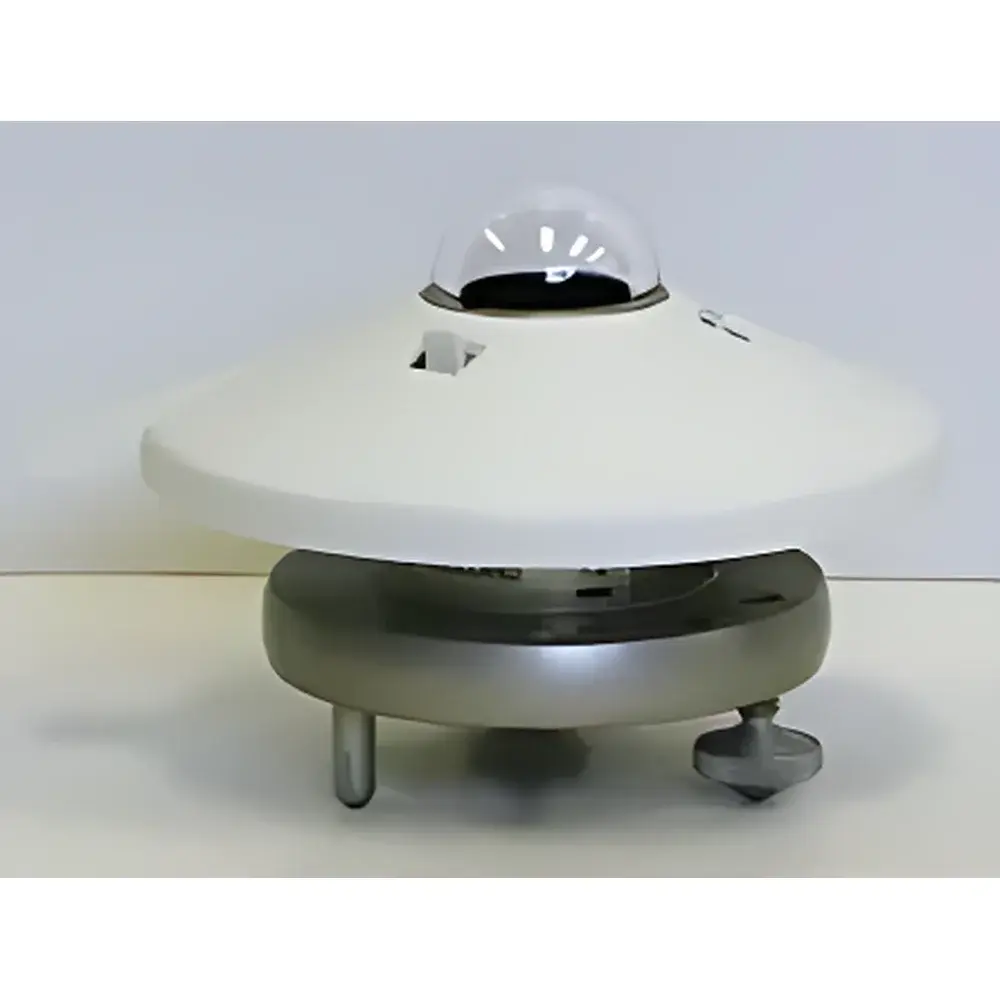
Solar Light PMA2144 Class II Pyranometer
| Brand | Solar Light |
|---|---|
| Origin | USA |
| Model | PMA2144 |
| Classification | ISO 9060:2018 Class II |
| Detection Principle | Thermopile-based |
| Spectral Range | 310–2800 nm (FWHM) |
| Measurement Range | 0–2000 W/m² (0–200 mW/cm²) |
| Response Time (95%) | 18 s |
| Annual Drift | <1% per year |
| Nonlinearity | <2.5% at 1000 W/m² |
| Thermal Offset | <15 W/m² at 200 W/m² thermal irradiance |
| Cosine Response Error | ≤2% up to 70° zenith angle |
| Operating Temperature | −40 to +80 °C |
| Cable Length | 9 m |
| Shaded Diameter | 60.3 mm |
| Unshaded Diameter | 78.11 mm |
| Height | 84.0 mm |
| Weight | 0.31 kg |
| Calibration | NIST-traceable |
Overview
The Solar Light PMA2144 Class II Pyranometer is a thermopile-based broadband solar irradiance sensor engineered for reliable, long-term outdoor measurement of global horizontal irradiance (GHI). Designed and manufactured in the United States, it complies fully with ISO 9060:2018 classification requirements for Class II instruments—balancing high metrological performance with practical field deployment. Its sensing element utilizes a blackened thermopile mounted beneath a precision-ground, hemispherical quartz dome, enabling uniform spectral responsivity across the biologically and photovoltaically relevant range of 310–2800 nm (FWHM). Unlike silicon photodiode sensors, the thermopile architecture ensures minimal dependence on spectral distribution, eliminating errors induced by atmospheric conditions, cloud cover variability, or source spectral mismatch—critical for solar simulator validation, climate monitoring, and building energy modeling.
Key Features
- ISO 9060:2018 Class II certified performance for global horizontal irradiance measurement
- Thermopile detector with NIST-traceable calibration certificate included
- Flat spectral response (310–2800 nm) optimized for solar-weighted applications including PV testing and daylighting analysis
- Integrated cosine-corrected optical design achieving ≤2% deviation up to 70° zenith angle
- Proven long-term stability: <1% annual sensitivity drift under continuous outdoor exposure
- Rugged aluminum housing rated for continuous operation from −40 to +80 °C, IP67-rated for dust and water resistance
- Low thermal offset (<15 W/m² at 200 W/m² thermal load), minimizing diurnal measurement bias
- Standard 9-meter shielded cable with low-noise twisted-pair construction for signal integrity over extended runs
Sample Compatibility & Compliance
The PMA2144 is compatible with industry-standard data loggers supporting millivolt-level analog inputs (typically ±50 mV full scale), including Campbell Scientific CR series, Onset HOBO, Delta-T Devices DL2e, and custom DAQ systems compliant with IEEE 1149 or IEC 61000-4 EMC standards. Its physical dimensions and mounting interface (M6 threaded base) conform to WMO Guide to Meteorological Instruments and Methods of Observation (CIMO Guide, Chapter 7) and ASTM E892 for pyranometer installation. The instrument meets the environmental robustness criteria specified in IEC 61724-1 (Photovoltaic system performance monitoring) and supports compliance workflows under ISO/IEC 17025 accredited laboratories when used with documented calibration intervals (recommended annually). It is not intended for direct use in safety-critical control loops without redundant verification per IEC 61508 SIL-2 requirements.
Software & Data Management
While the PMA2144 operates as a passive analog sensor, its output integrates seamlessly into validated data acquisition ecosystems. When paired with Solar Light’s optional PMA2100 Series controllers or third-party platforms such as LabVIEW, Python-based PyMeasure, or MATLAB Data Acquisition Toolbox, users can implement automated zero-offset compensation, temperature correction algorithms (per ISO 9060 Annex C), and real-time GHI normalization to reference conditions. Raw thermopile voltage signals are linearly proportional to irradiance; conversion factors (µV per W/m²) are provided on the individual calibration certificate. For regulated environments—including GLP-compliant solar testing labs—the instrument supports audit-ready metadata logging (timestamp, ambient temperature, tilt angle, shading status) when deployed with compliant DAQ firmware that enforces 21 CFR Part 11 electronic signature and audit trail capabilities.
Applications
- Meteorological networks requiring cost-effective, maintenance-light Class II irradiance monitoring
- Agricultural research on evapotranspiration, crop canopy radiation balance, and phenology modeling
- Calibration and verification of solar simulators per IEC 60904-9 and ASTM E927 standards
- Building performance simulation (BPS) input validation for HVAC load calculations and daylight harvesting control
- Outdoor lighting system efficacy assessment under natural sky conditions
- University and national lab experiments in radiative transfer, atmospheric optics, and renewable energy education
- Long-term degradation studies of PV modules and concentrator optics under real-world insolation profiles
FAQ
Is the PMA2144 suitable for use under cloudy or diffuse-dominant skies?
Yes. Its thermopile design and cosine correction ensure accurate integration of both direct and diffuse components of global horizontal irradiance, independent of sky condition or spectral composition.
Does it require periodic recalibration?
Yes. While annual drift is specified at <1%, ISO/IEC 17025-accredited applications require traceable recalibration at least once per year; Solar Light offers factory-return services with updated NIST-traceable certificates.
Can it be mounted vertically for plane-of-array (POA) irradiance measurements?
Yes, provided mechanical leveling is verified and cosine error is evaluated for the specific incidence angle distribution; however, Class II designation applies only to horizontal mounting per ISO 9060 definitions.
What is the recommended cleaning procedure for the quartz dome?
Use deionized water and lint-free optical tissue; avoid solvents or abrasive cleaners. Dome contamination increases cosine error and reduces transmission—inspect visually before critical measurements.
Is temperature compensation necessary for high-accuracy work?
The unit includes internal temperature sensing for post-processing correction. For applications demanding <2% uncertainty, apply the published temperature coefficient (<5% over −10 to +40 °C) using logged ambient sensor data.





