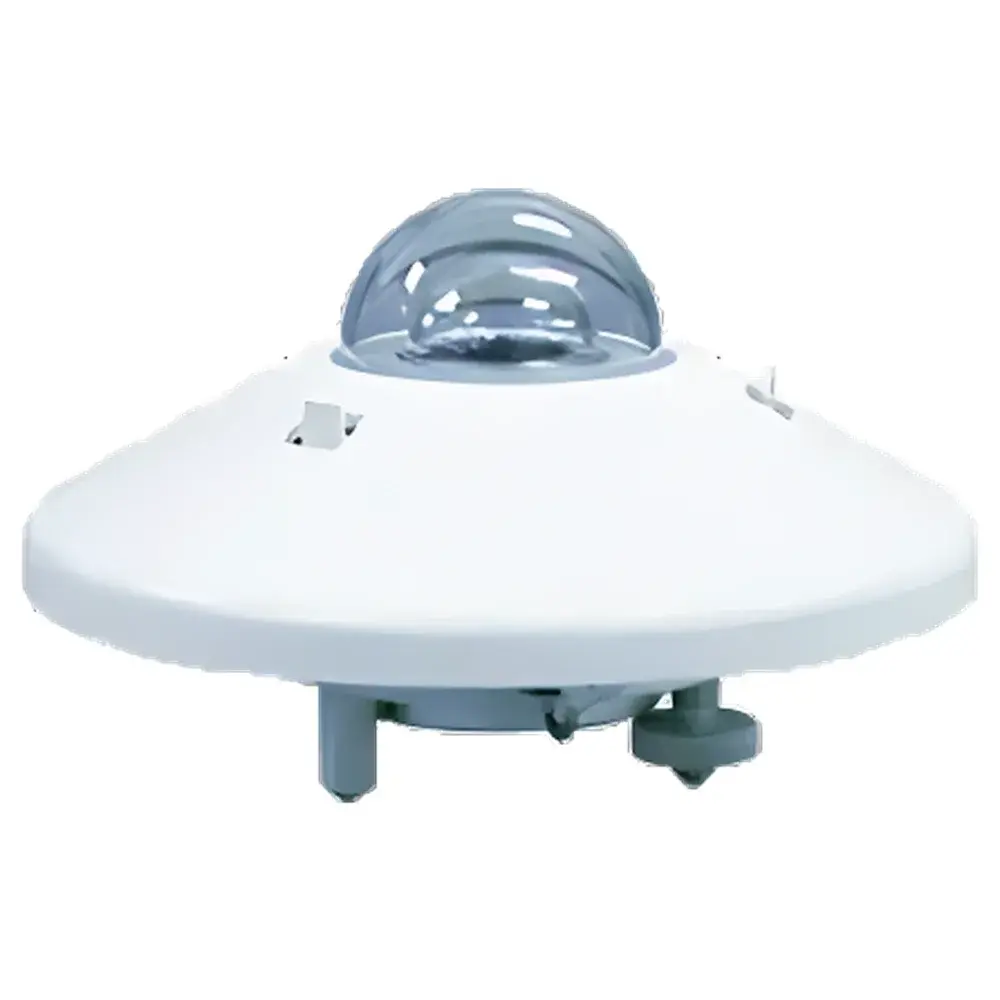
Solar Light PMA2145 Class I Pyranometer
| Brand | Solar Light |
|---|---|
| Origin | USA |
| Model | PMA2145 |
| Spectral Range | 310–2800 nm (FWHM) |
| Full-Scale Range | 2000 W/m² / 200 mW/cm² |
| Response Time (95%) | 18 s |
| Annual Drift | <1% |
| Nonlinearity | <1.0% (at 1000 W/m²) |
| Temperature Dependence | <2% (−10 to +40 °C) |
| Cosine Error | ≤1% up to 70° zenith angle |
| Zero Offset | <15 W/m² under 200 W/m² thermal irradiance |
| Resolution | 1 W/m² / 0.1 mW/cm² |
| Operating Ambient | −40 to +80 °C |
| Cable Length | 9 m |
| Shaded Diameter | 60.3 mm |
| Unshaded Diameter | 78.11 mm |
| Height | 84.0 mm |
| Weight | 0.31 kg |
| Calibration | NIST-traceable, ISO 9060:2018 Class I compliant |
Overview
The Solar Light PMA2145 Class I Pyranometer is a precision thermopile-based radiometric sensor engineered for high-accuracy broadband solar irradiance measurement in accordance with ISO 9060:2018 classification requirements for Class I instruments. It operates on the principle of thermal detection: incident solar radiation is absorbed by a blackened thermopile surface, generating a proportional thermoelectric voltage via the Seebeck effect. Its 64-junction thermopile array—coated with a highly stable, inorganic carbon absorber deposited via non-organic vacuum deposition—ensures exceptional spectral flatness and minimal degradation over time. The dual concentric Schott K5 hemispherical domes provide uniform optical transmission across the full 310–2800 nm spectral band (FWHM), while simultaneously shielding the sensing element from convective heat loss and environmental contamination. Designed for permanent outdoor deployment, the PMA2145 delivers metrologically robust performance under extreme ambient conditions ranging from −40 °C to +80 °C.
Key Features
- ISO 9060:2018 Class I compliance — validated for highest-tier solar monitoring applications requiring traceable uncertainty budgets
- Thermopile detector with 64 thermocouple junctions and NIST-traceable calibration certificate included
- Inorganic carbon absorber coating ensuring long-term spectral stability and resistance to UV-induced aging
- Dual Schott K5 hemispherical domes optimized for minimal angular and thermal offset errors
- Integrated bubble level for precise horizontal alignment during installation
- Low zero-offset design (<15 W/m² under 200 W/m² thermal load) minimizing nighttime drift
- Robust aluminum housing rated for continuous outdoor exposure and corrosion resistance
- 9-meter shielded cable with low-noise twisted-pair construction for signal integrity over extended runs
Sample Compatibility & Compliance
The PMA2145 is compatible with standard data loggers, SCADA systems, and analog-to-digital converters accepting low-level mV outputs (typically ~10 µV per W/m²). It requires no external power and produces a passive DC voltage output linearly proportional to irradiance. Its mechanical design conforms to WMO (World Meteorological Organization) siting guidelines for pyranometers, including recommended mounting height, shading geometry, and tilt tolerance. The instrument meets all functional and metrological criteria defined in ISO 9060:2018 for Class I classification—including spectral error, directional (cosine) response, temperature dependence, and stability specifications. Calibration is performed against reference standards maintained at NIST-accredited laboratories, with full uncertainty budgets reported per ISO/IEC 17025 requirements. Documentation supports GLP-compliant environmental monitoring programs and satisfies audit requirements for renewable energy performance validation (IEC 61724-1), climate research networks (BSRN), and building energy modeling (ASHRAE 140).
Software & Data Management
While the PMA2145 itself is an analog sensor, its output integrates seamlessly with industry-standard acquisition platforms including Campbell Scientific CR-series loggers, HOBO UX120 systems, and National Instruments DAQ hardware. When paired with calibrated data loggers supporting millivolt input scaling, users can configure real-time irradiance conversion using the factory-provided sensitivity factor (µV/(W/m²)). For long-term network deployments, the sensor supports automated quality control workflows: raw voltage logs enable post-processing correction for temperature-dependent offset and cosine error compensation using published coefficients. All calibration reports include serial-number-matched sensitivity values, date of calibration, measurement uncertainty (k=2), and traceability statements compliant with ISO/IEC 17025. Digital records are structured to support FDA 21 CFR Part 11–compliant electronic signatures when deployed in regulated GxP environments such as photobiological safety testing or medical device sunlight exposure validation.
Applications
- Meteorological monitoring networks requiring Class I-grade solar resource assessment
- Agricultural evapotranspiration modeling and precision irrigation scheduling
- Solar photovoltaic (PV) system performance ratio (PR) analysis and yield forecasting
- Building envelope thermal modeling and daylight harvesting system commissioning
- Photobiology and dermatological UV/solar spectrum studies
- Calibration transfer between reference cells and secondary pyranometers
- Physics and optics laboratory experiments involving broadband radiant flux quantification
- Validation of radiative transfer models (e.g., SMARTS, libRadtran) under field conditions
FAQ
What does “Class I” mean per ISO 9060:2018?
Class I denotes the highest accuracy tier defined in ISO 9060:2018, specifying maximum permissible errors for spectral response, directional (cosine) error, temperature dependence, and long-term stability—intended for reference-grade measurements in research and regulatory applications.
Is the PMA2145 suitable for use with a shading ring for diffuse irradiance measurement?
Yes—the 60.3 mm shaded diameter is designed to accommodate standard shading rings; however, proper alignment and periodic maintenance of the ring’s azimuthal positioning are required to maintain Class I angular accuracy.
How often should the PMA2145 be recalibrated?
Solar Light recommends recalibration every two years for critical applications; annual verification against a reference instrument is advised for operational continuity in BSRN or PV plant monitoring contexts.
Can the PMA2145 be mounted vertically for albedo measurement?
Yes—when inverted and co-located with a second unit facing upward, it enables bidirectional shortwave irradiance measurement; ensure both units share identical thermal mass and dome cleanliness to minimize inter-sensor bias.
Does the instrument require desiccant or dome heating in humid climates?
No—its sealed dual-dome construction and hydrophobic internal surface treatment prevent condensation under normal operating conditions; dome heating is unnecessary unless operating below −20 °C with high humidity.