
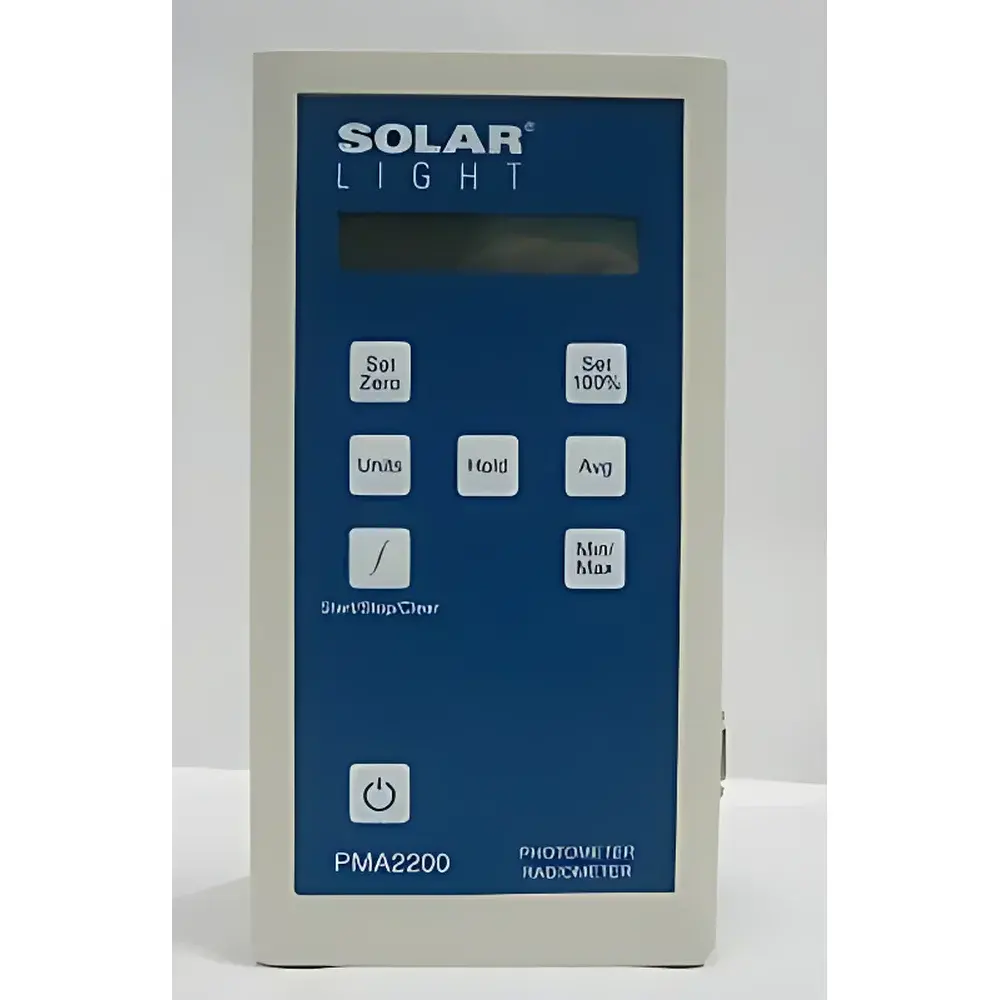
Solar Light PMA2200 Radiometer
| Brand | Solar Light |
|---|---|
| Origin | USA |
| Model | PMA2200 |
| Detector Input | 1 channel (supports up to 4 analog signals from PMA21XX-series detectors) |
| Input Range | ±4 V |
| Resolution | 3 µV |
| Dynamic Range | 2.6 × 10⁶ (6.5-digit equivalent) |
| Accuracy | ±0.2% of full scale |
| Integral Non-Linearity | ±0.003% |
| Temperature Coefficient | ≤50 ppm/°C |
| Sampling Rate | 3 samples/sec |
| Display Refresh Rate | 10 Hz |
| Operating Temperature | 0–50 °C |
| Power | 4 × AA alkaline batteries (>40 h continuous operation) or external 9–12 V AC/DC adapter |
| Power Consumption | ~110 mW |
| Weight | 510 g (18 oz) |
| Dimensions | 10 × 19.5 × 4.5 cm (W × H × D) |
| LCD Size | 6.4 × 1.3 cm (2.5" × 0.5") |
Overview
The Solar Light PMA2200 Radiometer is a precision, microprocessor-controlled optical measurement instrument engineered for quantitative spectral irradiance and radiant flux characterization across the ultraviolet (UV), visible (VIS), and near-infrared (NIR) spectral domains (typically 250–1100 nm, dependent on connected detector). Unlike conventional illuminance meters limited to photopic response, the PMA2200 operates as a calibrated radiometric platform—measuring absolute irradiance (W/m²), irradiance dose (J/m²), or time-integrated exposure—based on traceable NIST-calibrated detector responsivity curves. Its architecture implements a high-stability analog front-end with low-noise signal conditioning, 24-bit analog-to-digital conversion, and real-time digital signal processing to ensure metrological integrity under variable ambient conditions. Designed for laboratory, field, and regulated environments, the PMA2200 meets foundational requirements for radiometric traceability in applications governed by ISO/CIE standards for UV measurement, ASTM E1789 for sunscreen testing, and IEC 62471 for photobiological safety assessment.
Key Features
- Modular detector compatibility: Fully interoperable with the entire Solar Light PMA21XX series of spectrally optimized detectors—including UV-A/UV-B broadband, erythemal, UVA-340, UVC, PAR (photosynthetically active radiation), and visible/NIR sensors—enabling rapid reconfiguration without recalibration.
- Smart detector interface: Proprietary plug-and-play detector recognition ensures automatic loading of calibration coefficients, wavelength response correction factors, and unit scaling—eliminating manual coefficient entry and reducing operator error.
- Full-function keypad control: All operational modes—including zeroing, range selection, integration time adjustment, data hold, statistics (min/max/avg), and unit toggling (W/m², mW/cm², J/m², etc.)—are accessible via intuitive front-panel navigation; no PC required for routine measurements.
- High-fidelity analog acquisition: 3 µV resolution and <0.003% integral non-linearity support precise low-level signal detection, critical for low-flux UV monitoring or long-duration exposure studies.
- Robust environmental tolerance: Rated for continuous operation from 0 to 50 °C with temperature drift compensation ≤50 ppm/°C, ensuring stability during outdoor solar irradiance mapping or chamber-based accelerated aging tests.
- Extended battery autonomy: 4 × AA alkaline cells provide >40 hours of uninterrupted use—ideal for unattended field deployments or mobile lab applications where AC power is unavailable.
Sample Compatibility & Compliance
The PMA2200 does not directly interface with physical samples but serves as the primary radiometric reference for quantifying incident optical energy delivered to specimens in controlled exposure systems. It is routinely deployed in compliance-critical workflows aligned with ASTM G154 (UV fluorescent lamp exposure), ASTM D4329 (plastic degradation), ISO 4892-3 (weathering of plastics), and ISO 24444 (SPF determination in vitro). When used with NIST-traceable PMA2101 (UV-B) or PMA2104 (UVA-340) detectors, the system supports GLP-compliant documentation per FDA 21 CFR Part 11 when paired with Solar Light’s optional data logging software. Instrument calibration certificates include uncertainty budgets compliant with ISO/IEC 17025 requirements, and detector calibrations are performed at accredited laboratories against primary standard lamps traceable to NIST.
Software & Data Management
While the PMA2200 functions autonomously, it supports optional USB or RS-232 connectivity for real-time data streaming and remote configuration via Solar Light’s proprietary PMA Software Suite (Windows-compatible). This software enables time-synchronized multi-channel logging (when used with compatible detector arrays), automated exposure dose calculation, statistical trend analysis, and export to CSV or Excel formats. Audit trails—including user login, parameter changes, and calibration events—are recorded to satisfy 21 CFR Part 11 electronic record requirements. Raw analog output (±4 V) is also available for integration into custom SCADA or PLC-based environmental test chambers, supporting closed-loop UV intensity control in industrial curing or photostability testing platforms.
Applications
- Photostability testing of pharmaceuticals and cosmetics per ICH Q1B and USP <1058> Analytical Instrument Qualification guidelines.
- In vitro SPF evaluation of sunscreens and UV-filtering textiles using calibrated UV-A/UV-B ratio measurement.
- Accelerated weathering validation of coatings, polymers, and automotive materials per SAE J2020 and ISO 11341.
- Plant photobiology and circadian rhythm studies requiring precise PAR (400–700 nm) and UV-B (280–315 nm) irradiance quantification.
- Clinical phototesting of photosensitive dermatoses, including action spectrum mapping and minimal erythema dose (MED) determination.
- Validation and routine performance verification of UV-C germicidal lamps (254 nm) and far-UVC (222 nm) disinfection systems per IUVA and CDC guidance.
- Atmospheric science campaigns measuring solar spectral irradiance for ozone column estimation and radiative forcing modeling.
FAQ
Is the PMA2200 compatible with third-party detectors?
No—the PMA2200 is designed exclusively for Solar Light’s PMA21XX-series detectors, which embed proprietary calibration metadata and electrical interface protocols.
Can the instrument store measurement data internally?
No—data logging requires connection to a host PC running Solar Light’s PMA Software; the device has no onboard memory.
What is the recommended recalibration interval?
Annual recalibration is advised for GLP/GMP environments; biennial calibration may be acceptable for R&D use with documented stability checks.
Does the PMA2200 support analog output for process control integration?
Yes—simultaneous ±4 V analog output mirrors the displayed reading and is electrically isolated for noise immunity in industrial settings.
How is detector interchangeability validated?
Each PMA21XX detector contains an EEPROM chip storing its unique calibration matrix, spectral responsivity curve, and linearity correction coefficients—automatically loaded upon insertion.



